

MR. PUTIN, END THIS WAR! BIDEN’S BLUNDER WAS NO REAGAN REPLAY. President Joe Biden set off international alarms over the weekend when he committed the United States to the goal of regime change in Russia. “For God’s sake, this man cannot remain in power,” Biden said of Russian leader Vladimir Putin during a speech in Poland Saturday. The last time the U.S. set itself to removing a foreign leader, in Iraq in 2003, the plan turned into a long-running disaster. Now, with war raging in Ukraine, it would seem a terrible idea for the president to announce that the goal of U.S. forces is to remove Putin from his position atop the Russian government.
The White House was quick to explain that it was all a mistake — Biden’s mistake. Worried aides put out word that Biden’s statement was not in his prepared remarks. They made clear that no, no, no, U.S. policy was not regime change in Russia. “He was not discussing Putin’s power in Russia or regime change,” a freaked-out White House official told Fox News. “The president’s point was that Putin cannot be allowed to exercise power over his neighbors or the region.” So when Biden said Putin “cannot remain in power,” he meant that Putin cannot remain in power over his neighbors.
Secretary of State Antony Blinken performed the cleanup Sunday during a news conference in Jerusalem. Unbidden, he said, “As you know, and as you’ve heard us say repeatedly, we do not have a strategy of regime change in Russia or anywhere else.” Blinken said any regime change in Russia would be up to the Russian people.
Subscribe today to the Washington Examiner magazine that will keep you up to date with what’s going on in Washington. SUBSCRIBE NOW: Just $1.00 an issue!
Finally, when Biden, back home, attended church on Sunday, a reporter asked, “Mr. President, do you want Putin removed? Were you calling for regime change?” Biden’s one-word answer: “No.”
Nevertheless, some of the administration’s most fervent supporters argued that the president was right to say what he did. And as for regime change — bring it on! The pro-Biden Washington Post columnist Jennifer Rubin wrote that “Biden reminds us how fortunate we are to have an experienced diplomat and energetic proponent of our democratic alliances rather than Putin’s poodle,” by which she meant former President Donald Trump. Democratic fundraiser Bill Kristol, who as a Republican was one of the loudest and most influential proponents of regime change in Iraq in 2003, compared Biden’s retracted “cannot remain in power” statement to President Ronald Reagan’s famous declaration at the Berlin Wall in 1987: “Mr. Gorbachev, tear down this wall!”
It was a laughable comparison. For one thing, Reagan’s line was not a slip-up. For much of the following, I am relying on an account of the drafting and delivery of the speech from former Reagan speechwriter Peter Robinson, who wrote it. In the weeks leading up to the speech, some in the Reagan administration opposed the proposed “tear down this wall” declaration. The president favored it, and thus it stayed in the speech. Robinson’s article, on the National Archives website, includes an image of the page of Reagan’s speech that contained the declaration. So “Mr. Gorbachev, tear down this wall” was not a mistake. It was a planned remark.
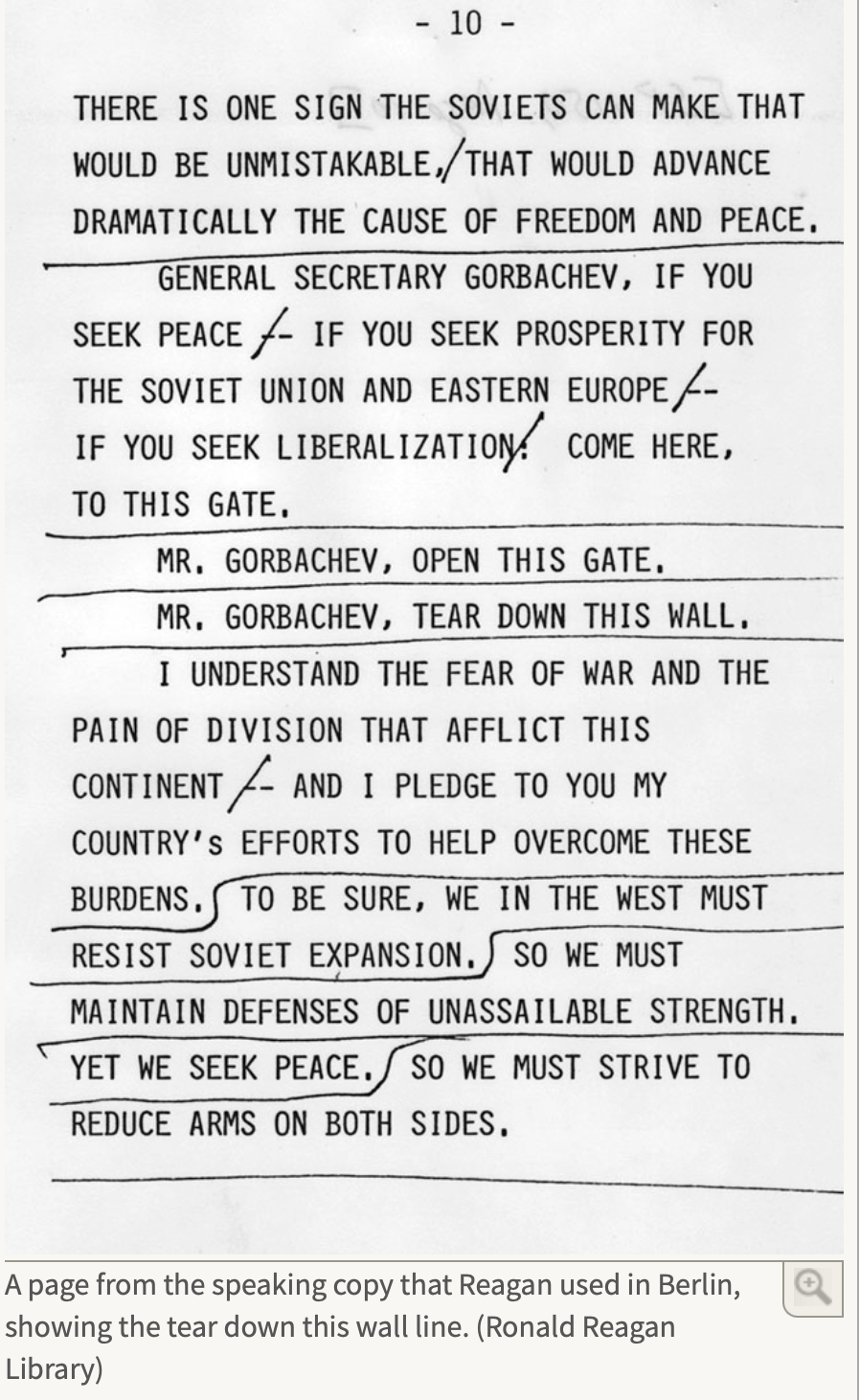
Second, the Reagan White House and administration did not rush to disavow the president’s words. The “tear down this wall” passage became the most famous of the speech, and one of the most famous of Reagan’s presidency, because it dramatically expressed Reagan’s feelings and policy toward communism. In the days that followed, the president did not run away from his own words.
Third, Reagan called for Mikhail Gorbachev, the Soviet leader, to allow freedom in his country and the nations under Soviet control. Reagan did not call for the removal of Gorbachev. Perhaps if Biden had said, in today’s circumstances, “Mr. Putin, end this war,” there would have been some analogy. But that is not what Biden said.
After Biden’s gaffe, there emerged a debate over whether it was really a gaffe — whether Biden said exactly what he intended to say and then allowed his staff to back away from it to avoid the charge that the U.S. is trying to remove Putin, even though in fact the U.S. is trying to remove Putin.
Just a week earlier, the historian Niall Ferguson argued that the Biden administration had decided to make Russian regime change its goal in the Ukraine war — in other words, to use the war to try to bring Putin down rather than to seek a quick and peaceful resolution to stop the killing. After Biden delivered his speech, Ferguson tweeted: “As I said last week, the Biden administration has apparently decided to instrumentalize the war in Ukraine to bring about regime change in Russia, rather than trying to end the war in Ukraine as soon as possible. Biden just said it out loud. This is a highly risky strategy.” Instead, Ferguson wrote, “The U.S. should be doing everything in its (considerable) power to broker a ceasefire and compromise peace.”
Now, after Biden’s “cannot remain in power” gaffe, or non-gaffe, the U.S. strategy is not clear. If it was a gaffe, it was a sign of a disturbing trend. As Glenn Greenwald noted, “This episode marked at least the third time in the past couple weeks that White House officials had to walk back Biden’s comments, following his clear decree that U.S. troops would soon be back in Ukraine and his prior warning that the U.S. would use chemical weapons against Russia if they used them first.” If it was not a gaffe, it was perhaps even more disturbing.
So if it was a gaffe, it was bad. If it was not a gaffe, it was worse. What it definitely was not was the reincarnation of Reagan’s “tear down this wall” declaration. Of that, everyone can be sure.
For a deeper dive into many of the topics covered in the Daily Memo, please listen to my podcast, The Byron York Show — available on the Ricochet Audio Network and everywhere else podcasts can be found. You can use this link to subscribe.
