

In Focus delivers deeper coverage of the political, cultural, and ideological issues shaping America. Published daily by senior writers and experts, these in-depth pieces go beyond the headlines to give readers the full picture. You can find our full list of In Focus pieces here.
JERUSALEM — When Hamas terrorists crossed into Israel on the morning of Oct. 7, 2023, they struck multiple population centers across the Gaza periphery, known in Hebrew as the Otef aza, the “Gaza envelope.” The brutality spread across quiet agricultural communities. Each suffered differently, but all were permanently changed. People were slaughtered in their homes on a holiday morning, while others were kidnapped. Children, grandmothers, teenagers, reservists, and peace activists were dragged into Gaza on motorcycles or shoved screaming into stolen vehicles. Entire families disappeared in minutes. In these kibbutzim, where neighbors shared meals and raised children together, dozens were murdered and homes burned to ash.
Just 5 miles from the Gaza border, the Nova Music Festival was transforming a sleepy field near Re’im into a sunrise rave celebrating freedom, music, and youth. That morning, terrorists surrounded the festival from multiple directions, massacring 364 young people and kidnapping dozens more. Hamas fighters blocked every road, and cars blocked all of the roads going north, south, east, and west as they were abandoned when Hamas opened fire. The neighboring communities and army bases could not provide refuge — they were the scenes of their own massacres. As a result, there was no point of escape, and the field became the deadliest site of the attack.
Two years have now passed. In October 2025, two years to the day on the Hebrew calendar, the last surviving hostages were returned. Many of them, still hollow-eyed from captivity, were driven past that same Nova field, past crowds of Israelis cheerfully welcoming them home along the highway that was a killing field the day of their kidnapping. They looked out the windows of their vans at what was once a simple rest stop and a raw crime scene. Now, it is something else entirely.
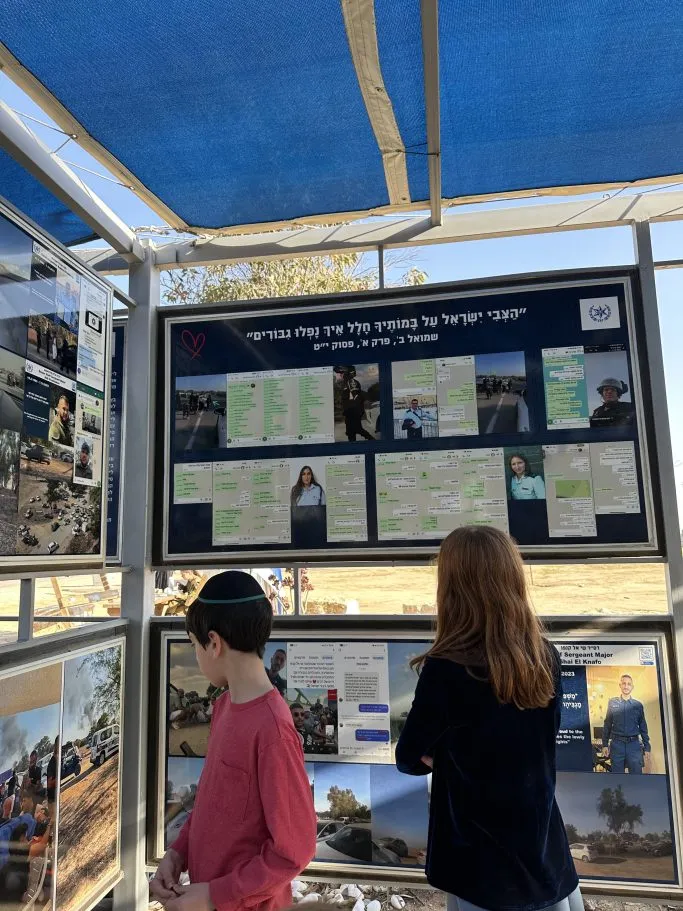
A hundred days after the war began, the Nova site felt improvised: grass trampled, metal poles stuck into the ground, hundreds of posters flapping in the wind with the faces of the murdered or missing. I visited then, and there was no structure to grief, only rawness. Families and friends wandered silently, touching photographs and silently crying.
When I returned in December 2025, the transformation was stark. Now, dozens of large touring buses arrive each day, along with countless private vehicles. Many of the original posters are still there, but they now sit alongside polished, permanent displays that tell the story of the attack. There are markers at the main stage and the DJ booth, a yellow dumpster where victims hid, and signage honoring the first responders who saved lives under fire. It is no longer just an open wound — it is a memorial, as well as an educational and a purposeful space. The returning hostages drove past their own faces printed beside those who never came home.
The kibbutzim also look different from the way they did in the shock-filled first months. One hundred days after the massacre, many homes were still blackened from fire. Bullet holes chewed through doors and windows. The air carried the smell of burned wood and plastic, along with something else indescribable. We felt constant explosions in Gaza under our feet and heard the booms echo through the air.
Now, in late 2025, construction is everywhere: cranes, scaffolding, new wiring, new concrete. But rebuilding is not limited to repair — it is expansion. These communities are not waiting to see if residents will return. They are actively recruiting new families and preparing for growth. Plans for new neighborhoods, redesigned communal infrastructure, expanded agriculture, and large-scale solar fields are underway. The vision is not simply to restore what was lost — it’s to strengthen and build beyond it.
At Kibbutz Alumim, one of the communities that withstood the Oct. 7 assault with both loss and extraordinary battlefield heroism, the dining hall now hosts residents, volunteers, soldiers, and visitors. During our visit, we noticed a young man quietly eating lunch, the twin brother of two recently released hostages. He presumably worked nearby, rebuilding his life in proximity to the place where his family was shattered.
Alumim is also where the body of Staff Sgt. Ran Gvili, the last hostage taken, was abducted. His name has become one of the last unresolved threads of the attack. Gvili was home with a broken shoulder when the first reports from the Gaza envelope flooded in, and even though he had not even had surgery yet, he raced out. During the battle near Alumim, he rescued about 100 people who fled the Nova music festival and killed 14 members of Hamas before he was abducted. His courage and endurance have become part of the collective memory of Oct. 7, and his return, though not the return Israelis prayed for, will mark the symbolic end of the hostage crisis.
Nearby, Kibbutz Be’eri, one of the hardest-hit communities, where over 10% of residents were murdered, now shows unmistakable signs of rebuilding. Foundations are being poured, homes are being framed, and infrastructure is being repaired. Yet reminders of that day remain impossible to miss. An email from the Director of Development accompanying the community’s most recent annual report reflects this duality:
“Our new educational complex is taking shape. Construction is underway for a kindergarten and youth center, and additional structures are advancing steadily. A stark reminder of October 7 surfaced when two rifles used by Hamas were discovered beneath the rubble.”
Be’eri is rebuilding beside memory, not over it.
Just minutes away, Kfar Aza remains fixed in my memory from my January 2024 visit. The destruction there was intimate — not just structural, but personal. A red alert siren forced us into a safe room in the bedroom of a young man who was murdered there. His personal belongings, torn photographs, books, and clothing, all of it, remained where it fell, scattered across the room in chaos. The entire kibbutz felt suspended between life and death: bicycles abandoned, children’s toys, books, and Ikea Tupperware littered the ground, houses blackened but untouched. It felt impossible then to imagine laughter returning, or a community rebuilding from such a void.
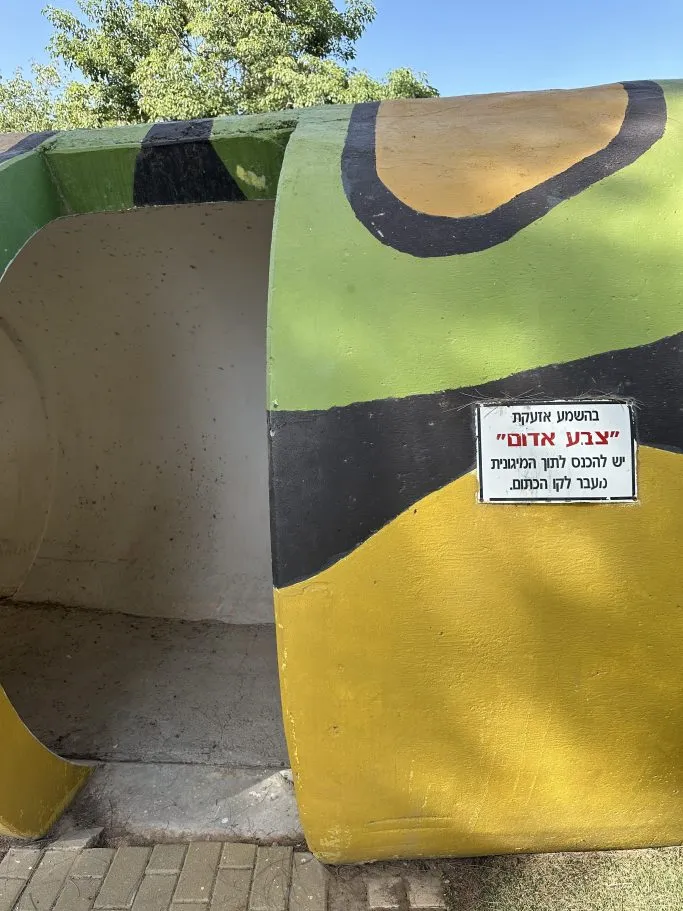
Further along the border sits Sderot, a larger town that lived under constant rocket fire for years before Oct. 7. Bomb shelters appeared everywhere: on street corners, at bus stops, and in playgrounds. One academic study found that years of bombardment increased miscarriage rates by 59% among local women.
I visited Sderot twice, once as a journalist in January 2024 and again in December 2025 as a mother traveling with my children. On that first visit, the playground bunkers struck me as surreal. On my second visit, my children played on the structures that double as a bunker, as we saw the posted Hebrew instructions explaining how to take shelter during a red alert. This time, there was no siren, and there has not been for a long time. Hamas, now significantly dismantled, has lost its ability to terrorize this region the way it once did.
Later that same day, near Re’im, we heard and felt a deep underground explosion, an Israeli military detonation of yet another Hamas tunnel. We all froze and paused, worried it was a red alert siren, an incoming rocket attack. But we realized the boom came without a siren — what we were feeling was not in Israel, but in Gaza. For me, after my visit 100 days into the war, the vibration, even miles away, reverberated like a memory.
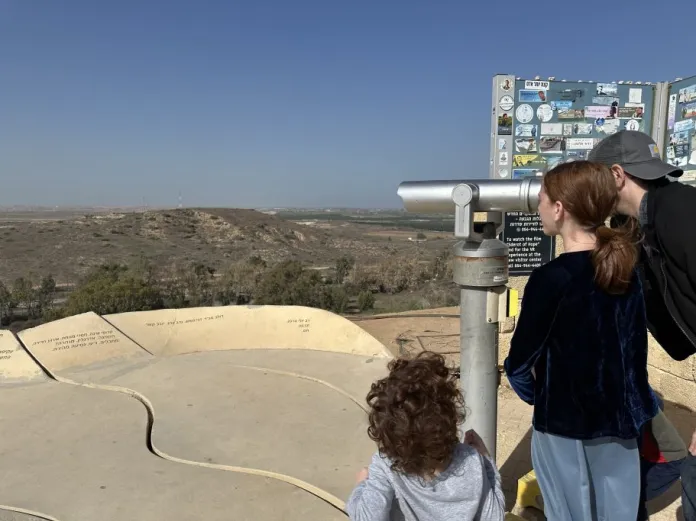
From a lookout point in Sderot, we peered into Gaza through a mounted viewfinder. Everything on the horizon appeared flattened, block after block reduced to rubble. We could not even tell there were ever blocks of buildings and structures — what you can see from up close and far away is just ruins. A soldier who served multiple tours in Gaza told us the destruction there is “unimaginable.” Rebuilding on the Israeli side is rapid, strategic, and intentional. In Gaza, rebuilding has barely begun — my daughter observed a single crane through the viewfinder — but its efforts are constrained not only by resources but also by Hamas’s hold and its priorities.
Across the entire Gaza envelope, there is now a sense of movement — not returning to what was, but building toward what will be. New homes, gardens, communal spaces, schools, agricultural fields, and solar infrastructure are emerging. Volunteers, funders, and families are arriving, not just to mourn, but to rebuild and live.
Yet beneath this revival sits a disturbing reality: This region is now the site of the deadliest day for Jews since the Holocaust. Every playground rebuilt will miss children who will never return.
The yellow ribbons tied across Israel, but especially throughout this region, symbols of prayer for the hostages, are beginning to tatter and disappear. For the first time in two years, families are not waiting for news. They are still grieving, but they are also planting and rebuilding.
Israel rebuilds not because loss is forgotten, but because life remains sacred.
TRUMP LOOKS TO LITERALLY BUILD HIS LEGACY. DOES IT SOUND LIKE AN AFFORDABILITY CLARION CALL?
Whether Gaza will rebuild remains uncertain. Its future depends not on materials but on leadership, whether it continues to choose terrorism or finally chooses the lives of its people.
For now, the roads into the Gaza envelope are full again: volunteers, families moving home, visitors trying to witness, understand, and remember. Re’im, Be’eri, Kfar Aza, Nir Oz, Alumim, once symbols of horror, are becoming symbols of resilience. Two years after Oct. 7, the story is no longer only about what was destroyed. It is about what is being built.
