

In Focus delivers deeper coverage of the political, cultural, and ideological issues shaping America. Published daily by senior writers and experts, these in-depth pieces go beyond the headlines to give readers the full picture. You can find our full list of In Focus pieces here.
The art world is currently having one of its periodic meltdowns over politics and culture, here and internationally. And it is soiling its collective diapers as the Venice Biennale, one of the world’s oldest and most prestigious art festivals, opens this Saturday.
Recommended Stories


The Leftist cognoscenti running the art world blame President Donald Trump, of course. Another supposed culprit is Israel’s Prime Minister, Benjamin Netanyahu. Viktor Orban has been voted out as Hungarian prime minister, so the beautiful people no longer have to ritually denounce him to alert others that they are beautiful.
Having grown up in New York City, where museums are power centers, Trump probably understands the arts better than most modern presidents, certainly better than his two Democratic predecessors. A fixture of their galas and benefits, he certainly understands the power of culture and wants to retake that world from the Left.
Which may be why, as the New York Times recently put it in an article about the ruckus at the Biennale, the art world “generally views association with the Trump administration as toxic.”
And which is also why curators, collectors, art writers, etc., are snootily raising eyebrows and shaking their heads in unified exasperation at the fact that this year’s U.S. exhibition at the Biennale intends to celebrate American identity and not attack its history, the flag, imperialism, or any other such nonsense.
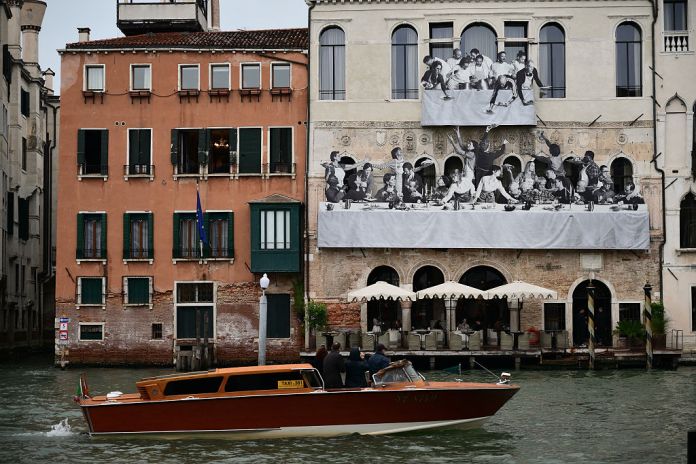
They find it particularly irritating that the administration bypassed their inbred world by deciding which artists to send to the contemporary art festival to showcase national exhibitions, which is so acclaimed that it is known as the “art world Olympics.”
The State Department chose the sculptor Alma Allen, which brought a torrent of condescension. The selection, as CNN snobbishly observed on April 23, prompted “a string of ‘Who is Alma Allen?’ headlines when he was announced.”
Zachary Small, the New York Times’s “investigative reporter on the dynamics of power and privilege in the art world,” according to his author’s bio, chipped in on April 20 with a long article dripping with contempt.
Small, who a “has a master’s degree from The Courtauld Institute of Art in London and a bachelor’s in art history and political science from Columbia University,” and goes by the pronoun “they,” did not like at all how Allen was chosen.
For nearly a century, Small complained, America’s participation in the Biennale had followed the same familiar script: “A team of prominent museum leaders or curators would propose exhibitions with the nation’s top artists. Then, an independent panel of experts working for the State Department would choose the best of the bunch, sending the likes of Robert Rauschenberg and Helen Frankenthaler — or, more recently, Mark Bradford and Simone Leigh — to Italy as a representation of American cultural excellence. Like many traditions under the second Trump administration, this one has been turned on its head. The art world veterans are out.”
But what seemed worse to Small was that taking the place of the old insular world of anti-American artsy types was a nonprofit run by a woman whose most recent job was — gasp — “owning a luxury pet food store in Tampa.”
Yes, Tampa! As in Florida, home to Gov. Ron DeSantis, Mar-a-Lago, and “Florida man.” To Small of Manhattan, this must have been rubbing salt in the wound.
That woman is Jenni Parido, whom the State Department has appointed as commissioner of the U.S. Pavilion at the Biennale and whose nonprofit, the American Arts Conservancy, helped select Alma Allen with the aid of independent curator Jeffrey Uslip.
Small was left struggling with the fact that Parido had gone from “selling venison nuggets and dried sardines” to organizing the United States pavilion. “America will be known as having squandered a major opportunity to show serious work,” Small quoted Robert Storr, a former dean of the Yale School of Art, as lamenting. “People will ask: Is this the best we can come up with?”
Outflanking the leftist flunkies who have anointed themselves the nation’s cultural gatekeepers is vintage Trump, however. It is a major part of the reason he is reclaiming the cultural terrain they have conquered, and why he is constantly giving them the vapors.
And if we judge it by its actions, the Conservancy has done well so far. It has taken on the challenging task of running the Biennale when the art world tried to blacklist anyone involved, knowing that attacks from people like Small would be personal.
The State Department awarded the Pavilion to the Conservancy after it dropped from consideration a project by the artist Robert Lazzarini that was going to use mathematically warped iconic figures like George Washington, the Stars and Stripes, and the American Eagle to question the role that American identity plays in the world.
Lazzarini’s proposal noted that the Pavilion played an important role in shaping perceptions of America. We’re going through, it added, “a critical moment in our nation’s history, when American ideals of democratic governance, social justice, and freedom of expression are under increasing pressure.”
Huh? That sounded more like a dog whistle for “Orange Man Bad.” It is hard to see how Lazzarini’s work would pass muster under the State Department’s new guidelines, which call for proposals that “reflect and promote American values,” in Venice, and ban projects that “operate any programs promoting diversity, equity, and inclusion.”
Many in the insular art world sneered at the idea of using the Biennale to actually promote America and not wokeness.
“It’s hard to imagine who would accept,” Matthew Higgs, director of the New York nonprofit art space White Columns sniffed to Artnet’s The Art Angle podcast. “It seems unlikely to me that a contemporary art institution would even apply.”
Except, except, that the U.S. government has routinely used the Pavilion to score propaganda points.
Small may wax nostalgic about the time when “an independent panel of experts” chose the likes of Rauschenberg as an example of “the best of the bunch.” Maybe “they” was never taught at the Courtauld Institute or at Columbia that the State Department, the CIA, and the Kennedy administration engineered Rauschenberg’s selection and the Grand Prize he eventually won in 1964. The whole thing was intended to demonstrate American superiority over the Soviet Union.
In fact, the U.S. government and the CIA used the Biennale and other art festivals to promote the U.S. over communism throughout the 1950s and 1960s. New York’s Museum of Modern Art took over the U.S. Pavilion at the Venice Biennale in 1954 and owned it till 1962, allowing the U.S. government to showcase our artistic freedom.
As James Panero rightly observed in the New Criterion in 2011, “The United States Pavilion at the Venice Biennale has always been a tool of American propaganda.”
In 2011, of course, Obama was using the Pavilion to “show American power gone deliberately awry.” In 2022, the Biden administration’s choice, Simone Leigh, covered the neoclassical-styled U.S. Pavilion, which was built in 1930 and is a permanent structure, in a thatched façade evoking traditional African forms to protest the supposed “erasure” of women, black, and colonial expositions.
So the Conservancy’s choice of Allen would not be the eyebrow-raising event that our insulated and uninformed arts folks believe it is. Allen does not even appear to be a political person. State Department officials, he says, “have been great so far and have given me total freedom in what I want to make.”
In its announcement of the selection, the Conservancy noted that Allen’s exhibition, “Call Me the Breeze,” will coincide “with America 250, the nation’s Semiquincentennial.” “Call Me the Breeze” will offer a “resonant reflection on American identity, landscape, and material heritage.”
All of this happening stateside is relatively mild compared with what is happening on the ground in Venice, where the entire international jury of the festival resigned on April 30 to protest the inclusion of Israel and Russia. The International Jury has limited responsibilities, but it awards the Biennale’s official prizes to the exhibitions.
In a warning statement issued on April 22, the jury had expressed its “commitment to the defense of human rights … Consequently, this jury will refrain from the consideration of those countries whose leaders are currently charged with crimes against humanity by the International Criminal Court,” by which they meant Netanyahu and Russian President Vladimir Putin.
Then, when the foundation that runs the Biennale, la Fondazione La Biennale di Venezia, refused to budge, the five members of the jury resigned en masse just a week before the festival’s opening. The two main “Golden Lion” prizes given to best artist and best national pavilion will now be chosen by the vote of ticketholders.
That Netanyahu, a man defending his country from attacks by Palestinian terrorists masterminded by Iran, another terrorist regime, has been lumped alongside Putin, a bloodthirsty dictator who launched an unprovoked attack on a neighbor whose existence he refuses to accept, is a testament to the fecklessness of the ICC.
THE MYSTERIOUS PRINCIPLES OF BARACK OBAMA
Replacing the five jurors with a popular vote is a stroke of genius, however, and on a par with Trump’s actions. It is easy to laugh at the art world for its sneering insularity, but whoever controls the culture controls how men and women eventually think.
It’s about time to take it back.
