

In Focus delivers deeper coverage of the political, cultural, and ideological issues shaping America. Published daily by senior writers and experts, these in-depth pieces go beyond the headlines to give readers the full picture. You can find our full list of In Focus pieces here.
Barney Frank, who died Tuesday at 86 after months in hospice care, spent his final weeks doing something most retired politicians never get the chance to do: telling his own party, loudly and on the record, that it had lost its way.
Stay informed.Stay ahead.
Join Washington Examiner for unlimited access to the news, analysis, and commentary that matter most.
Already a member? Log in
From his home in Ogunquit, Maine, Frank gave interviews to the New York Times, the Boston Globe, CNN, and the Jewish Telegraphic Agency. He used the attention his impending death drew to deliver a single, blunt message to Democrats. Stop alienating the voters you need and turning every cultural fight into a loyalty test. And stop mistaking the party’s fringe for its core.
“Frankly, if I weren’t dying, people wouldn’t be paying as much attention,” he told the New York Times.
They should pay attention anyway. Frank was not some recovering centrist looking for absolution. He was, as he once described himself, a “left-handed gay Jew” from Bayonne, New Jersey, who spent more than three decades in Congress as one of its most reliably liberal members. He wrote the Dodd-Frank Wall Street Reform and Consumer Protection Act after the 2008 financial crisis. He was the first sitting member of Congress to come out as gay voluntarily in 1987 and the first to enter a same-sex marriage. He filed his first piece of state legislation in 1972, as a freshman Massachusetts state representative, to ban housing and employment discrimination based on sexual orientation. No one earned the label “progressive” more honestly.
And yet Frank also belonged to a vanishing species of Democrat: the kind who could win, and keep winning, in places that no longer vote for his party.
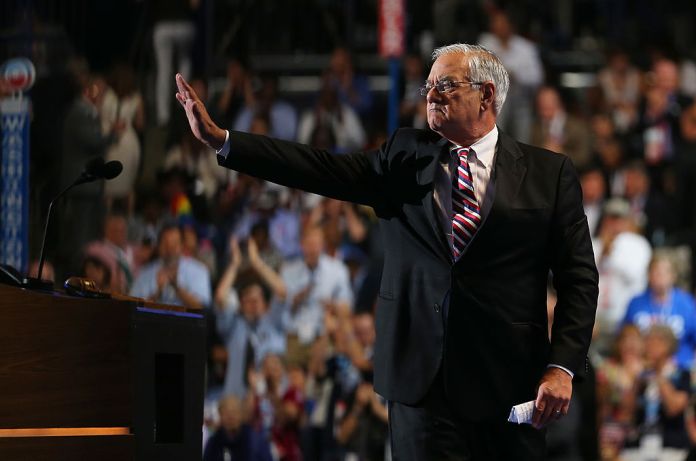
After the 1980 census, Massachusetts redistricting threw Frank into a substantially redrawn 4th Congressional District that absorbed a large swath of blue-collar communities in the southeastern part of the state. In 1982, he ran against a sitting Republican, Margaret Heckler, who had held the seat for 16 years. The Boston suburbs were one thing. New Bedford, Fall River, Taunton, and the old mill towns were another. Frank campaigned in them, debated in them, and won them. He kept winning them for the next 30 years.
Those are the voters Democrats now write off as lost causes, the “deplorables” who drifted to Donald Trump and the GOP because they sold grievance politics. The truth is closer to what Frank tried to say. The Democratic Party did not lose those voters as much as it stopped trying to talk to them. It traded them, knowingly, for a coalition of credentialed academics, campus activists, nonprofit staffers, and the most online wing of the cultural Left, and then expressed surprise when working-class areas in typically blue states started turning red.
Frank saw it coming. In one of his final interviews, with GBH News, he described how the party’s success in putting economic inequality back on the agenda was hijacked by what he called “the most militant left,” which took that victory as proof it was right about everything else, too. “They adopted an agenda that calls for a degree of drastic social change that goes beyond what’s acceptable to most people,” he said. He pointed specifically to transgender athletes in women’s sports as the kind of issue the Left has chosen to die on while losing voters by the millions.
He warned his party against precisely the litmus tests that now define its primaries. Look at Maine, where Frank spent his final years. Gov. Janet Mills (D-ME), a two-term Democrat with statewide name recognition, entered the Senate race against Sen. Susan Collins (R-ME) as the choice of Senate Minority Leader Chuck Schumer (D-NY) and the Democratic establishment. She was outraised and outorganized by Graham Platner, an oyster farmer and political newcomer endorsed by Sen. Bernie Sanders (I-VT) and Sen. Elizabeth Warren (D-MA). Platner survived revelations of crude Reddit posts about women, controversial comments about his military service, and a Nazi tattoo, which he said he made sure to cover up. Mills dropped out in April, citing financial troubles. Platner is now the presumptive nominee and leads Collins by 7 percentage points in the most recent poll.
Frank, who lived in Platner’s state, endorsed Mills. He also endorsed Rep. Haley Stevens (D-MI), the American Israel Public Affairs Committee-backed candidate, in Michigan’s Senate primary over the progressive Abdul El Sayed. In other words, the most prominent progressive of his generation spent his final political capital backing the moderates against the insurgents his own party’s activist class was lining up behind.
This is the Democratic Party that produced Zohran Mamdani as the mayor of New York. It is the party in which Rep. Alexandria Ocasio-Cortez (D-NY) carries more cultural weight than the chairman of the House Financial Services Committee did during Frank’s tenure. It is a party that has confused volume on social media with strength at the ballot box.
Frank knew the difference because he had built coalitions the old way. He worked with Republican Treasury Secretary Hank Paulson and Federal Reserve Chairman Ben Bernanke to pass the Troubled Asset Relief Program in 2008. Paulson later called him “a pragmatic, disciplined, completely honorable politician.” Iowa Republican Jim Leach, whom Frank succeeded as Financial Services Committee chairman, called him “probably Congress’s smartest member in sheer IQ.”
Frank once intended to vote against a major tax bill because it lowered top rates, then voted for it after extracting an expansion of affordable housing tax credits. That was the deal. Get something for your side. Live to fight another day.
Even his late-life turn on Israel was characteristic of him as a persona and politician. Frank told the Jewish Telegraphic Agency that the United States should suspend arms sales unless Israeli Prime Minister Benjamin Netanyahu changed course on the West Bank and Gaza. But his quarrel was with Netanyahu, not with the Jewish state, and certainly not with the broader project of supporting Israel. He was offering a policy critique, not joining the campus chants and silly bromides about “apartheid” and “genocide” masked as policy disagreements. The distinction matters because much of the activist Left has stopped bothering to draw it, and Frank, who had spoken at Harvard Students for Israel rallies as a sitting congressman, never confused criticism of an Israeli prime minister with what the Left now too often slides into.
MEET GRAHAM PLATNER: MARINE, OYSTER FARMER, COMMUNIST
Frank’s forthcoming book, due out in September, is titled The Hard Path to Unity: Why We Must Reform the Left to Rescue Democracy. The man who wrote it spent half a century building the case for an expansive American liberalism. He died believing his party was actively undermining that case by turning every coalition partner into a heretic and lecturing working-class voters instead of persuading them.
When a liberal of that pedigree spends his final weeks warning the party he loved, the answer is not to wave him off as a relic. The answer is to ask why so few Democrats sound like him anymore.
