How the DSA turned support for Israel into grounds for expulsion

Published July 23, 2026 4:00pm ET


In Focus delivers deeper coverage of the political, cultural, and ideological issues shaping America. Published daily by senior writers and experts, these in-depth pieces go beyond the headlines to give readers the full picture. You can find our full list of In Focus pieces here.

On Oct. 7, 2023, Hamas carried out the largest massacre of Jews since the Holocaust. More than 1,200 people were murdered, 250 taken hostage, civilians deliberately targeted at a music festival, in kibbutzim, and inside their homes. Hours later, the Democratic Socialists of America issued a statement describing the attack as “a direct result of Israel‘s apartheid regime.” The statement never condemned Hamas. It explained the murders.

That response was not an aberration. It reflected an ideological transformation years in the making, one that helps explain not only the DSA’s foreign policy but the organization it has become as it accumulates influence inside the Democratic Party.

Michael Harrington would have recognized very little of it.

Harrington, the Catholic-born founder of the DSA, described himself as a “Labor Zionist.” He rejected the Soviet-backed 1975 U.N. resolution equating Zionism with racism, arguing it drained “the concept of racism of any serious meaning.” His democratic socialism rested on an explicitly anti-totalitarian foundation: He believed liberal democracy and socialism were inseparable, and he opposed authoritarian movements whether they called themselves Left or Right. Thirty-six years after his death, the organization he founded adopted a resolution making support for Israel’s right to defend itself an expellable offense.

antisemitism democratic socialists socialism Israel Palestine
Anti-Israel protesters, including members of the communist Workers World Party and Democratic Socialists of America, march on Oct. 9, 2023, in New York City. (Lev Radin/Pacific Press/LightRocket via Getty Images)

The break came before Oct. 7. In 2021, then-Rep. Jamaal Bowman (D-NY) voted to fund Israel’s Iron Dome missile defense system. Dozens of DSA chapters demanded his expulsion. The National Political Committee rejected the demand and disciplined its own BDS Working Group for pressing it. Roughly 10,000 members left in the following months, more than 5,500 in October alone. The moderating faction lost the argument and then left the building.

At the DSA’s 2025 national convention in Chicago, delegates approved Resolution 22, “For a Fighting Anti-Zionist DSA,” by a vote of 675 to 524. The resolution made opposition to Zionism an organizational principle, declared affiliation with AIPAC, J Street, or Democratic Majority for Israel incompatible with membership, and embraced the Palestinian Thawabit, including explicit support for armed resistance. For the DSA, Israel had ceased to be a foreign policy question. It had become a loyalty test.

That shift is worth examining against what Israel actually is. Its Supreme Court rules against its own government. Its press is adversarial and free. Arab citizens serve in the Knesset, vote in competitive elections, and challenge state decisions in court. It is America’s most capable regional ally and the foundation of a security architecture that has served U.S. strategic interests for seven decades. 

Israelis themselves argue fiercely over settlements, judicial reform, and the conduct of military operations. None of that makes Israel immune from criticism. It does make the question harder to avoid: Why has support for Israel’s right to exist, let alone its right to defend itself, become the one position for which America’s largest socialist organization will remove members?

Anti-Israel protesters, including members of the communist Workers World Party and Democratic Socialists of America, march on October 9, 2023 in New York City. (Lev Radin/Pacific Press/LightRocket via Getty Images)
Anti-Israel protesters, including members of the communist Workers World Party and Democratic Socialists of America, march on Oct. 9, 2023, in New York City. (Lev Radin/Pacific Press/LightRocket via Getty Images)

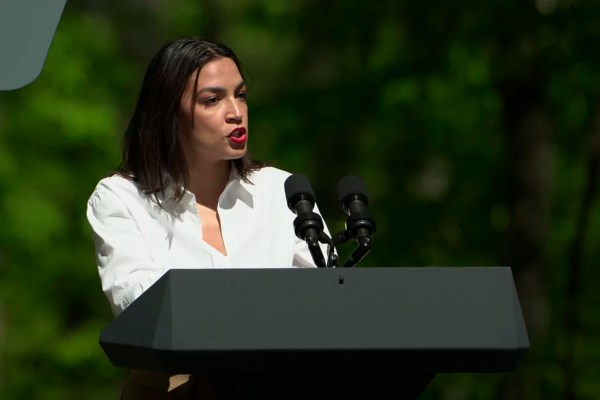
The enforcement mechanism fell first on Rep. Alexandria Ocasio-Cortez (D-NY), who had done more than any other elected official to make the DSA a national political force. National leaders conditioned her 2024 endorsement on publicly supporting BDS and opposing all American military aid to Israel. She declined, the endorsement was withdrawn, and the 2025 convention debated censuring her for tacit support for Zionism. The politician most responsible for the DSA’s electoral relevance had become a disciplinary case.

The distance between that dispute and the present moment is itself a measure of how quickly the political landscape has shifted. On July 15, 2026, Ocasio-Cortez voted “yes” on the Massie amendment, a measure that would have blocked $3.3 billion in U.S. military assistance to Israel, which critics including House Minority Leader Hakeem Jeffries (D-NY) called overly broad for also restricting humanitarian aid and counter-Hamas operations. She was joined by 102 other House Democrats and Minority Whip Katherine Clark (D-MA). Jeffries voted “no.” The fault line the DSA has spent years drawing inside Democratic primaries had arrived on the House floor, splitting the party’s top two leaders in real time.

By 2026, Gaza had become the organization’s central electoral argument. Darializa Avila Chevalier defeated Rep. Adriano Espaillat (D-NY) in New York’s 13th Congressional District on his AIPAC support. Brad Lander beat Rep. Dan Goldman (D-NY) on the same issue. In Colorado, Melat Kiros defeated Rep. Diana DeGette (D-CO) after Israel policy became the principal divide between the campaigns. Resolution 22 had moved from internal doctrine to campaign strategy.

The contradiction this produces is worth stating plainly. The DSA presents itself as the country’s foremost advocate for LGBT rights, women’s equality, and minority protections. Hamas, the movement at the center of the DSA’s defining foreign policy cause, governs Gaza under Sharia law. Homosexuality is criminalized, with documented cases of lashing and honor killings, and Hamas monitors social media to identify and detain gay Palestinians and has executed its own senior commanders on charges of homosexuality.

Women require male guardian permission to travel. Women’s employment stands at roughly 18%. The only two Palestinian LGBT organizations, Al Qaws and Aswat, operate not from Gaza but from inside Israel. The DSA has made transgender rights a national campaign priority. It has also made solidarity with a movement that imprisons or kills gay and transgender people its single nonnegotiable commitment.

The Islamophobia question cuts the same way. Avila Chevalier, an Afro Dominican Muslim, was right to condemn the smear circulated by a senior Espaillat adviser, who accused her and New York City Mayor Zohran Mamdani of trying to replace Dominican New Yorkers with Muslims and Haitians. The DSA defended her against it, yet the organization applies no equivalent scrutiny to Hamas’s authoritarian use of political Islam.

Prejudice against Muslims in the United States draws swift organizational condemnation. A governing movement that criminalizes Muslim identity it deems insufficiently orthodox draws silence. The DSA defends Muslim identity from American institutions and withholds that defense when the threat comes from Hamas.

The DSA’s broader position requires treating Hamas and Palestinian public opinion as largely separate. Dr. Khalil Shikaki’s Palestinian Center for Policy and Survey Research, a Ramallah-based institution with no Israeli affiliation and the most credible independent record on Palestinian public opinion, found in October 2025 that 53% of Palestinians across the West Bank and Gaza viewed Oct. 7 as the correct decision, with 59% in the West Bank. Seventy percent oppose Hamas disarmament. Eighty-six percent deny the documented atrocities. 

Hamas outpolls every rival faction. Even in a Gaza devastated by nearly two years of war, a majority opposes disarming the organization that started it. A population with those numbers is not waiting to be liberated from its government.

Hamas initiated the Oct. 7 attacks. It embedded military infrastructure among civilians, used hospitals and schools as command facilities, and rejected ceasefire proposals, including a comprehensive framework in May 2024, that required disarmament. It bears direct responsibility for decisions that prolonged the conflict at Palestinian civilian expense. The DSA’s framework assigns the war’s consequences almost entirely to Israel.

Gaza Health Ministry casualty figures, compiled under Hamas administration, are treated as authoritative. Hamas’s own strategic choices go unexamined. That is not moral seriousness. It is a framework that reaches its conclusions before examining the evidence, and now enforces those conclusions as organizational doctrine.

AMERICA NEEDS A NEW RED SCARE

Harrington understood that the enemy of American capitalism is not automatically a friend of human freedom. Today’s DSA has abandoned that distinction. Israel has become the movement’s defining ideological boundary, the issue where discipline is most aggressively enforced and dissent least tolerated. 

That tells us more about the organization than it does about the Middle East. For a movement seeking to reshape the Democratic Party from within, it raises a question worth sitting with: If this is the one issue where disagreement is no longer acceptable, what does that suggest about how power will be exercised once there is more of it to exercise?