
In Focus delivers deeper coverage of the political, cultural, and ideological issues shaping America. Published daily by senior writers and experts, these in-depth pieces go beyond the headlines to give readers the full picture. You can find our full list of In Focus pieces here.
France’s National Assembly recently passed physician-assisted killing. Far more than just another policy debate, the dramatic vote crossed a major social and cultural threshold. This “turning point in the nation’s history,” as the local Catholic bishops put it, means that France now finds itself in the unenviable position of trying to show how killing is compatible with a coherent understanding of healthcare.
Recommended Stories


Delegates from the American Medical Association, in stark contrast, reaffirmed by supermajority vote in June 2025 that PAK is “fundamentally incompatible with the physician’s role as healer.” Most countries and U.S. states agree with the AMA and reject the practice.
For now. The international push for PAK is well-funded and well-organized. As more and more states and countries find themselves on the verge of legalizing it, the question pro-lifers have been pushing for decades remains at the center of the debate: “What is healthcare?”
One could be forgiven for wondering whether a massive, foundational, thorny, and even metaphysical question could really take hold in a fragmented public discourse dominated by 20-second video clips. But I believe we are on the verge of attempting to answer this question and many other foundational questions like it.
The AI revolution will force our cultural hand.
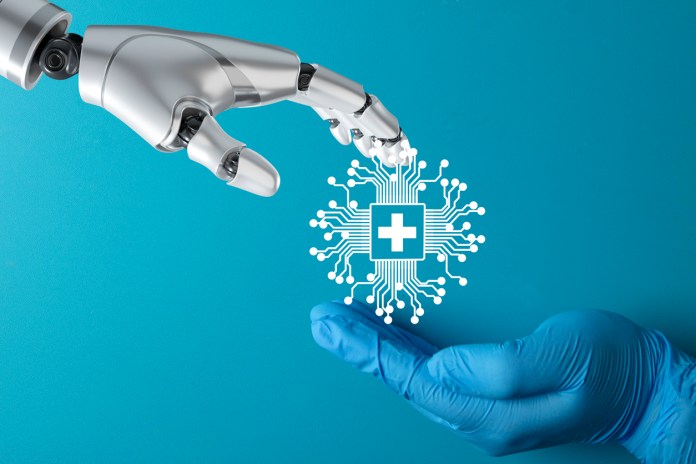
Anthropic recently signed a three-year MOU with Rwanda to improve its health outcomes. Will Claude be making diagnoses and prognoses in that country? If so, will such practices stay there? In worrying about this development, I also highlighted the movement toward AI refilling prescriptions without human decision-making. The CEO of Anthropic, Dario Amodei, recently wrote favorably of AI providing healthcare, arguing that “touch” and physical presence are not necessary for the practice. He even suggests that Claude has a “better bedside manner” than human physicians and makes more accurate diagnoses.
If some very influential and powerful people believe that AIs can practice healthcare — and we are on the verge of putting LLMs in the clinical chain as practitioners — then part of deciding whether to do this means asking the question: What is healthcare?
As foundational as that question is, the challenges and opportunities before us go even deeper. Invoking the inspiration of Pope Leo and Magnifica Humanitas, Arianna Huffington wrote recently that the AI revolution is providing a “gift to humanity” by forcing “the conversation we’ve neglected since the Enlightenment: Who are we, and what truly defines us?”
For centuries, we have imagined ourselves as “thinking things,” defined by our intelligence, cognitive processing power, and capacity to produce more efficient outcomes. But now, Huffington notes, AI is forcing us to reconsider this and ask new questions about who we are. Perhaps our humanity is found in something quite different.
A physician’s hand on her patient’s shoulder when giving a difficult diagnosis, and a nurse sitting in supportive silence in the aftermath, suggest that there is something about practicing healthcare that cannot be performed by AI. A veteran teacher who has developed a sixth sense for when a student is struggling or when the class’s attention is flagging suggests that there is something about teaching that cannot be performed by AI. A spouse who intuitively knows what kind of music to play after a rough day at work, or who can discern without a word the perfect film for a given movie night, suggests that there is something about human relationships that cannot be performed by AI.
But there are, of course, those who take quite a different view. Anthropic seems to believe that Claude can be a genuine companion for human beings and suggests that it has the qualitative data to prove it. Significant percentages of (especially young) people use AI chatbots in ways that, from the outside at least, seem like relationships. Spurred in part by the Trump administration (and even the first lady), school districts have now formally moved to have AI-directed ‘teachers’ in classrooms.
The die has been cast. Just as the culture will be forced to give an account of the nature of healthcare, we will also be forced to give accounts of the nature of teaching and friendship.
Pope Leo, writing in Magnifica Humanitas, has important insights to offer those trying to do this. In some ways, AI demonstrates certain limits of human beings. AI “doctors,” “teachers,” and “companions” may possess more cognitive ability and computational speed. They may have access to more information. They may make fewer mistakes. They may produce outcomes more efficiently. And these will be the arguments made in their favor.
On the other side of the ledger will be the pope’s vision: Human beings are not “projects to be optimized,” but rather finite and flawed individuals called to relationship and communion. The limitation of our nature, rather than problems to be fixed, are often the very things which make our particular flourishing as human beings possible. The Holy Father boldly and counterculturally claims that attempts to totally eradicate rejection, illness, and other kinds of suffering risk eradicating the most important sources of our compassion and love. Of our sense of gratitude and desire to give back. Of the mysterious processes by which we gain new wisdom, closeness in our relationships, and even access to the presence of God.
For the first time in many decades, and perhaps centuries, these deepest questions about human nature are up for grabs in a very public and meaningful way. And we are no longer giving away the game to the middle managers of our culture, who have gatekept public discourse in ways that sideline the humanities (and especially theology) in favor of “experts” working within a banal, disenchanted, technocratic paradigm.
Indeed, there is a new, authentic, and particular kind of curiosity about how religious traditions have been thinking about these foundational questions over millennia. I have seen this up close in everything from packed Hill briefings on the encyclical run by the U.S. Bishops, to secular media reaching out for my views on these matters specifically as a Catholic moral theologian, to meetings with hundreds of encyclical-curious people in Silicon Valley who now say that religious belief has lost its stigma.
How did we arrive at a place that, at least by the standards of the last 60 years, seems so strange? As a more authentic understanding of human nature would have it, it appears that our limitations, failures, and sufferings paved the way.
Looking back on the development of the smartphone and social media, almost everyone can see how this technology has undermined our humanity. But for more than a decade (and despite the makers of this technology not allowing their own children to use it), we ignored the terrible downsides in favor of efficiency, optimization, and virtual social connections. And we got all three.
But with them also came a surgeon general’s warning about loneliness, health outcomes akin to smoking, algorithm-driven outrage so strong it causes family members to become estranged, and even a sense that we may no longer have access to anything like objective truth. Human nature was hacked and put at the service of what would concentrate the most money and power with those who already held most of the money and power.
Significantly, a course correction has now arrived. Educational institutions are banning smartphones, parents are more intentional than ever about how their children use technology, and we have had a social moment of recognition that something went terribly wrong. That we lost something essential about our humanity.
And now consider this: It is at the very moment we have come to this realization that we are also being confronted by the massive questions forced by the AI revolution.
I have profound faith that our new wisdom means we will not repeat the same mistakes. As Pope Leo reminds us, our trials and sufferings “leave their mark like scars, the memories of a journey shaped by freedom and failure, dreams and disappointments. It is only thanks to the interplay of these elements that the wonders of the soul occur within us, allowing us to sense the richness of our humanity.”
The AI revolution portends a golden age of asking the big questions. Especially given the enormity of what is at stake, I intend to jump right in, and I urge my readers to do the same. We must not let this opportunity pass.