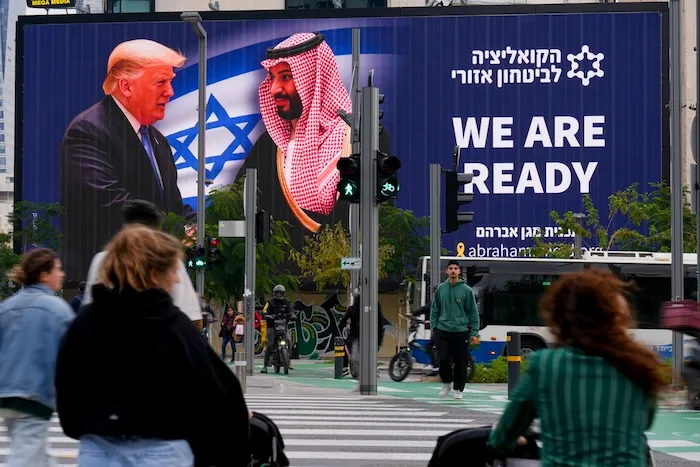
The Mecca defense pact is the anti-Abraham Accords

Published August 24, 2026 2:00pm ET | Updated August 24, 2026 2:46pm ET


In Focus delivers deeper coverage of the political, cultural, and ideological issues shaping America. Published daily by senior writers and experts, these in-depth pieces go beyond the headlines to give readers the full picture. You can find our full list of In Focus pieces here.

On Aug. 7, Pakistan, Turkey, and Saudi Arabia signed a historic defense pact dubbed the “Mecca Joint Defense Agreement.” It was portrayed as a response to Iranian belligerence, treating an attack on one as an attack on all. But Iran may not be its only target. The pact could also accelerate the formation of a regional security order that would be less dependent on the United States and hostile to Israel.

Six years ago this week, America boldly advanced the prospects for peace in the Middle East when President Donald Trump brokered the Abraham Accords, normalizing relations between Israel and the United Arab Emirates, Bahrain, Morocco, and Sudan. For years, analysts and diplomats indicated that an agreement between Israel and Saudi Arabia was just around the corner and would usher in a new era of regional cooperation and security.

Hamas’s Oct. 7, 2023, terrorist attack against Israel, which murdered 1,200 innocents and kidnapped over 250, including 12 Americans, was widely understood as an effort to derail Saudi-Israeli normalization.

The Mecca defense pact unites the second-largest military in NATO (Turkey), the Middle East’s largest producer of crude oil (Saudi Arabia), and the Islamic world’s only nuclear power (Pakistan) into an alliance with a collective-defense principle that Turkish Foreign Minister Hakan Fidan explicitly compared to NATO’s Article 5, which declares that an attack on one member state is an attack on all.

The framework that was previously pushing Saudi Arabia closer to normalization with Israel, mainly America’s role as security guarantor, coupled with Israel’s military dominance, has been shattered by Iran’s uncontained belligerence. For Saudi Arabia, this new defense pact provides the grounds for deterrence against Iran while also establishing a counterweight to Israel’s regional dominance.

Pakistani military chief Asim Munir even reportedly leveraged a joint oil transport venture with Iranian Islamic Revolutionary Guard Corps chief Ahmad Vahidi to secure an agreement between Iran and Saudi Arabia under which Tehran agreed to halt attacks against the Gulf kingdom. It has also been reported that officials in one regional country encouraged their partners in another country to be tactically flexible and reach an agreement with Israel to “lull it to sleep” while preparing for a larger conflict against it. The Iranian government has openly welcomed the agreement as weakening the “Zionist enemy and its allies.” These developments bode ill for Washington and Jerusalem.

Iran is exerting its influence far beyond the Strait of Hormuz. America’s inveterate enemy has deepened its cooperation with Russia, China, and North Korea, while growing closer to Islamic nations. Unfortunately, Turkey and Pakistan, each for reasons of its own, have pursued policies that would unravel the U.S.-led order in the Middle East and the defense capabilities of Israel.

For decades, Turkey’s increasingly authoritarian president, Recep Tayyip Erdogan, has employed enormous sums of Turkish treasure and political maneuvering to develop a modern military and the influence to become a serious player in the region. This has involved hosting and supporting Hamas leadership in Istanbul and Ankara, with Erdogan describing the terrorist organization as a “liberation movement.” Turkey has threatened Israel with military action, attempted to block the Jewish state from NATO collaboration, and has repeatedly denounced Israel at the United Nations.

In Pakistan, Defense Minister Khawaja Asif asserted that “Israel is a threat to the entire Muslim world,” and called for “a united military front” against it, just a day after the signing of the agreement. Asif has in the past called Israel “evil and a curse for humanity,” and a “cancerous state.” Saudi Arabia is also tying its security to the country whose A.Q. Khan network became one of history’s most consequential illicit suppliers of nuclear technology, essentially a hedge against participating within the American-led security order at all.

With Turkey’s deep ties to the Muslim Brotherhood and Pakistan’s own radical Islamist currents, the tripartite agreement moves the Gulf away from the moderate and promising path displayed by the UAE and Bahrain and retreats toward a bloody past. The one way to throw the sheets off of this convergence of ugly bedfellows is for the U.S. and Israel to finish the job, topple the Iranian regime, and liberate the Iranian people.

WHAT TO KNOW ABOUT THE IMPENDING U.S.-CANADA TRADE WAR

The U.S. should use its influence over all three capitals — Ankara, Riyadh, and Islamabad — to end efforts to form a counter-American order in the region. In his tweet on the anniversary of the Abraham Accords, Jared Kushner, one of its chief architects, said, “The Abraham Accords showed that a different path is possible. Now we have an opportunity to build an even broader movement.”

That’s the posture that Washington must take and make clear that the way to peace still runs through making peace with Jerusalem and broadening the Abraham Accords to rally all three nations behind a truly inclusive umbrella that can stand against the threat of Tehran and its partners in Moscow, Beijing, and Pyongyang.

Dr. Sheila Nazarian is a Los Angeles physician whose family escaped from Iran to America. She starred in the Emmy-nominated Netflix series Skin Decision: Before and After.
