

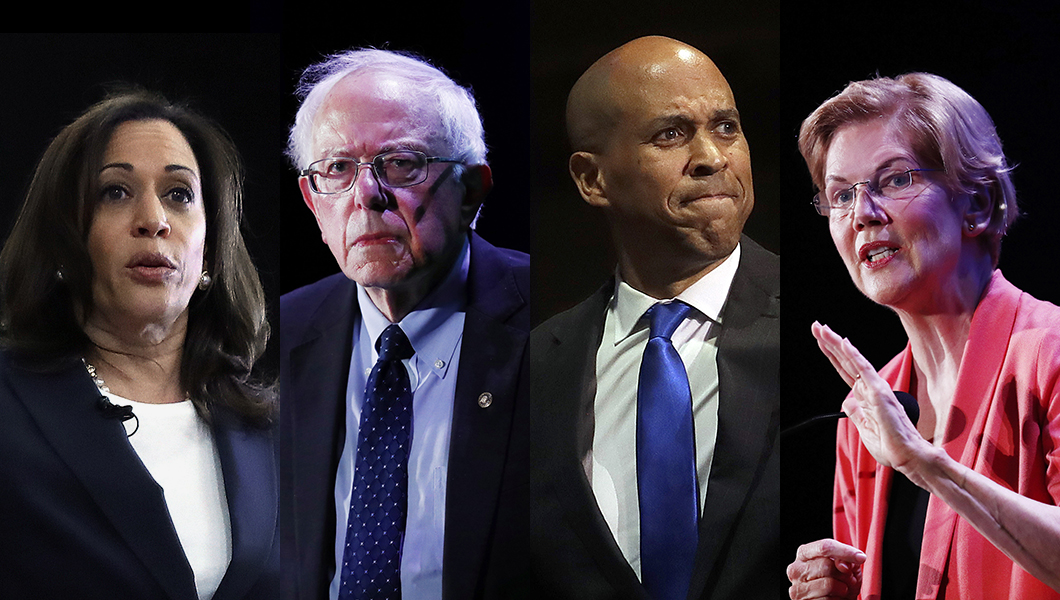
If a Democrat is elected president in 2020, there is a good chance he or she will face a Republican-controlled Senate that will block the boldest policy proposals, such as Elizabeth Warren’s wealth tax or Bernie Sanders’ plan to create a single-payer “Medicare for all” healthcare system, from taking shape.
But Democratic presidential hopefuls have plenty of ideas on how to achieve their policy goals without congressional approval.
Recommended Stories



“There’s a lot that a president of the United States — oh, I love saying this — can do by herself,” Warren said at a campaign stop in Newton, Iowa, in May, when explaining what she will do to address climate change. The Massachusetts senator said she would ban drilling on federal lands on her first day in office as president.
Candidates in the crowded Democratic presidential field broadly support reversing many measures taken by the Trump administration, such as ending zero-tolerance immigration enforcement that led to the separation of migrant families, reentering the Paris climate agreement, and reversing the ban preventing transgender people from serving in the military.
Presidents have long been criticized for disregarding the separation of powers across government branches.
President Barack Obama came under fire after declaring he would not wait on Congress to move forward with his policy priorities. “I’ve got a pen, and I’ve got a phone,” he said at a Cabinet meeting in 2014, referencing the pen to sign executive actions and a phone to court support for his legislative agenda from outside groups.
Many of the Democratic presidential candidates, too, have criticized President Trump for taking actions without Hill approval, such as failing to gain congressional authorization for military strikes in Syria last year and declaring a national emergency in order to reprogram funds to build barriers on the U.S.-Mexico border.
“The American people, the Congress and the courts must show Trump what the Constitution and separation of powers is about. Trump cannot declare a ‘national emergency’ whenever he wants, and spend money on his pet project,” Sanders, an independent senator from Vermont, said in a Facebook post in February.
Now, explaining how to create substantive change without Congress is a key part of Democrats’ presidential campaigns, and some White House hopefuls have gotten creative with their plans not only to reverse Trump’s actions but to advance their own agendas through executive action.
Cory Booker pledged to create a “White House Office of Reproductive Freedom,” which would work to advance “abortion rights and access to reproductive health care.” The New Jersey senator also said he would use the president’s power to grant clemency to about 17,000 nonviolent drug offenders.
Kamala Harris promises to take executive action to ban assault-style weapons and mandate near-universal background checks if Congress does not pass gun safety legislation in her first 100 days as president.
“I will put in place a requirement that for anyone who sells more than five guns a year, they are required to do background checks when they sell those guns,” the California senator said at a CNN town hall in April. “I will require that for any gun dealer that breaks the law, the ATF take their license.”
Minnesota Sen. Amy Klobuchar one-upped part of Harris’ gun rights executive action plan, pledging to close the “boyfriend loophole” immedately, rather than waiting 100 days to take action.
Harris’ “roadmap to citizenship” plan is also based entirely on executive action. She promised to reinstate the Deferred Action for Childhood Arrivals, or DACA, program to protect parents of U.S. citizens and legal permanent residents from deportation on a case-by-case basis.
As a part of his large plan to address climate change, former Texas Rep. Beto O’Rourke says he will establish more national parks and national monuments. His immigration plan puts a focus on building diplomatic relationships with Central American countries to improve regional security.
