

Populism is having a defining moment again, though it never really went away. This approach to politics surged after Donald Trump made his appearance on the stage in 2015, along with Sen. Bernie Sanders (I-VT) in the Democratic primaries. The two candidacies helped to reshape both parties a decade ago, and this populist trend remains at the center of American politics. Everyone claims to be against “the system.” Everyone insists they are fighting “the elites.” And very few people seem interested in explaining what comes after the anger has spent itself.
Populism certainly is rhetorically effective and electorally useful. However, the problems come when anger itself becomes the organizing principle of politics, and distrust is no longer a starting point for reform but merely the point of the exercise.
One of populism’s most significant problems is not an ideology. It is almost entirely about feelings and mood. It has no coherent theory of markets and no settled view of government and its institutions. The late PJ O’Rourke called populism “a muddle — a political, economic, and moral dog’s breakfast.” It exists to identify enemies rather than resolve trade-offs. It promises vindication rather than governance. Its power comes from turning complex issues into moral dramas, with villains to be punished and systems to be wrecked.
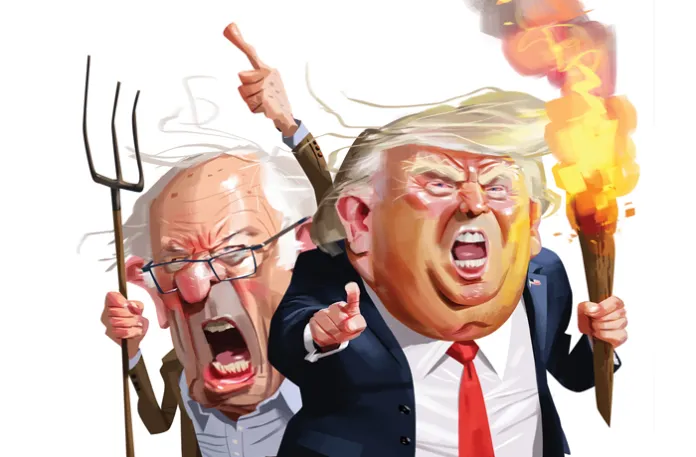
This is not new. American politics has produced populist figures before, particularly during moments of institutional strain. In the 20th century, two strains stood out most clearly. Louisiana Sen. Huey Long represented economic populism, railing against concentrated wealth and promising redistribution through executive power. Alabama Gov. George Wallace embodied grievance populism, directing public anger toward the courts, bureaucrats, and the supposed elites who are deemed contemptuous of ordinary people. Both claimed to speak for “the people.” Both treated institutional limits as obstacles rather than safeguards. And both elevated resentment into a governing principle rather than a temporary corrective.
The appeal of that approach is easy to understand. The Great Recession broke something fundamental in the country’s relationship with authority. Banks and auto companies were rescued. Insurance companies were stabilized. Americans watched that happen as millions of them lost their homes, their jobs, their savings, and, in some cases, their futures. To them, the system did not fail. It only failed for them. Those with direct access to power players and politicians in Washington didn’t suffer the consequences of their actions.
Populism offered an explanation that felt emotionally satisfying, even if it was intellectually thin. The problem was not complexity, misaligned incentives, or regulatory capture. The problem was corruption. The system was “rigged” against the average person.
That mindset reshaped the 2016 election on both sides. Trump did not just win the Republican nomination. He steamrolled the competition, openly attacking other Republicans, including former President George W. Bush and Arizona Sen. John McCain. He railed against free markets, open trade orthodoxy, and blasted institutional restraint. His campaign treated expertise as suspect, process as obstruction, and compromise as weakness. He did not promise to fix institutions. He promised to “fight” against them.
On the Democratic side, Sanders came much closer to the nomination than expected, fueled by post-crisis anger over what he said was a concentration of power and elite failure. The enthusiasm was genuine, and the target of his grievances familiar. Sanders was ultimately blocked not by lack of support, but by the party’s stronger institutional primary structure. Party leaders and superdelegates aligned early with former Secretary of State Hillary Clinton, signaling stability and limiting Sanders’s chances before the primaries began. Republicans, meanwhile, tried to placate Trump, thinking he’d burn out on his own.
Since then, populism has not receded. Language that once marked insurgency now sounds routine. Suspicion of institutions is no longer confined to outsiders. It has been absorbed into the rhetoric of leadership itself. Attacks on “the system” have become a prerequisite for credibility rather than a challenge to power.
This is where the populist moment begins to look less like a corrective and more like a permanent condition. Institutions are not ornamental. They are how large, pluralistic societies govern themselves without resorting to force. They impose rules, limits, and processes that frustrate immediacy but preserve legitimacy. They require patience and compromise, virtues that populism treats as evidence of bad faith.
The paradox is that populism thrives on institutional failure while making institutional repair more difficult. When every negative outcome is seen as corruption and every unfavorable decision as betrayal, there is little motivation to improve. Distrust becomes self-perpetuating, and outrage is rewarded.
Both parties are now operating inside this dynamic. Republicans surrendered to populism outright, elevating grievance over governance and loyalty over competence. Democrats have absorbed populism rhetorically, adopting its language even as they claim to defend institutional norms. The mechanisms differ, but the trajectory is similar. Politics becomes less about governing choices and more about signaling opposition to an ever-expanding list of enemies.
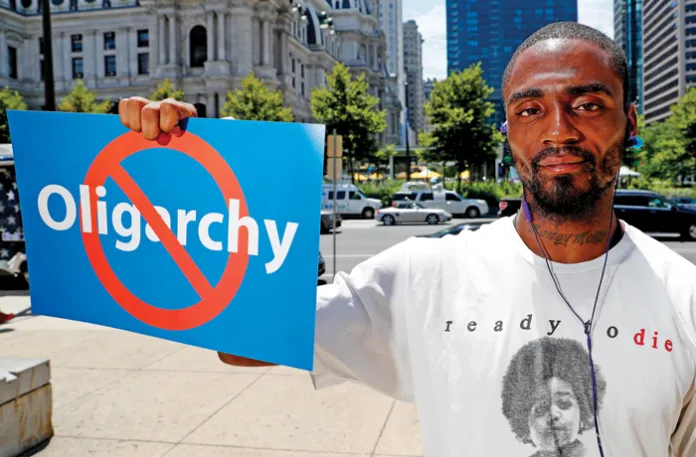
Looking ahead, this posture is only intensifying. The progressive populist wing of the Democratic Party is more popular today than it was a decade ago. It has normalized, and despite Clinton winning the nomination in 2016 and Joe Biden winning it in 2020, populism remains deeply embedded in the Democratic Party. Sanders has toured the country with Rep. Alexandria Ocasio-Cortez (D-NY) on the “Fighting Oligarchy,” the latest bugaboo of the populist Left, tour, alongside other Democratic politicians. Ideas once treated as insurgent now form the baseline of primary politics. That shift all but guarantees that future contests will be less about competing visions of governance and more about competing claims of authenticity. Who is really against “the system”? Who is fighting “the man” hardest?
Republican populism is following the same path, just with different villains. Trump’s call to cap credit card interest rates at 10% is not a serious market reform. It is a price control, one that would have been laughed out of a Republican policy conference not that long ago. It now sits alongside proposals for zero- or low-down-payment mortgages and capital gains exemptions for homeowners who sell to first-time buyers. These ideas are pitched as relief for working families, but they are really expressions of the same impulse driving the populist Left. Identify a pressure point, declare the system rigged, and promise a shortcut around economic reality. The details do not matter. The symbolism does. As with Democrats, policy becomes less about incentives, trade-offs, or long-term consequences and more about signaling whose side you are on. The result is a party increasingly comfortable replacing conservative economics with performative fixes that feel bold, poll well, and solve very little.
The real problem is that there is no obvious off-ramp from this. Populism is not a policy framework that can be refined or corrected. It is pure posturing. It thrives on ginned-up conflict, not resolution, and it loses its power the moment trade-offs are acknowledged. That is why it keeps producing the same kinds of proposals across party lines, such as price caps, debt forgiveness, symbolic punishments of “the rigged system,” and promises that sound bold precisely because they are disconnected from reality. It thrives on voter anger, nothing more.
The deeper problem is not that these ideas fail. It is that failure no longer disqualifies them. Populism does not ask whether a policy works. It asks whether it feels right and if it targets the proper “enemy.” It must confirm the belief that someone else is to blame. In that environment, governing becomes secondary. Performance is everything.
If there is any path away from this, it does not begin with better slogans or even better policies. It begins with people and with institutions. As Yuval Levin writes in his book A Time to Build, a healthy society depends on institutions that shape people over time, teaching responsibility, competence, and restraint. Institutions are not meant to be instruments of instant gratification or platforms for politicians. They exist to channel ambition, absorb pressure, and turn raw impulses into durable outcomes.
Populism is fundamentally at odds with that model. It distrusts institutions because institutions impose limits. They require patience and demand adherence to rules and norms that cannot be bent to fit the mood of the moment. Populism treats institutions not as mediators between citizens and power, but as obstacles to be smashed or captured, a la “burn it all down.”
WHAT DOES THE DEMOCRATIC NATIONAL COMMITTEE HAVE TO HIDE?
Both parties are now trapped in that dynamic. Democrats frame politics as a working man’s struggle against systems that they apply fancy labels to but can’t define with any coherence. Republicans increasingly mirror that approach, substituting different villains while embracing the same logic. The result is a politics that is less interested in policy outcomes than in emotional validation and electoral wins. Voters are promised free stuff that “others” will pay for, a power dynamic that thumbs its nose at responsibility, and change without any sacrifice.
It is, without a doubt, an effective way to win primaries, dominate cable news, and become social media influencers instead of legislators. But fundamentally, it is a disastrous way to govern. And until voters again demand institutions that build rather than flatter, populism will continue to thrive, not because it works, but because it feels good.
Jay Caruso (@JayCaruso) is a writer living in West Virginia.
