

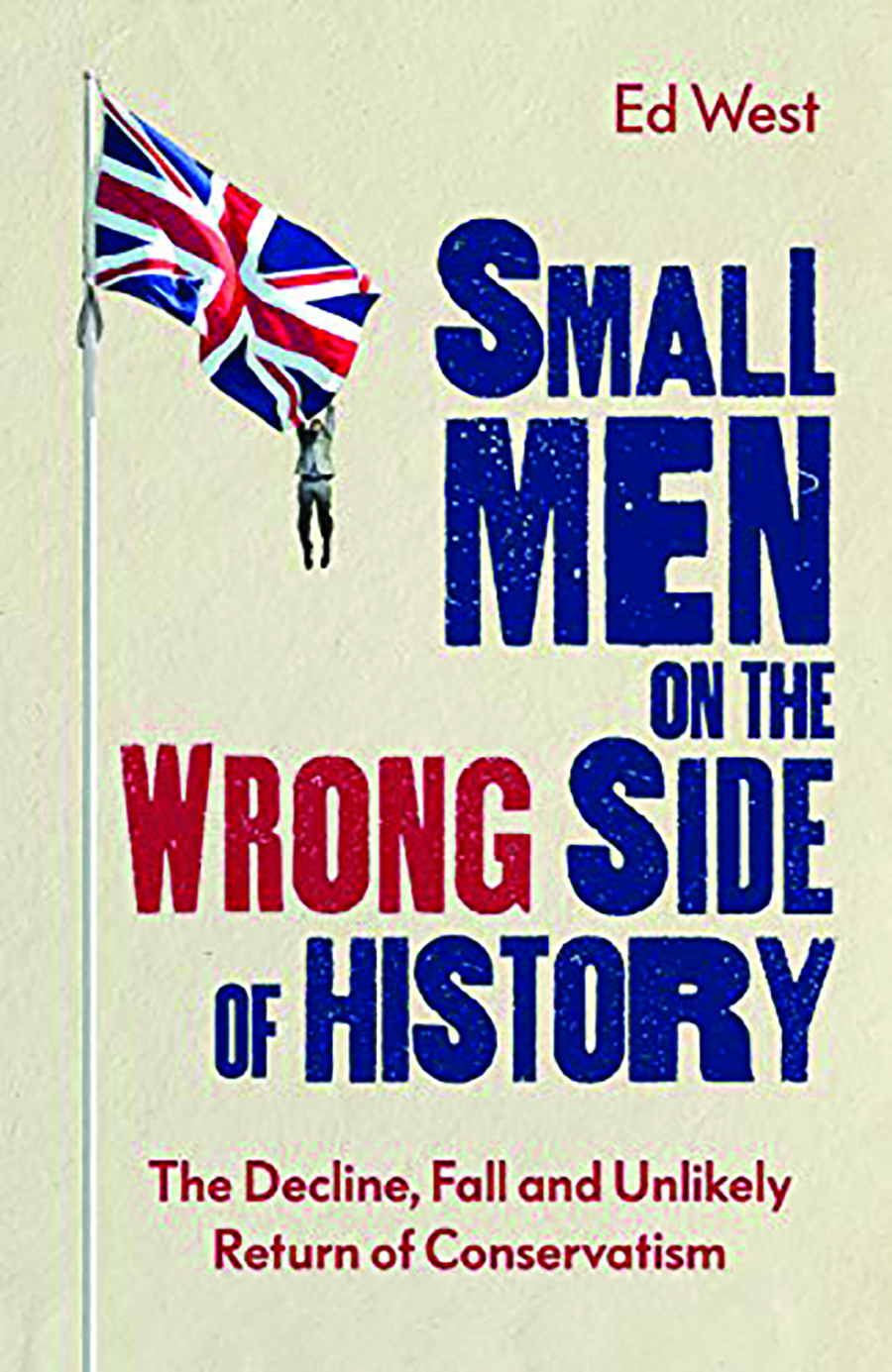
Ed West’s conservatives are a deeply unattractive bunch. Wannabee rugged individualists frightened of the world, losers driven by resentment and self-pity, sex-obsessed hypocrites whose internet searches likely contain a “mixture of depraved filth and censorious finger-wagging puritanism.” Conservatism itself fares little better; like baldness and impotence, it is a chronically low-status curse that afflicts the unfortunate souls who find themselves possessed by it. Given these descriptions, one might imagine that West, a professional writer living in bourgeois-bohemian north London, has no special insight into the conservative mind. But he does, chiefly because West himself is a conservative. And as his new book, Small Men on the Wrong Side of History, shows, quite a conservative one at that.
Self-deprecation and pessimism are not new trends in conservatism, and certainly not in English conservatism, which has never shared the bombast or reactionary streak of its respective American and European cousins. Roger Scruton’s paean to his country was entitled England: An Elegy. Peter Hitchens has repeatedly declared Britain “finished” and urged people to move abroad. English conservatism is neatly summed up by A.E. Housman’s poem “A Shropshire Lad”: “What are those blue remembered hills / What spires, what farms are those? / That is the land of lost content, / I see it shining plain, / The happy highways where I went / And cannot come again.”
In West’s book, however, there is no land of lost content, no prelapsarian state from which liberalism has wrenched us. History shows human life to be Hobbesian, and he is honest about the ways in which the past was much worse than the present. But unlike Tony Blair, whose 1997 campaign song was “Things Can Only Get Better,” West, ever the optimist, argues that “however bad things were, they can always get worse.”
The book, a kind of memoir of West turning into his ultraconservative father, is breezy and genuinely funny. It is worth the price for the character assassination of Rousseau alone. But it is also serious and thoughtful. He shows how every institution in British public life is run by liberals: the broadcast media, the judiciary, the education system, churches, and even the Conservative Party itself. He repeats this standard litany not with the anger of a golf club bore but with a self-effacing weariness. It is deeply embarrassing to talk about these things; it places one in the company of the kind of people who spend their time writing about “cultural Marxism” in the comment sections of local newspapers. The book takes its title from President Barack Obama’s description of al Qaeda: “another group of guys not entirely comfortable with the modern world.”
This, for West, is why conservatism loses and will continue to lose. It is a fundamentally low-status philosophy often driven by resentment. Its tenets — a belief that humans are flawed or fallen; a defense of the social function of tradition, mores, and prejudice; respect for limits and constraint; caution about sweeping change — are not readily translated to pithy slogans that pull on the heartstrings. They are rarely understood even by those on the Right. Conservatism attracts the unattractive, and thus its pessimism becomes self-fulfilling.
West is surely right that liberals are culturally hegemonic. In the United Kingdom, low-status (but widely read) tabloids provide perhaps the only challenge to this hegemony, and you can picture West writhing with embarrassment at their crudeness. Those things that once were subversive are now de rigueur: “While British arts folk love to break taboos, the highest praise, they only like breaking the taboos of fifty years ago, not the ones that today will actually lose you friends.” As an obnoxiously political teenager, my knowledge of the First International debates between Karl Marx and Mikhail Bakunin turned out, to my horror, to be par for the course once I arrived at university. And my reading of Judith Butler and bell hooks was, frankly, the bare minimum expected of a man who wanted to date any self-respecting arts student.
And while nonconformism today does imply flirtation with the Right, that is no recipe for a more attractive conservative movement. Nonconformists, West notes, “don’t have to be James Dean or Marlon Brando in The Wild One — they can also be very uncool.” So, for now, the Left’s hegemony sails on untroubled by popular votes or elected governments. When the British media had worked themselves into a histrionic fury over Prime Minister Theresa May’s milquetoast government because she gave a speech in which she suggested citizenship was bound by nationhood, liberalism continued its steady march unabated.
But things may be changing. The cultural Left, its complexion gnarled and its tone scolding, is becoming distinctly unattractive. Cultural critic Mark Fisher described the emerging intersectional political scene as a vampire’s castle driven by the “priest’s desire to excommunicate and condemn, an academic-pedant’s desire to be the first to be seen to spot a mistake, and a hipster’s desire to be one of the in-crowd.” The subcultural recesses of radical politics just aren’t fun anymore. The parties are uptight and the people neurotic. For now, the cultural vanguard continues to search for new forms of absurd radicalism, such as the call to abolish the family. But soon, the Left may have to look anew for ways to distinguish itself.
You can tell West has spent much of his life among people to whom if he fails to conceal his opinions, he must at least justify them with apologies and data. The book is full of both and, at times, relies too heavily on studies from psychology, genetics, and social science. This can lead to confusion. He cites, for instance, research showing that leftists are inherently more artistic and creative while describing elsewhere that the Left only began to capture the arts in the 19th century.
What’s more, the framing of these studies presupposes a dichotomy of Left and Right that it then confirms. This is a shame because West is attuned to philosophies that blend the two, such as Tory socialism (the great Victorian art critic John Ruskin described himself as both a “violent Tory of the old type” and the “reddest of the red”). In 2015, West wrote an essay in a book about the culturally conservative wing of the labor movement, Blue Labour, in which he argued that, although the prevailing view was that the Left had won the culture war and the Right the economic war, in fact, the rich had won both. It is the cultural Left, not the economic Left, that is hegemonic.
Around the world, politics are trending toward a marriage of left-wing economics and cultural conservatism. This book suggests West and perhaps English conservatism in general is a passive observer of this process. In a telling anecdote, he describes a phone call he had with Steve Bannon. West gives the impression of being slightly frightened of Bannon, alarmed by his enthusiasm, his talk of crushing enemies, and, most of all, by his desire to win. Bannon spoke like a madman about getting an outsider figure to run for president and upend the liberal order. This was in 2014. In contrast, English conservatism is a “pasty, effete” affair that struggles to move from lamentation to action. Are conservatives content to go gentle into that good night?
Customarily, books of this nature end with a slapdash attempt to answer Vladimir Lenin’s question: What is to be done? West doesn’t bother. In the end, in a passage of earnest and touching writing about his young son suffering pneumonia and the murder of a Labour MP by a far-right terrorist in 2015, he concludes that the culture war is so demoralizing that it is not worth fighting, whichever side wins. And so, like J.R.R. Tolkien, he “does not expect history to be anything but a long defeat.”
Tobias Phibbs is a writer and director of research at the Common Good Foundation. He lives in London.
