

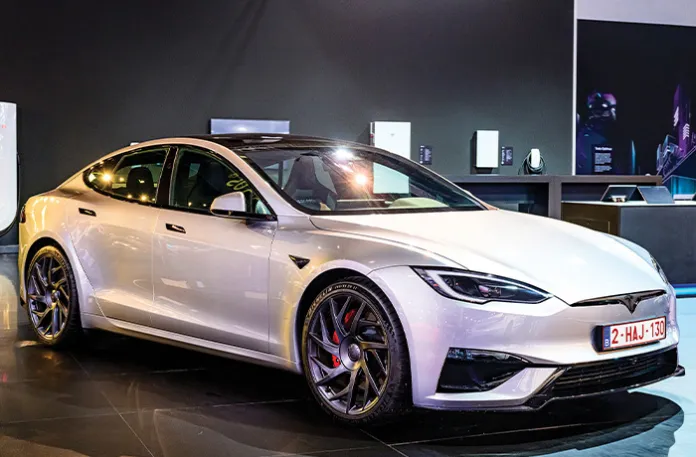
After nearly 14 years on the market, Tesla’s remarkable Model S electric vehicle is being discontinued. There will be no direct successor.
Much will be said and written about the impact the Model S had on the automotive industry, but this will be one of those cases where the truth is more outrageous than all but the strongest hyperbole, because the shark-like liftback sedan has turned out to be more important than the Model T, the Volkswagen Beetle, or both of them put together. It is the only mass-production vehicle in history to completely define its segment, and it is the only EV that has ever mattered.
These are bold claims, but they are easy to make. Compare the Model S, if you will, to the Model T. That humble, useful Ford put the country on wheels and, at one point, made up half of the American vehicle fleet, but its only long-term effect on the automobile was that it demonstrated what most of us did not want. By the time Henry Ford reluctantly pulled the plug on the endeavor, it was surrounded on the roads by vehicles that looked nothing like it and in many cases were sold based on their difference from the T. While most people today could drive Ford’s Model A, which succeeded the T, with little or no instruction, the Model T was operated with controls that simply never reappeared on the automotive landscape. In steady-state usage, you don’t touch any of the three pedals, none of which operate the throttle anyway.
(If you ever find yourself needing to drive a Model T in a hurry, which is an implausible concept to begin with, start the obvious way: by pushing the leftmost pedal to the floor, which engages low gear, then releasing the pedal to engage high gear. You might need to fuss with the hand throttle and the hand brake at the same time. Use your third hand, if you possess one, to steer.)
The Volkswagen Type 1 “Beetle” would eventually break the Model T’s sales record and serve as the official vehicle of the Woodstock Generation. But when it went out of production, it, too, was surrounded by vehicles that took nothing from its engineering or packaging. The closest thing you could buy to it in the USA was the Chevrolet Corvair, which was closer to a Porsche 911 in concept than to a Beetle and, in any event, had long since been discontinued when the Beetle closed up shop.
Now, if you will, consider the Tesla Model S. When it arrived in 2012, everyone in America already knew what an electric vehicle looked like: Nissan’s shambolic Leaf, a sad little four-seat bento box filled with lowered expectations that practically shouted “I. AM. POOR. AND. ALSO. QUITE. WEIRD.” to everyone around it. The Leaf couldn’t outrun a minivan full of children, accelerate convincingly on a grade, or go much past 100 miles without requiring a 12-hour meeting with an electric plug. The best thing you could say about the Leaf was that it was better than the General Motors EV-1, an electric vehicle so awful that GM had no choice but to call them all back to its corporate bosom and crush-recycle them into Chinese dishwashers.
It was an era of “compliance cars,” which were normal economy cars hastily rebuilt with electric powertrains and sold exclusively in California for, you guessed it, compliance with the state’s insane environmental regulations. Remember the RAV4 EV, the Spark EV, the Ford Focus EV, or the Honda Fit EV? Of course you don’t. In the words of Seinfeld’s Elaine Benes during her all-too-brief elevation to leadership of J. Peterman: “Nobody’s buying it, and you shouldn’t be selling it.”
The Model S, therefore, was anything but business as usual in electric vehicles. True, the original Tesla Roadster had been a quick little thing, but it had also been a profoundly half-baked revamp of the Lotus Elise, barely a real car itself. There was nothing half-baked about the Model S. It looked like a Jaguar from the future, and it was quicker in a straight line than any Jaguar ever sold. But it wasn’t until the dual-motor powertrain arrived in 2013 that the Model S became truly impossible for anyone in the business to ignore.
The P85D boasted 691 horsepower from two motors — only 463 horses could be deployed at the same time, however — and a 253-mile range. All of a sudden, the EV wasn’t a toy. It was an unmistakably desirable, luxurious, and rapid transportation alternative. And Tesla kept the proverbial foot to the floor, replacing the P85D with the P90D, the P100D, the Ludicrous, and eventually the monstrous Plaid model, which humbled million-dollar hypercars in the quarter-mile while swanning 300 miles or more between Tesla’s unique Supercharger stations.
What followed was the most concentrated and sustained episode of direct imitation in automotive history. In 2012, everyone understood the EV to be a crummy little $25,000 penalty box. By 2014, the whole world knew that an EV was actually a $100,000 sedan that went faster than a Ferrari. Heretofore, no one would take an EV seriously unless it was big, heavy, fancy, and fast. Every major automaker in every market suddenly discovered the need to produce a five-door, 600-plus-horsepower premium EV. Pathetically faithful copies of the Model S appeared immediately from firms as diverse as Ford — hello, Mustang Mach-E, which in profile is between a Model 3 and a Model S — and Porsche — the Taycan is essentially identical to the Model S Plaid.
By the time all the ersatz Model S’s appeared, of course, Tesla had moved its focus to the affordable Model 3 and Model Y, after a slight detour to the wacky gullwing-door Model X SUV, also being discontinued, although it won’t be missed by most. The Model 3, which is now familiar to everyone in America as either an Uber or their neighbor’s car, is simply a de-glamorized Model S for a third of the price.
The competition continued to embarrass itself. The Audi e-tron GT is basically a schnitzel-flavored Model S, as is the BMW i4. The Cadillac Celestiq is a $400,000 Model S competitor that doesn’t go as quickly, nor can it boast as much credibility with the valets in Las Vegas. The Dodge Charger is a Model S with the appearance, but not the reality, of a conventional trunk — to its credit, Stellantis secretly built the thing to have a twin-turbo inline-six engine just in case sanity returned to the presidency, which is now the case at least with regard to the electric vehicle. The Hyundai Ioniq 6 is a Model S for people who dislike pretty cars, and the Kia EV6 is the same thing but with a dumpier shape. The Mercedes EQE and EQS are similar to a Model S but have none of its durable appeal to buyers.
The best competitor to the Model S, the Lucid Air, is still beholden to the basic Model S idea but offers quite a bit more luxury and interior quality. The worst variant of the Tesla “fast EV” concept is surely the massive EV truck platform from General Motors. It seemed vitally important to CEO Mary Barra and her cast of clowns in the C-suite that the Hummer EV, Silverado EV, and Escalade IQ have Tesla levels of acceleration, so the engineers created 9,000-pound behemoths that owe 2,923 of those pounds to the massive “Ultium” battery pack. Of course, the Tesla is still faster in all respects, especially in the speed with which it leaves the showroom to actual buyers.
Not a single competitor had the guts to completely reject Tesla’s influence. Every electric vehicle you can buy in the United States is heavier and more expensive than it needs to be in order to live up to the “EVs are fast and fancy” stereotype. No wonder most of them were a tough sell even when federal and state taxpayers were compelled to foot up to $15,000 of the bill. Now that the incentives have disappeared, pretty much every EV without a Tesla badge has electric-arc-welded itself to the showroom floor. I recently had a conversation with a very dispirited Chevrolet-GMC dealer in which he lamented that even a $45,000 discount wasn’t sufficient to raise interest in General Motors EVs.
Not even Tesla is fully immune to this decline in EV interest, especially at the top of the market. Rather than engineer a brand-new Model S for a shrinking segment, CEO Elon Musk is pulling the plug and directing his well-heeled buyers to Performance models of the Model 3 and Model Y. The biggest reason for the drop-off in Model S sales is that the car looks “too generic” now. Which is a fitting epitaph for the world’s formative electric vehicle: It looked like nothing else when it arrived and exactly like everything else when it left.
Jack Baruth was born in Brooklyn, New York, and lives in Ohio. He is a pro-am race car driver, a former columnist for Road and Track and Hagerty magazines, and writer of the Avoidable Contact Forever newsletter.
