

The New York Times publishes two basic kinds of articles about family life in America: opinion pieces by women describing how terrible their husbands are and puff pieces promoting alternative family lifestyles.
Last week, the outlet published one of the latter under the headline, “In Search of a Platonic Co-Parent.” Apparently, the burden of finding someone you are romantically interested in has become so great that increasing numbers of midlife professionals who think they want children are using apps to help match them not with a date, but with a platonic co-parent.
“A co-parent doesn’t need to be my romantic partner,” Rave Reid, a 33-year-old owner of a social wellness club in Los Angeles, told the outlet. “They need to be a great teammate.”
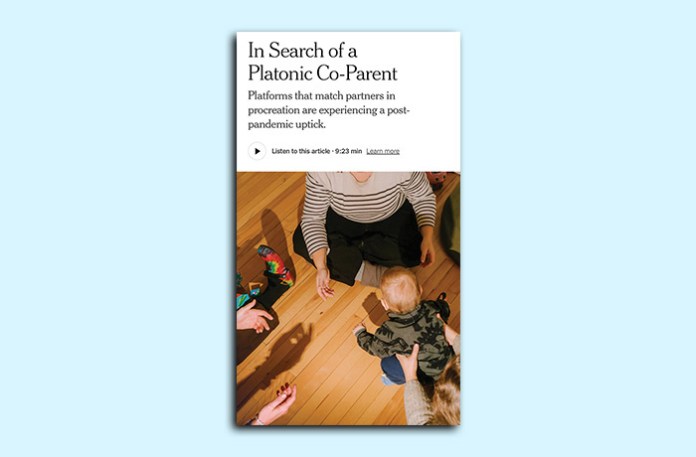
Reid uses an app called Modamily to search for her ideal platonic co-parent. In 2020, there were just 30,000 users on the platform. Today, there are over 100,000. Reid uses a totally separate app for dating.
“I really feel like it let me separate two huge decisions,” Reid, who wants to have a baby before she is 36 years old, explained. “Who do I want to date and who do I want to parent with? We put so much pressure on our partner to be everything.”
The outlet then profiled one family that is practicing this platonic co-parenting model. Zachary Sahuque, a 34-year-old environmental health and safety specialist, and Amanda Lohse, a 47-year-old high school geography teacher, matched on Modamily before creating two children through in vitro fertilization. The four of them now all live on a 52-acre ranch in Texas, where Sahuque and Lohse each have their own house.
Sahuque told the outlet that “he grew up in a home with a lot of arguing and promised himself that he would never put his children through that.” He said he believes “having children with someone who was his best friend, not his lover, would mitigate the risk.”
The outlet then noted that one study of 23 co-parenting families found, “The children seem to be doing well and no different to other family types.”
The only danger for children in this environment, according to the outlet, is from stodgy conservatives judging them.
“Some parents reported feeling stigmatized,” for their lifestyle, the outlet reported.
But as authoritative as one study administering one questionnaire to an entire 23 families is, might there be some inherent dangers to this lifestyle choice that the outlet completely failed to even address?
Reid, we are told, has not entirely given up on romance. She still uses another app for that. And the outlet never tells us whether Sahuque and Lohse are dating other people. But usually, even after becoming parents, people do not stop having physical and emotional intimacy needs. In traditional families, those needs are met by a married husband or wife. But the entire point of “platonic co-parenting” is that those needs are met somewhere else. And that is where the danger lies.
Multiple studies covering thousands of families over decades have found that the single greatest danger young children face is from unrelated men living in their households. One University of Chicago study found that young children who live in households with an unrelated man are nearly 50 times more likely to die from an inflicted injury (such as being shaken or struck), as compared to children living in a home with both biological parents.
HOLLYWOOD NEEDS MORE GROUNDHOG DAYS
The nuclear family, consisting of a married father and mother and their children, is not something that was invented by conservatives in the 1950s. It is how we evolved into humans. The connection we feel with a romantic partner, especially after sex, is hard-wired into us through hormones such as oxytocin and vasopressin. These chemical messengers have been binding men and women together into long-term projects of cooperative care for millennia.
The New York Times can’t change these facts with even a thousand alternative lifestyle puff pieces. But it can encourage thousands of people to make bad decisions that endanger themselves and others.
