

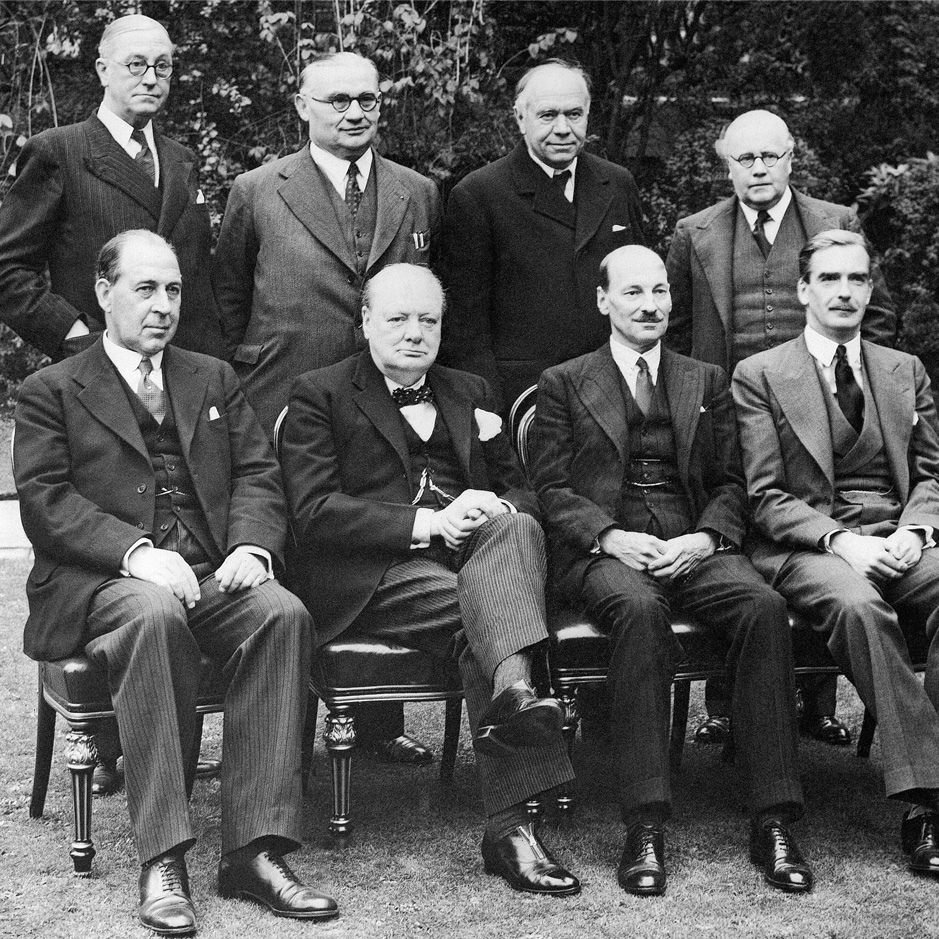
In this tale of Winston Churchill and his war cabinet, the answer to the perennial question—Do we really need another book about Churchill?—is a definite Yes. Unlike many other studies, Jonathan Schneer focuses on Churchill the wily and astute politician, a man who managed domestic politics so cannily that he was asked to form a government in Britain’s moment of deepest peril, who cobbled together a coalition cabinet to wage war on Nazi Germany while managing the home front, and who held that sometimes-fractious group of politicians together through difficult times, until victory in Europe was secured.
At which point, this skill deserted him.
Recommended Stories



Much of what we know about Churchill relates to his wartime leadership, chronicled as part of the late Sir Martin Gilbert’s magisterial biography. Schneer does not repeat the oft-told tales of the prime minister who wooed Franklin Roosevelt, kept Joseph Stalin informed and reasonably content as a new ally, and did so much to hold the Allied coalition together. Instead, Ministers at War deals with his success with a different coalition: his wartime cabinet. Here is a riveting account of how Churchill—working behind the scenes as skillfully as he worked in public to rally the nation, using the same gifts of tenacity and charm—contended with strong-minded men from different parties and backgrounds, with differing ambitions, and competing against each other, both at cabinet meetings and in Parliament.
This is Churchill as domestic politician, the man we seldom see.
After a decade in the wilderness, mistrusted by his own Conservative party, Winston Churchill was grudgingly reappointed first lord of the Admiralty by Neville Chamberlain, who badly needed his expertise and support when war broke out. Churchill, sensing that Chamberlain was losing the confidence of the House of Commons, and that his own time was near, played a long game, placating cabinet colleagues and keeping contact with supporters in the House. Still, even when a national coalition was needed, and Labour members ensured the fall of Chamberlain by refusing to serve under him, it was not at all clear that Churchill would be the one summoned by King George VI to form a government. Not everyone flocked to Winston Churchill as the obvious choice, with many preferring the foreign secretary, Lord Halifax, and others supporting Anthony Eden—or even David Lloyd George, “the old lion,” then 77 years old.
Schneer’s tale of just how Churchill bested his rivals is the stuff of which novels are made. The first lord listened to his closest advisers, took the pulse of friends at lunches and dinners, but kept his plan to himself. When, on May 9, 1940, Chamberlain, who knew he could not go on, summoned Churchill and Halifax to a meeting to decide who would succeed him, Churchill did something uncharacteristic: He kept silent. Asked whether a peer such as Lord Halifax, who could not attend the House of Commons, might run the war, Churchill said nothing. Thus, says Schneer, he avoided “being dismissed as a self-promoter.” Churchill later wrote that “a long pause ensued. It certainly seemed longer than the two minutes which one observes in the commemoration of Armistice Day.” In the event, Halifax demurred and told Chamberlain that he thought “Winston was the better choice.” Nothing final was said at the meeting, but the decision had been taken and, as Schneer writes: “What would proper Englishmen do in such circumstances? Churchill and Halifax went into the garden behind No. 10 and had a cup of tea in the afternoon spring sunshine.”
At dawn on May 10, Hitler’s armies broke through Belgium and overran Holland and Luxembourg. At 5:30 that morning, Churchill awoke to hear the news of the advance, which Chamberlain saw as a “reprieve”—and decided not to resign. So Churchill went about his urgent duties as first lord of the Admiralty. But by tea-time, the king had sent for Churchill, who promised to form a national government to include both Liberal and Labour members, with himself as minister of defense as well as the head of a separate, five-member war cabinet.
Churchill induced key Labour parliamentarians to serve under him in the cabinet, among the most important of whom was Ernest Bevin, cofounder and head of Britain’s largest union. Bevin was asked to manage the nation’s labor supply to keep the mines and factories operating at full tilt, and to keep strikes at a minimum, which he did effectively. Churchill also made the Labour leader, Clement Attlee, deputy prime minister. But Churchill’s position was still precarious: “Chamberlain loyalists regarded the man who had replaced him as a usurper,” writes Schneer. Churchill was “loathed” by many for reasons ranging from the Gallipoli disaster of World War I to the belief on the left that he was a reactionary. Only Neville Chamberlain was cheered as Churchill entered the House of Commons to give his first speech as prime minister. Schneer describes, in wonderful detail, how the new leader found a “balance between his critics on both sides of the spectrum” and maintained that delicate balance through the next five years—all the while leading the fight on the Axis.
We don’t often see Churchill depicted as a domestic political genius, but that is the picture that Schneer paints, taking us through each step by which Churchill transformed a group of “ill-assorted colleagues” into an efficient wartime government. But what about those in his cabinet who had personal ambitions, waiting for Churchill to fail so that they could step into his place? “Parliament is given over to intrigue,” noted one Labour member. Schneer describes how Churchill disposed of his rivals—not in the manner of his ally Stalin, but more like his other cunning ally, FDR. Stafford Cripps, Anthony Eden, even his close but unpredictable friend Lord Beaverbrook harbored hopes of succeeding Churchill. But “Churchill was lucky that the critics did not coalesce behind a single leader,” notes Schneer, and his handling of the situation “reveals his mastery of the political game.”
Churchill took care of Beaverbrook by taking him into the cabinet and putting him in charge of aircraft production, where he performed brilliantly—but was treated with sufficient cunning, patience, and insight to stymie his behind-the-scenes maneuverings and ambition. Then there was Cripps. Schneer writes that Stafford Cripps seriously “underestimate[d] the tenacity and cunning of a man who had immense reserves of both,” and who was a “master of political maneuver.” Churchill neutralized Cripps by making him leader of the House of Commons, where he antagonized his own party, and then sent him to India to promise eventual independence, serving the dual purpose of rallying “South Asians to England’s cause” and “getting his most dangerous rival” out of the country and “out of the public eye.”
Yet even Churchill’s skills could not make his management of the war smooth sailing. There were, after all, times when the British effort was not going well: After the 1942 fall of Tobruk to Rommel’s Afrika Korps, for example, MPs from all three parties, seeking reforms in the cabinet structure, placed before the House a motion of “no confidence in the central direction of the war.” Had they succeeded, Churchill would have been forced to call a general election that, given a succession of British military defeats, it was not at all certain he would win. But Churchill’s response in the House to his critics persuaded many Tories (initially inclined to abstain) to vote against the no-confidence motion. Who but a shrewd parliamentarian would have ended his precise and detailed defense exactly at 5 p.m., leaving no time for debate before the vote, which Churchill won?
Schneer dates the beginning of Churchill’s failure in the management of postwar expectations for domestic policy to the Beveridge Report. Published in late 1942, the report proposed what has since become Britain’s welfare state—many features of which, by the way, Lord Beveridge himself would not have approved. But in the darkest hour of the war, the fracas caused by the report set off alarms even among Labour ministers and MPs, who supported Beveridge while Conservatives expressed “reservations.” So it was temporarily shelved. But the report, when published, was a sensation: “The left . . . which had never ceased calling for Labour ministers to demand further reforms and government interventions . . . sensed the tide of history flowing with it.”
Unfortunately, Churchill paid little attention to the Beveridge Report, leaving Britain to meet with Roosevelt in Casablanca, and then on to Cairo, Turkey, Cyprus, and Algiers. For him, fighting and winning the war took prec-edence over everything else—and if he thought about it at all, he believed that Britain could not afford “airy visions of Utopia and Eldorado.” Churchill’s reluctance to commit to social legislation that would determine the future of postwar Britain meant that he was unprepared for the “growing movement for far-reaching postwar reconstruction,” a failure that would mean his tenure in office would be shortened by inattention to domestic affairs.
Here, Churchill’s famous prescience failed him. Throughout the 1930s he had foreseen the coming war with Germany but he had not the foresight to envision a postwar Britain more in keeping with liberal ideals, many of which he had fought for as a young Liberal. Churchill, in his own estimation, had a war to fight and was largely uninterested in domestic policies. He failed, writes Schneer, “to understand the power of the building wave of leftist sentiment in the country [and] would not remember that Labour had been the decisive factor in Chamberlain’s downfall, and that it had held the whip hand even if it did not know it. And it never occurred to [Churchill] that Labour’s role in 1940 might in some ways presage its part in the unmaking of his own administration in 1945.”
Cita Stelzer is the author of Dinner with Churchill: Policy-Making at the Dinner Table.
