

A lot of people worry about Ebola these days. Not me. I’m calm, relatively speaking. That is, I’m calm, relative to the shuddering, sobbing basket case that the mere thought of infectious disease once reduced me to.
A movie from third-grade science class is to blame. Since we didn’t see many films in school, I remember every one I saw. Aside from a few underwater documentaries by Jacques Cousteau, there was Viva Zapata!, The Last Hurrah, and Stanley Kramer’s Bless the Beasts and the Children. They seem to have been meant to teach us “critical thinking,” although I also recall one about Erich von Däniken’s theories of how extraterrestrials built the pyramids.
Recommended Stories



Nothing prepared me for The Rival World. It was about insects. All the details that follow are a 9-year-old’s thoughts, unreliably recollected from decades back, but the terror the film induced is vivid and with me still. It was a cross between Science Friday and “Sinners in the Hands of an Angry God.” Mankind was locked in an apocalyptic battle against bugs, it seemed, and we were outnumbered a-bazillion-to-one. We were probably doomed. Look what was happening in Africa: See the devastation wrought by bugs. There was a rail-thin man shivering uncontrollably in his bed, making a hih-bih-bih-bih sound. I am ashamed to say we 9-year-olds tittered at this point—the shaking man sounded like Curly in The Three Stooges.
But now the narrator was enjoining us, in his authoritative baritone, to wipe that complacent smirk off our faces. This was malaria, the work of the anopheles mosquito, which breeds in its teeming billions in swamps around the world and gets closer and closer to our school in Massachusetts every day. Up close the anopheles looked like the mosquitoes that had ravaged my ankles the summer before, except that it covered about eight feet of schoolroom wall. You could see the thing puncturing the skin of some hapless tribesman with its death-dealing proboscis.
The narrator was just getting started. Soon we met the tsetse fly, bearer of trypanosomiasis, the dread Gambian “sleeping sickness.” Oh, cripes. There were scenes of felled human beings immobile in the dust. Then we saw the tsetse at a thousand times its size. The camera got so close you could hear it buzz. Look at that! After a close-up on a locust, the film crew boarded a small-engine plane and flew into a whole plague of them. The bugs splattered loudly against the windshield like so many balls of snot, turning it amber-colored and opaque. Now look again! There was a giant beetle on top of a lettuce leaf, secreting dark and poisonous drool as it chomp-chomp-chomped, with a deafening noise as of tramping boots.
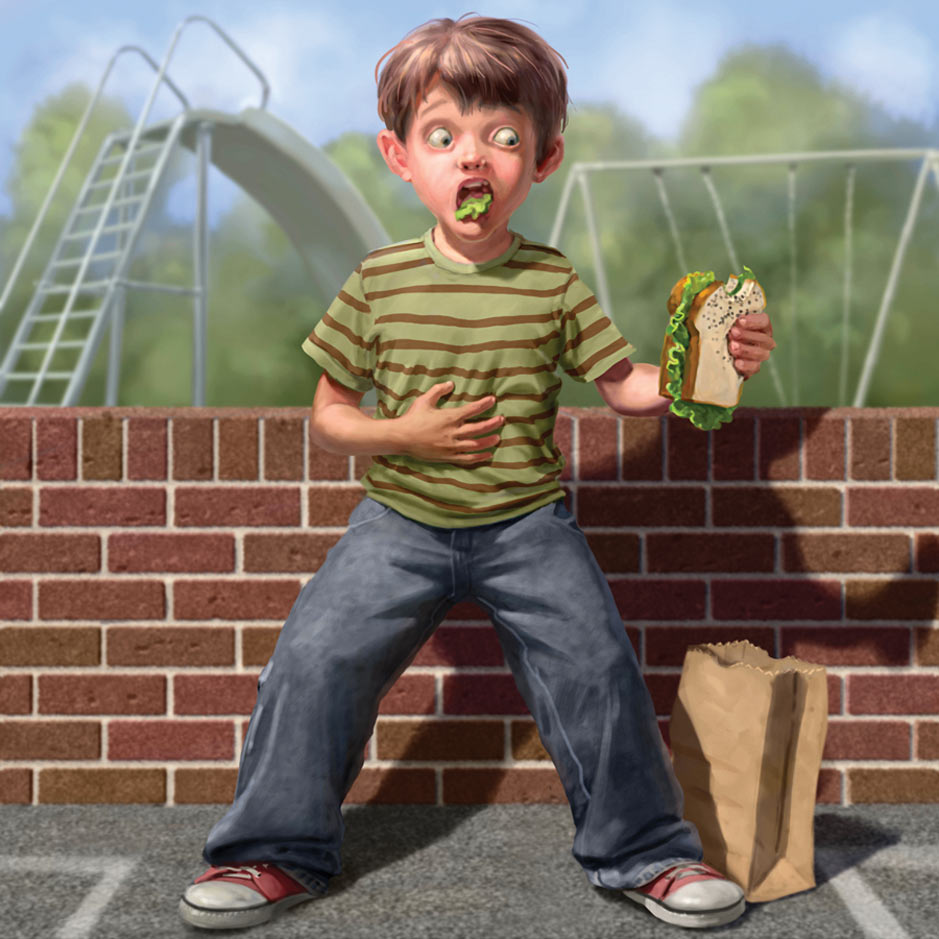
When the lights came up it was lunchtime. I had a horrible feeling that I wouldn’t have again until alcohol became part of my life many years later: that of recollecting something recent, horrible, and dreamlike that turns out to be no dream at all. No one else appeared concerned in the slightest. We were all carrying our brown lunch bags out to the playground. My classmates were laughing as if nothing had happened. I sat down on the tar, leaned against the sunny brick wall that faced the tetherball poles, and opened my lunch. My mother had made me a tuna-salad sandwich, my favorite. But now I got it out of the wax paper and saw it had lettuce on it. Was she crazy? It was probably swarming with beetle eggs and contaminated with bug drool! I put it aside. I pulled out the plastic baggie of Hydrox cookies (a kind of cut-rate Oreo) and ate those instead.
That made me feel better. I had acted like an idiot, I now saw. I took a bite of the tuna sandwich—it was my mother’s usual delicious concoction, on Arnold’s white bread, of Chicken of the Sea, Cains mayonnaise, salt, pepper, and chopped celery. I looked down at it and . . .
Oh, no! I had been right! There were beetle eggs all over the thing! Small, black, right where I had been chewing. I leapt to my feet in terror, threw my sandwich into the bag and ran into the school with it.
“Oh, Mrs. Booth, Mrs. Booth!” I wailed at the lady who managed the front desk. “Call the nurse!” I told her about The Rival World and about the beetle eggs in the sandwich my mother had made.
“I don’t think there are beetle eggs in your sandwich,” Mrs. Booth said.
“Yeah?” I said, with a mix of fear and impatience, pushing the sandwich onto the desk in front of her. “What do you call these?”
She bent over it and squinted. “If I didn’t know any better,” she mumbled, “I’d say they were little pieces of Hydrox cookie.”
