

For a minute or two last week, over coffee in a working-class bakery in Massachusetts, I recovered my optimism about the human race. To say working-class might be a stretch. It was in a gentrifying neighborhood once inhabited by factory workers. It had an Italian name. Everyone was welcoming, voluble, and obese. It was not a grand place. Sitting down at a small table, I was struck by a sign on the napkin-holder at the next table, where a bunch of college girls were studying. It read: “Due to limited seating, we ask that this space be reserved for groups of three or more.”
The word that struck me was “be.” Americans have forgotten how to use the subjunctive mood, which is used for not-necessarily-actual states. When a mother says, “It’s bad that your husband be a drunkard” (subjunctive), she’s giving advice about the future. When she says, “It’s bad that your husband is a drunkard” (indicative), it’s too late for advice. Phil Simms and other NFL color commentators assume that jumbling enough verb forms together will eventually amount to a subjunctive: “If he woulda cut when he goes down the sideline, there wouldn’t oughta been someone covering the seam, had there?”
Recommended Stories



Knowing that someone in this very coffeebar could wield the subjunctive made the place seem exotic—like being told one of the barmen fought with ISIS or that one of the waitresses works evenings as a stripper. You’d kind of like to know which one. Boston-Accent Lady, drying the glasses with a rag? Nose-Ring Guy, behind the cash register there? The college girls next to me were studying out of a first-year Latin textbook. Maybe they’d know!
When you see someone reading something you care about, it’s nice to make a connection. But it’s awkward. One doesn’t want to come off like that stock figure of college life, the Renaissance Sleazebag—the man who corners a girl reading quietly in a coffeehouse and says with a knowing leer, “Ohhh, Pablo Neruda. I love Pablo Neruda. He’s sooo sensual.” One Google search ago, the guy thought Pablo Neruda batted cleanup for the Tigers.
Instead, I tried to pass for a harmless old coot, something I can now manage with an ease that alarms me. “You’ll never regret taking Latin,” I said.
One of the girls said she had to take it. She was a history major at the Christian college up the street.
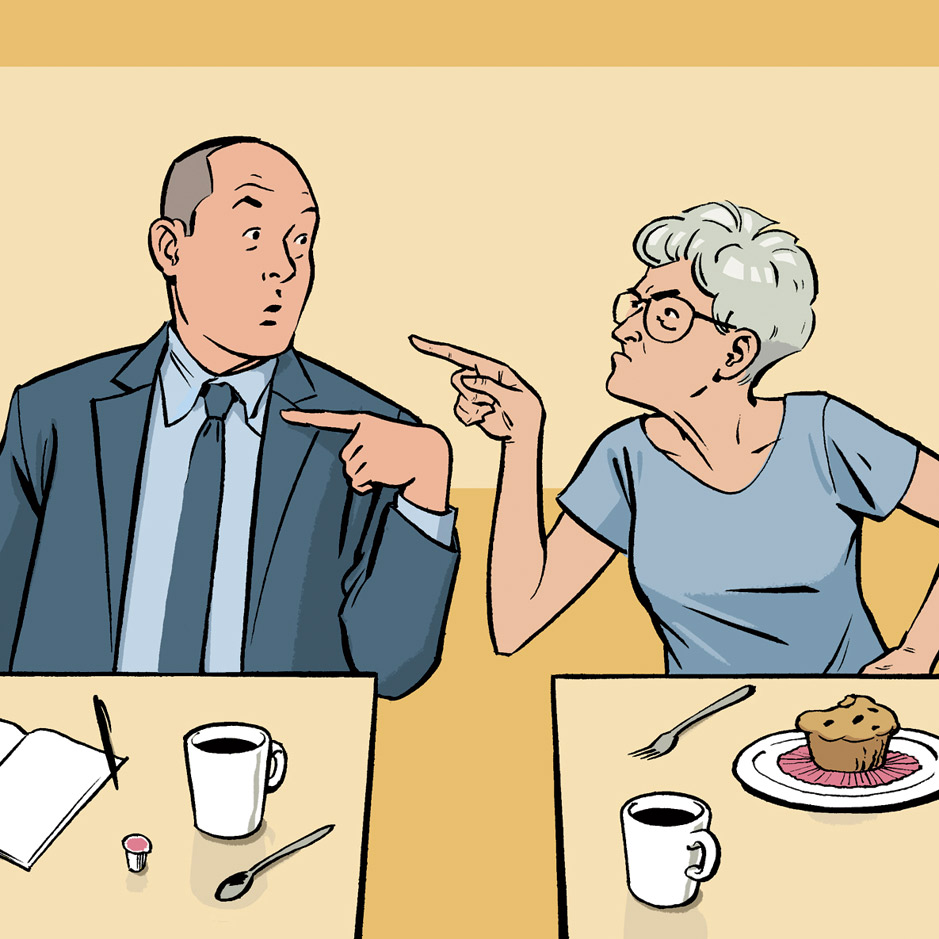
“What do you mean, she’ll never regret it?” piped in a sixty-something lady at the next table. “I took five years of Latin. Cripes.” Then she turned to me and said: “Whadda you do?”
“Me?”
“Yeah, you. Whadda you do that you think Latin’s such hot stuff?”
“Mmm. I’m an editor.” Strictly speaking, this is true. It’s my title at this magazine, an honorific. But it’s not the whole truth. I call myself an editor the way Henry Kissinger calls himself a “doctor.” You can call him that, too, but I wouldn’t go scheduling a colonoscopy from him.
Problem is, if you tell people you are a journalist, they will compose a quick friend-or-foe search query. It used to be possible to walk through a crowd of, say, Ron Paul supporters, tell them who you are, ask questions, build an article. Nowadays you introduce yourself and some runty guy holding an iPhone says: “So why’d’ja write that article ‘Matt Burke Is a Fat Jerk’?”
“Who’s Matt Burke?”
All eyes turn to the guy with whom you’ve been chatting amiably up till now, and whose face, indeed, looks familiar from a story you vaguely recall doing around 2003.
Unless the journalist can be anonymous in the field, he can’t practice his craft. The journalist’s first rule of conduct—his Hippocratic Oath, as Dr. Kissinger would put it—is that he not act on the story. Once an interview subject knows who you are, your article describes a performance, not a news event. You’ve contaminated the lab. You might reach a more valuable conclusion if you stayed home.
Perhaps journalists need “trail names,” like hikers on the Appalachian Trail, where pseudonyms can keep the needy strangers you walk a hundred miles with from turning into unwanted Best Friends Forever. If I could have said my name was “Tex” or “Stretch,” we could have had an interesting conversation. Now I was trapped in my editor’s personality and the lady was laying into me.
“So you had to take Latin to learn those two or three editing words! Like stet! Or caret! How wonderful for you!”
“It really is,” I said. I drank the last of my coffee and bid her ave atque vale.
