

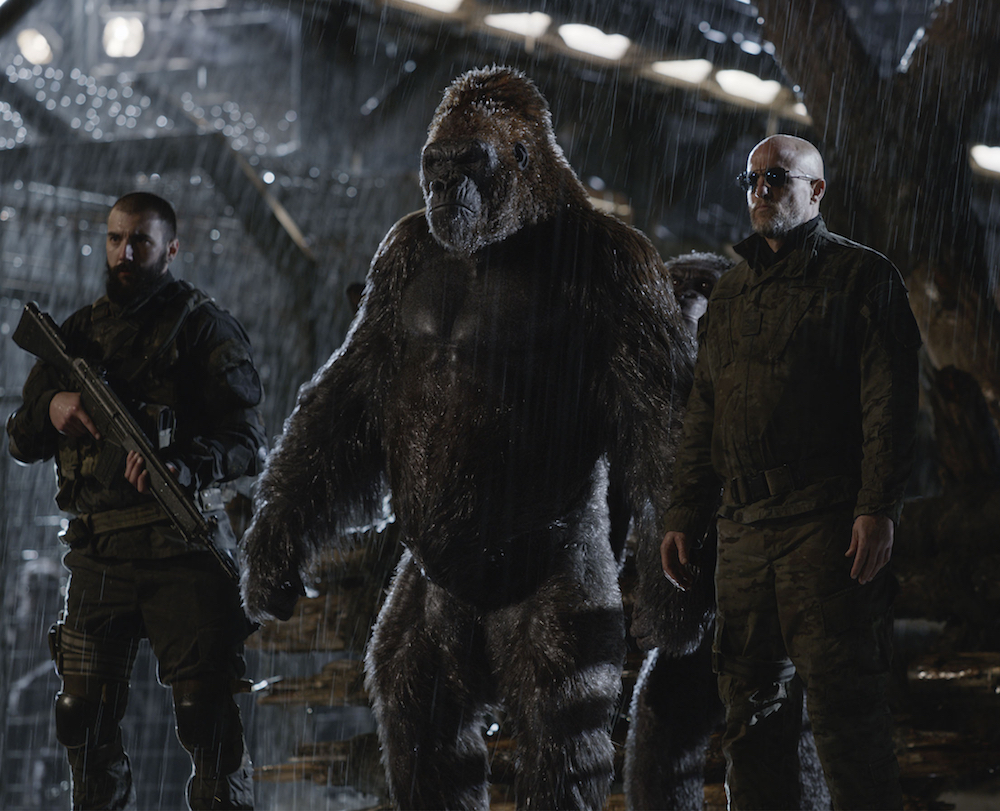
War for the Planet of the Apes hits theaters today and if it’s anything like its predecessors, Rise of the Planet of the Apes (2011) and Dawn of the Planet of the Apes (2014), it should be a hoot.
But as good as the modern Apes series, is, for overgrown boys of a certain age it will never quite compare with the five movies that constituted the original series. In the mid-’70s, this celluloid Pentateuch spurred a few million of my fellow pubescents to play endlessly with Mego’s Ape action figures, engage in hunched simian imitations on the playground, and lap up the all-day “Go Ape!” retrospectives at the local movie house.
Recommended Stories



How and why could such nonsense happen?
Don’t give too much credit to Pierre Boulle, who wrote the original French novel, La Planète des Singes. Published in 1963, the book was a provocative, but humorless, allegory of humanity and its foibles. The author, who also gave us The Bridge on the River Kwai, among other things, thought of it as one of his lesser works.
Instead, the success of the Apes series should probably go to producer Arthur P. Jacobs. As related in the documentary Behind the Planet of the Apes—released in 1998 to celebrate the 30th anniversary of the first film—Jacobs realized that Boulle’s book had a compelling combination of thought-provoking drama and high action.
Granted, the mix of these elements varied wildly across the five films. The original Planet of the Apes achieved an almost perfect balance, thanks largely to the savvy screenplay from the socially conscious Rod Serling and the formerly-blacklisted Michael Wilson. “Without ever saying it,” noted associate producer Mort Abrahams, “we were doing a political film.” But franchises always develop their own internal economic logic. By the time of the final entry, Battle for the Planet of the Apes (1973), was being filmed, Jacobs told director J. Lee Thompson, “We’re going to make a kid picture.”
But the the early films were overbrimming with subtexts. Planet of the Apes was released in 1968, the year of Columbia and the Sorbonne, of the killings of MLK and RFK, of the Prague Spring. It was the time of the finger on the button and Indochina. No wonder Charlton Heston’s starbound astronaut Col. George Taylor declares, “I leave the 20th century with no regrets.”
Three years later, in Escape From the Planet of the Apes (1971), the subtext actually broke into the text. Eric Braeden’s maniacal Dr. Hasslein exclaims, “Later we’ll do something about pollution. Later we’ll do something about the population explosion. Later we’ll do something about the nuclear war. We think we’ve got all the time in the world. How much time has the world got? Someone has to begin to care!”
The series cared deeply about the subject of nuclear war and the tension between a worship of science and the destruction that science can unleash. The original Apes begins as an astral dream, but ends as a post-apocalyptic nightmare: Mighty, star-stalking man reverted to his Neanderthal roots, laid low by the atomic age isotopes he had unleashed.
But as much as the series concerned itself with those profound questions, it also dealt with more pedestrian political concerns, like the emergence of the various movements which would become the New Left.
There was the youth movement: In the original, the teenage chimpanzee malcontent Lucius (Lou Wagner) wails, “You can’t trust the older generation!” There was feminism: In Escape, the proto-women’s libber Zira tells a ladies’ club, “A marriage bed is made for two. But every damn morning, it’s the woman who has to make it!”
Then there was race relations: Screenwriter Paul Dehn and director Thompson deliberately modeled the insurrection in Conquest of the Planet of the Apes (1972) on the Watts riots. It’s no coincidence that the most sympathetic human characters in the later movies—apart from the animal doctors Lewis Dixon (Bradford Dillman) and Stephanie Branton (Natalie Trundy) in Escape—were minorities. These were the compassionate Hispanic circus owner Armando (Ricardo Montalban) in Escape and Conquest, and the only nice apparatchik of Conquest’s monolithic city-state, the black MacDonald (Hari Rhodes).
And at the conclusion of Conquest, MacDonald implores Caesar, “I, a descendant of slaves, am asking you to show humanity!” Ultimately Caesar does, allowing Battle to wind up with a heart-warming scenario in which beasts of all stripes and humans of all colors live together in harmony.
But at their core, the Apes movies did not look kindly on American society. In the first film, the moody astronaut Landon (Robert Gunner) plants a bite-sized American flag on Earth’s blasted landscape, representing our shattered ideals. The flag is filmed from the wrong side and in case audiences still didn’t get the message, this small gesture is underscored by as cynical guffaw from mission commander Heston.
Whatever else you want to say about the ’60s and ’70s, they gave artists a lot of material to work with, so you can’t quite blame the new Apes movies for perhaps being more superficial than the originals. But there’s still enough going on in the modern Apes movies to let the audience get subtextual: bioengineering, contagion fears, the Great Recession, the rise of nationalism. You can find all of that—and more, probably—in the current series.
I remember a capsule review of Battle for the Planet of the Apes that read in part, “Pierre Boulle is still shaking his head in disbelief.” Perhaps. But I hope that in that great Forbidden Zone in the sky, the man who made it all possible is doing so in wry pleasure.
Thomas Vinciguerra is the author of Cast of Characters: Wolcott Gibbs, E.B. White, James Thurber, and the Golden Age of The New Yorker (W.W. Norton, 2015).
