

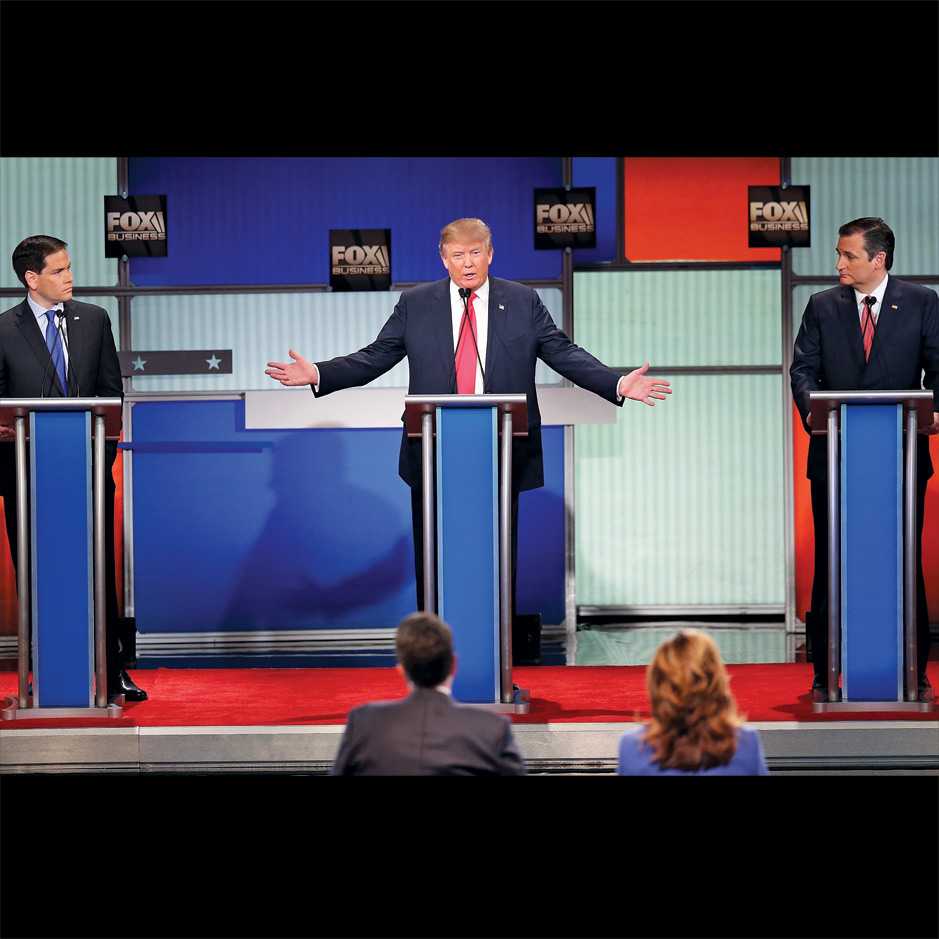
With very little warning, the Republican primaries began in earnest at the Charleston debate on January 14, closing out a year of fundraising and polite jockeying. What had once been a field of 17 declared candidates—with 8 or 10 of them being serious, substantive contenders—was, by the end of the night, whittled down to three men, each of whom has drawn a bead on the weaknesses of the others. The months of nice-guy, look-to-the-future optimism are over. It will be three-way siege warfare from here to Cleveland.
Of course, for the moment it looks like a two-way fight. Donald Trump commenced hostilities in the week leading up to the debate by questioning whether Calgary-born Ted Cruz is constitutionally eligible to be president. When challenged on these grounds during the debate, Cruz responded first by suggesting that Trump was being hypocritical and then by launching an attack on Trump for being the embodiment of “New York values.”
Recommended Stories



Trump answered Cruz with a quiet, restrained paean to New York, touting the city’s resilience in the aftermath of 9/11. It might have been his strongest moment in any of the debates so far. And in the days following, conservatives in the media largely took Trump’s side, castigating Cruz for what they saw as a crude attack that unfairly denigrated New Yorkers and risked alienating both the New York diaspora and city-dwelling voters generally.
But “New York values” is more clever than it seems. To this point in the race, a number of Republicans had taken shots at Trump, including Rick Perry, Carly Fiorina, John Kasich, and Jeb Bush. The substance of their critiques has been, more or less, that Donald Trump is not a “serious” candidate.
Whatever the merits of this charge, as a political matter it’s been a dead letter, because it is not so much an argument against Trump as it is an insult to Trump’s supporters. Those voters have real concerns—about the effects of uncontrolled immigration, about Islamic terror, about Chinese currency manipulation, about America’s place in the world—and to argue that the candidate they support is simply “not serious” is to declare that their concerns aren’t serious either. These voters have gotten enough of that highhandedness from Barack Obama over the last seven years. They don’t need Jeb Bush talking down to them, too.
But “New York values” smartly puts the critique entirely on Trump, the man, suggesting he is not what he seems and is not in step with the culture of his own supporters. What are “New York values”? They can be anything: the city-stopping gay pride parade; a culture of easy divorce and remarriage; Goldman Sachs; nanny-state soda bans; machine politics; public corruption; rigged real estate deals; vast income inequality; welfare fraud; hubris; the 7 train; the Yankees. The beauty of “New York values” is that the term is so elastic as to be almost meaningless. Voters can supply the meaning they want.
What “New York values” does is tell the disparate parts of the Trump coalition not that they’re fools for worrying about the state of America, but that Trump may be hustling them for their votes.
A telling sign that this might be an effective attack came when Trump opened up a broader front against Cruz. “Nobody likes him,” he said on This Week. “Nobody in Congress likes him. Nobody likes him anywhere once they get to know him. He’s a very—he’s got an edge that’s not good. You can’t make deals with people like that and it’s not a good thing. It’s not a good thing for the country. Very nasty guy.” Two days later, at a campaign stop in Iowa, Trump continued, attacking Cruz for having called Mitch McConnell a liar.
This was the first serious miscalculation Trump has made in the campaign. For starters, he has now burned bridges with conservative talk radio—both Rush Limbaugh and Mark Levin rallied to Cruz’s defense and came out, more or less, as anti-Trump, after months of coyly refusing to criticize him. For another, defending Mitch McConnell in order to criticize Ted Cruz risks undermining Trump’s own antiestablishment pitch. But the biggest problem was just how weak it made Trump look. The alpha male was complaining about someone else being too nasty for him, even admitting that he couldn’t do a deal with such a person. It’s enough to make you wonder: If Trump thinks he couldn’t do a deal with Ted Cruz, why should voters believe Trump can conduct successful foreign policy—do “deals,” in his parlance—with Vladimir Putin or Xi Jinping? The whole idea of Trump as chief executive is that his unique skill set means he can do deals with anyone.
Trump was worried enough that on January 19 he rolled out Sarah Palin to endorse him, in theory to shore up his antiestablishment credentials and give him cover for his New York values. A week earlier, the Palin endorsement would have looked like a show of muscle. Post “New York values” it looked like a defensive maneuver. And it marks the first time Trump has been on defense since he launched his campaign. In a stroke, Ted Cruz may have wounded Trump, elevated himself, and set the stage for a two-man race.
Except that there’s actually a third man. At the Charleston debate Marco Rubio marshaled two compelling, detailed prosecutions. The first was against Chris Christie, in which Rubio argued that the New Jersey governor had been on the wrong side of abortion, gun control, Common Core, and even the Supreme Court appointment of Sonia Sotomayor. In a rare misstep, Christie responded not by explaining his positions (the Common Core charge was not entirely fair) or his conversions, but by categorically denying that there was any truth to them, when to the contrary there was a great deal of truth to them.
For most politicians, lying about their weaknesses is par for the course, but for Christie—whose entire campaign is premised on his being a tough, no-nonsense, straight-talker—it’s death. The Charleston debate is likely to have been the high-water mark of Christie’s New Hampshire surge.
Rubio’s second calculated prosecution was against Cruz. Rubio didn’t have a ready-made phrase, like “New York values,” but he had an idea: that Ted Cruz is not a conservative so much as an opportunist. As lines of attack go, this is potentially much more devastating than questioning Cruz’s eligibility or complaining about his being nasty, because it goes to the heart of the Cruz campaign’s rationale and attempts to turn its strength into a weakness. If Rubio finishes ahead of the center-right pack in New Hampshire, the supporters of Kasich, Bush, and Christie will consolidate quickly behind him. And what’s more, the next phase of the campaign is built for Rubio, because he’s the only candidate who’s already had to face down his biggest weakness—his Gang of 8 immigration support—just to get here. Now that the gloves are off, we’ll see if Cruz and Trump can take a punch, too.
So that’s where we are with Iowa less than two weeks away. It’s like a scene in a Western where one guy has the loot, a second guy has his pistol on him, and a third guy has that guy covered with his shotgun. Who’ll be the last man standing?
Jonathan V. Last is a senior writer at The Weekly Standard.
