

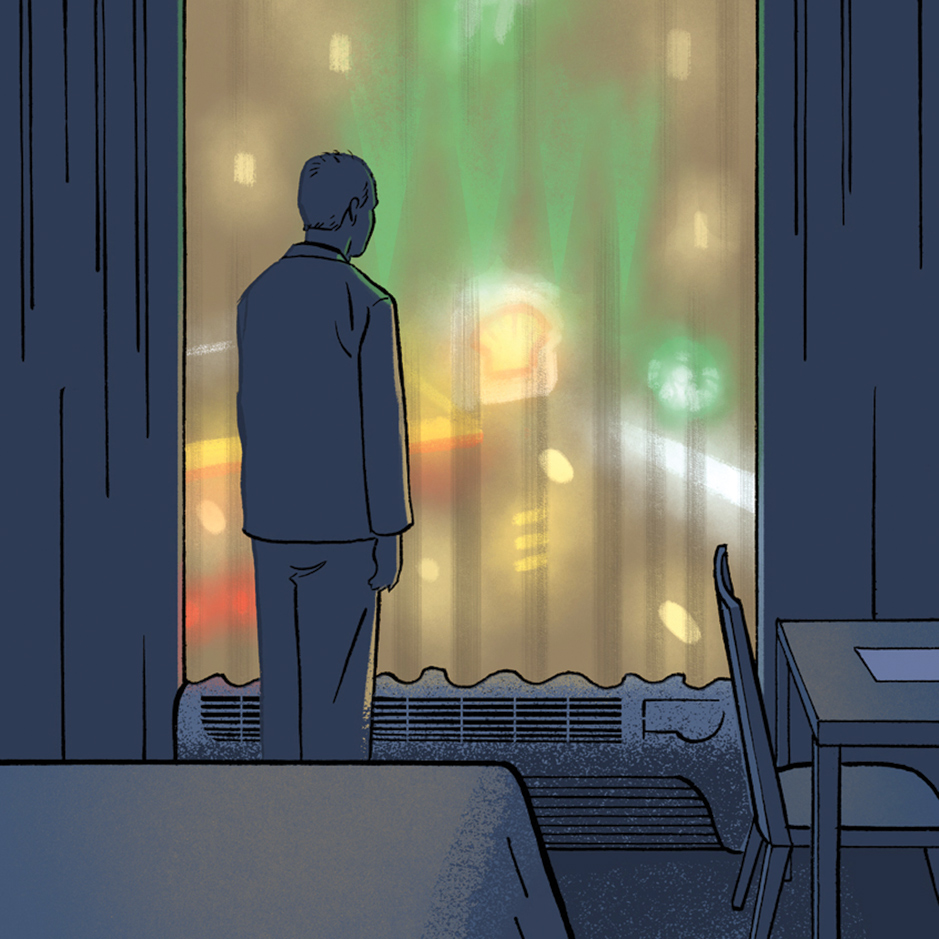
Last month, I had to stay a night in Oxford. Having not set foot there since my 20s, I was looking forward to it. If memory served, there were good B&Bs near the Thames and the Cherwell. There were rooms at the colleges where one could stay for cheap. Any place would serve, as long as it was close to bookstores and somewhere in the heart of “that sweet city with her dreaming spires,” as Matthew Arnold called it.
It wasn’t. “You should have planned earlier,” said the lady at the tourist information center. The city was booked. What they could offer me was a motel along the highway north of town. “You catch the 300 bus at the Tesco on Magdalen Street. Take it past the BP station to the parking lot on the A44. Then cross the parking lot—if it’s not flooded—and walk up the on-ramp to the A34. Tell the bus driver you’re looking for the Pear Tree Park & Ride.”
Recommended Stories



Was she joking? It wasn’t that she was proposing to put me up in the Oxford equivalent of a HoJo’s. It was her use of the word “ride.” When I lived in England as a young man, Americans kept an informal list of words, innocent-sounding to us, that confused, insulted, or grossed out English people. “Pants,” “shag,” “slash” . . . these were not words for idly tossing off! “Ride” was near the top of the list. Park & Ride was what young men sought to do on high school dates, the former being the means to the latter. It was not advisable, when staying at friends’ parents’ houses, to show up at breakfast and say, “I’m headin’ back to London! Anybody wanna ride?”
Nor was it considered an act of mercy for a driver to make the same offer to an old lady carrying her grocery bags home in a rainstorm. English people said “lift.” Riding was something you did on a horse. “Ride” was a noun in theory, but it went wholly unused in practice.
I can well remember the first time I heard the term used in the vulgar sense, back in the 1980s. I had been in the Shetland Islands and was taking an overnight ferry back to Aberdeen. Both places were centers of Scotland’s then-thriving oil industry. My sleeping cabin, a double, was empty when I boarded. But it turned out I had a bunkmate, a roustabout from Glasgow. He burst into the sleeper, drunk, 15 seconds after I had fallen asleep, in accordance with the First Law of Shared Conveyances. (The Second Law states that the last person to get into an up-elevator will always press the lowest floor.)
He asked me if I had been to the Shetlands. Since the place is on the edge of the Norwegian Sea, on the way to Svalbard and the North Pole, and since our ship had just left Lerwick, he could not have been shocked when I answered in the affirmative.
“Did you run across any guddles, lad?” He had the Scottish habit of addressing as “lad” anyone under the age of 80.
“Any what?”
“Guddles,” he said, with a hopeful look.
“Depends what you mean by guddles,” I said.
He explained that there were two types of people. There were boys. And there were guddles.
“No,” I said. “Why do you ask?”
“Because,” he replied, his hopeful look turning to outright glee, “they really lake to raid!”
I now had a sense of where he was going with this, but was determined not to follow him nohow. “Ride?” I said. “You mean equestrian, like?”
This just lit him up. He could barely contain his laughter. “Oh, aye, lad! I suppose you could call it that!” He took equestrian for some fancy intellectual obscenity.
I took the 300 up to the Pear Tree Park & Ride. The parking lot was flooded but wadable. I thought of writing a poem that would rhyme “puddles” with “guddles.” I got a room for 75 pounds. It was down the hall from the candy machine. It had a nice view of the highway and another motel, a Holiday Inn, across the parking lot. As night fell, trucks were passing at 80 miles an hour, making drawn-out sounds of “Yee-yong! Yee-yong!” And I looked out across these very Oxford outskirts that Matthew Arnold had walked with his friend Arthur Hugh Clough: These English fields, this upland dim, / These brambles pale with mist engarlanded. That Starbucks. That Trax tire dealership. That Shell station.
