

I had coffee at Peet’s with a childhood friend who is plotting a major change in his life. Victor will pull it off. He has done it before. He does not subscribe to the lazy American view that there is something special about having big “dreams.” Every loser has them. But Victor works. In him, romanticism and Sitzfleisch meet. He got a doctorate in physics from one university and a doctorate in chemistry from another, probably just to show he could do it. He taught both subjects at a third. Then he started a high-tech firm in Silicon Valley. Still, I was uneasy about what Victor might be planning. The resolutions of driven men in their prime often involve moving to Tahiti, giving their fortune to some communistic cause, or running off with a 19-year-old who “makes me feel young again.”
Victor’s new life plan is shocking in its simplicity. It has three steps. He is going to:
Recommended Stories



1. learn to smoke fish,
2. buy a boat,
3. fish.
Victor imparted this information in the tone you’d use to tell a friend you were embracing his religion, or an addict that you were checking in to detox. Victor expected me to find his new enthusiasm comradely, validating, and even flattering. It was odd. I am every bit the child of the Information Age that Victor is, albeit with less income to show for it. Yet for him, wandering from meeting to meeting in Palo Alto and Menlo Park, I had somehow come to represent the yellow-raingear-wearing New England fisherman of folklore.
It is true that, as kids, my friends and I fished every day we could. We cast for striped bass off the rocks at the beach. We fished for flounder (with drop lines on wooden frames shaped like tic-tac-toe grids) off other people’s moored boats in the harbor. My father and I even trolled for bluefish on our 13-foot Boston Whaler. I caught tons of fish—literally. My father could filet and skin a flounder in about a minute. We wound up eating these filets—dipped in egg-white, dragged through bread crumbs, and pan-fried—for every meal. It was a glorious thing on a summer evening, with corn on the cob. In fact, we caught enough fish to fill a highly unreliable second freezer we’d bought used. (Thawed flounder, eaten months later, meal after meal, on nights when the sun sets at 4:15 p.m., is a bit less glorious.)
My father’s ambition to exploit the ocean was imperial. He would wake us for the two or three dead-low “clamming tides” every summer, which came when the moon was full, seemingly always at 3:30 in the morning. Clamming required not only setting an alarm but also procuring a permit from town hall. Lobstering posed a bigger bureaucratic hurdle—a state license. These licenses were sold only to commercial fishing operations, not to pikers like us, and they cost hundreds of dollars. But there was a loophole: me. For $15 Massachusetts issued “student licenses,” on the theory that the only thing that stood between the small-town coastal proletariat and hopes of the Ivy League was the authorization to sell $800 worth of crustaceans every summer. So there I was—a licensed member of the Massachusetts fishing fleet when my voice had barely cracked.
Pulling lobster pots is easy (if slimy) work. It was made much easier by the light-alloy wire pots that had just come on the market. Unfortunately, my dad and I didn’t know this and armed ourselves for the first few years with a dozen of the ancient, wooden, always-waterlogged, hernia-inducing behemoths that you see in children’s books from the 1940s and nailed to the walls of failing seafood restaurants.
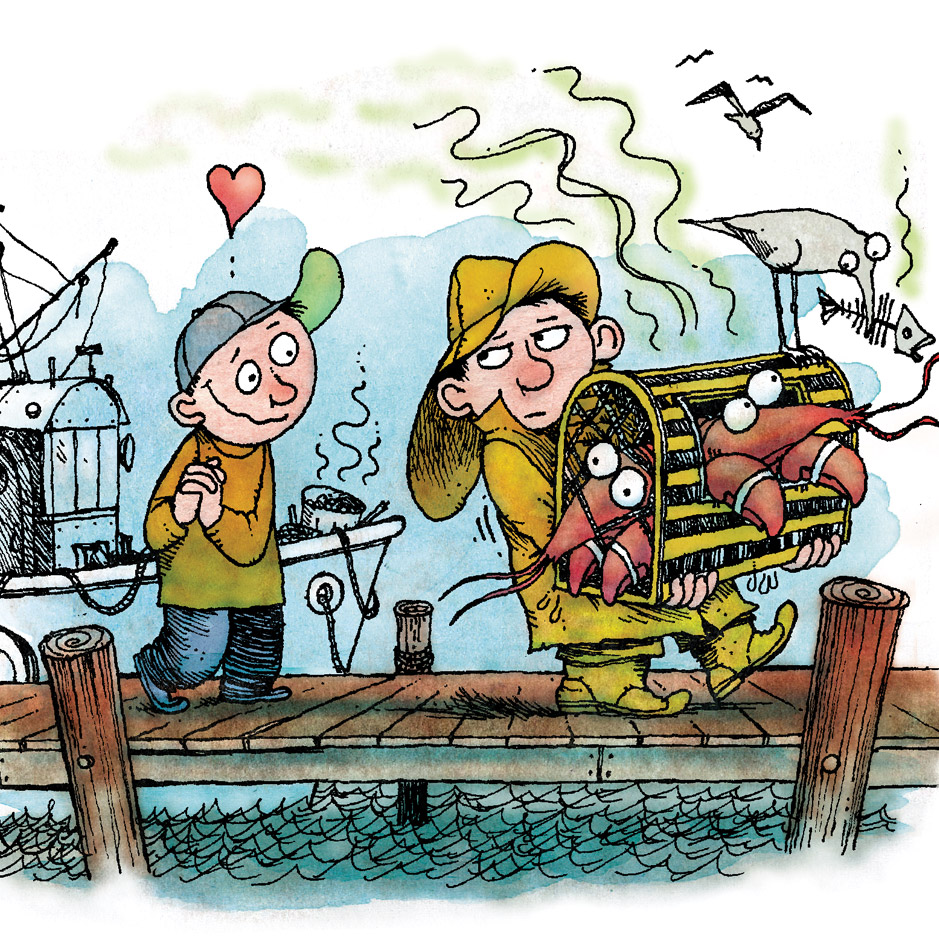
Modest though the operation was, it turned us into the local equivalent of gourmets. We might never have heard of pesto or hummus or Manchego, but we ate lobster every other day. One night we took Victor out on the boat. He had grown up in town but had never fished. We let him maneuver the boat, pull the traps, measure the lobster backs with the “gauge,” band the claws with the purpose-built backward pliers, store the surplus lobsters in the “car,” and row us back to the beach. We took half a dozen lobsters home in a canvas bag and ate them with melted butter.
Clearly this was one of the great nights of Victor’s life. He tells me about it every time we meet. It constitutes an alternative vision of happiness around which he is even building an entire midlife crisis. I really am flattered to think about that, just as he thought I should be.
“When you come to Massachusetts this summer, we’ll have a man’s day,” he said. “We’ll get a buncha roast beef sandwiches, take ’em out on the boat and catch some fish, and then we’ll go watch the Red Sox.”
It sounded great to me. I told him I’d call if I wasn’t in Tahiti.
