

The Walt Disney Company has released some of the world’s finest animated short films and movies for over a century, including Oswald the Lucky Rabbit shorts, Mickey Mouse‘s first appearance in Steamboat Willie, and popular films such as Fantasia, Snow White, and Pinocchio, as well as more recent releases, such as Frozen and Moana.
Not long ago, it was difficult for children to see their favorite Disney characters regularly. Televisions were not widely owned, and stations only reached small portions of the country. VCRs, Betamax, and streaming services were not yet dreamed of. Many families struggled financially during World War II and afterwards, making spare money for movie tickets just not plausible.
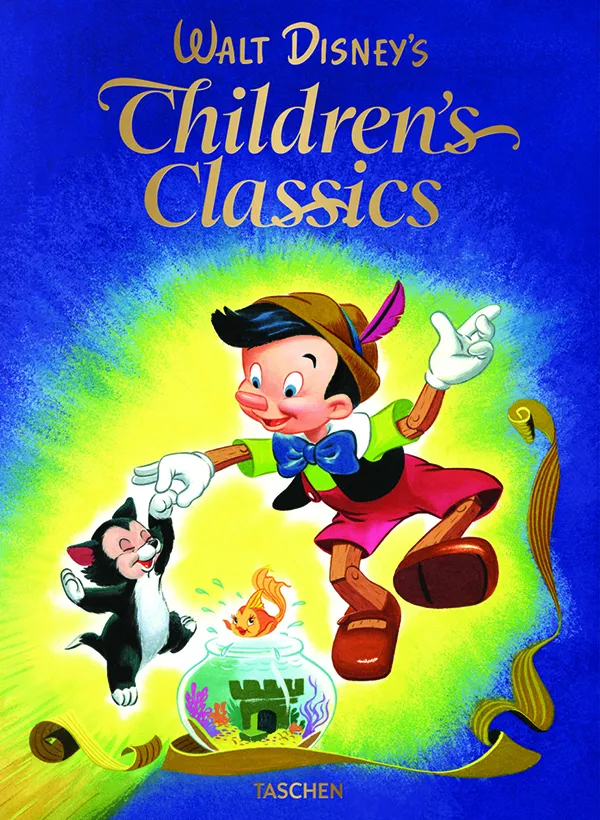
Fortunately, young children had another option to become acquainted with their Disney favorites. That was the world of books, which served as a golden ticket to help them journey into Walt Disney’s magical kingdom. Walt Disney’s Children’s Classics 1937-1953, published by Taschen, brings to life these beautiful stories that helped inspire a generation of children to dream big and use their imaginations.
To understand the true value of the Disney franchise in the printed word, we need to examine its coveted home in another popular franchise, Little Golden Books. Founded in 1942 by George Duplaix, president of the Artists and Writers Guild, these distinctive thin hardcover volumes with magnificent art and heartwarming stories have been a source of joy and inspiration for young and old alike. There are over 1,200 titles in its library, including The Poky Little Puppy, The Little Red Hen, Scuffy the Tugboat, The Tawny Scrawny Lion, and The Saggy Baggy Elephant.
Little Golden Books were cost-effective for WWII-era families. Each volume costs 25 cents apiece, as compared to $2-$3 for an average children’s book. A single movie ticket cost an average of 25 to 27 cents between 1940 and 1945. For parents counting their pennies, the choice was obvious. Spending a quarter for their children to have a few hours of enjoyment watching the silver screen would be nice, but spending the same amount on books they could constantly pick from their shelves and have years of pleasure was better for personal and educational development, and their wallets.
Walt Disney Studios also realized that Little Golden Books and its variations, such as Big Golden Books, provided the economic benefits they desperately needed. “After the Second World War,” Charles Solomon, the author of the volume, writes, “Walt Disney’s fortunes had somewhat faded … The Disney studio was deeply in debt, and the Golden Books provided much-needed cash during the difficult post-war years.” They earned book royalties of close to $275,000 in 1946, and “stayed in that range” for a decade. This steady cash flow, combined with the runaway success of the 1950 film Cinderella, helped Disney regain its public reputation and financial footing.
Shue and Solomon’s collection reproduces 10 classic stories from the profitable Disney Golden Books collection. Some titles are immediately recognizable (Bambi, Peter Pan), and others are less so (The Adventures of Mr Toad, Once Upon a Wintertime). All of them are well written and artistically brilliant.
“The authors and illustrators of the Disney Golden Books sometimes had to retell the story of an 80-minute feature in only 42, 28, or even 24 pages,” Solomon notes. The pictures also “had to be clear enough for a child to understand in the time it took to read the accompanying text.” Summing up an animated masterpiece in a few images with a limited number of words could be a daunting task. Certain scenes had to be eliminated, rewritten, or reimagined into something different. The skilled and talented teams working on these books were up to the challenge.
Here are some examples. Bambi (1941), which was released in Big Golden Book form a year before the movie came out, was lavishly illustrated by Mel Shaw. The story includes jovial elements, such as the young deer’s friendship with Thumper the rabbit and Flower the skunk, and was more pleasing and upbeat for young readers because Bambi’s mother doesn’t perish. Dick Kelsey, who illustrated Peter and the Wolf (1946), created stunning backgrounds and visuals that accompany Peter with his popgun, along with his “old friend” Sasha the bird, Sonia the duck, and the “sly cat” Ivan. The Adventures of Mr Toad (1949), an adaptation of Kenneth Grahame’s The Wind in the Willows, was magnificently illustrated by John Hench in such a manner that Toad, Ratty, Mole and MacBadger almost seem like Disney creations. Illustrator Al Dempster’s version of Pinocchio (1953), which includes Steffi Fletcher’s written adaptation, was beautifully drawn and allows the wooden puppet, along with Geppetto, Jiminy Cricket, and the Blue Fairy, to burst into life and a child’s imagination.
“For parents,” Solomon writes, these books “have been an important part of reading time.” The precious moments when mothers and fathers read to their young children, and those same children proudly reading these stories back to their parents when they get older, will last a lifetime. As for the children, who read these books “before the era of video cassettes, DVDs, Blu-Rays, and streaming services, they were a link to Disney animated films they had not yet seen or could no longer see.” The Little Golden Books and Big Golden Books they read during the day or at bedtime became a treasure trove of wonderful stories and lovable characters they could visit as often as their small hearts desired.
What will modern readers hopefully discover in this lavishly created Taschen collection of Disney stories? The important impact that Little Golden Books had on parents and their young children, for one thing, and how it could spur on today’s generation to read, discover and enjoy these memorable Disney tales once more.
Michael Taube, a columnist for the National Post, Troy Media, and Loonie Politics, was a speechwriter for former Canadian Prime Minister Stephen Harper.
