

When we watch a movie, our instinct is to root for the good guys when they kill the bad guys, even if they color outside the lines.
Take, for instance, the 2009 movie Inglourious Basterds, starring Brad Pitt leading a team of Nazi-hunters in occupied France during World War II.
It’s hard to work up much sympathy for the captured German soldiers whom the Americans murder in pursuit of vital intelligence that could save the lives of U.S. troops.
After all, they’re Nazis, albeit fictional, right? So they’re not just bad guys but really bad guys.
Though as one German officer is brutally beaten to death with a baseball bat and a second is shot in the back, it’s clear to anyone familiar with the law of armed conflict that what audiences may be cheering is, as Sen. Angus King (I-ME) recently put it, “a stone-cold war crime. It’s also murder.”
King was, of course, not talking about reel life, but real life — commenting on the Washington Post report quoting anonymous sources who claimed War Secretary Pete Hegseth’s “kill everyone” order to take out a suspected Venezuelan drug boat on Sept. 2. The action led to a senior military commander ordering a second missile strike to mop up two survivors who survived the first hit.
Outrage erupted because, if as first described, the survivors were clinging to their burning boat, killing them instead of rescuing them would be a clear war crime, according to the Pentagon’s own Law of War Manual, which cites this precise scenario as an example of an order military personnel are required to refuse to carry out.
“For example, orders to fire upon the shipwrecked would be clearly illegal,” the relevant passage states.
“I can’t imagine any American would want us to machine gun survivors in the water,” said retired Adm. James Stavridis, a former head of the U.S. Southern Command. “This is the functional equivalent of that. In World War II, the Nazis did that. We didn’t do that.”
The U.S. commander who ordered the so-called “double-tap” strike, Adm. Frank “Mitch” Bradley, head of the Joint Special Operations Command, did so under rules of engagement Hegseth approved before the strike, which was the opening salvo in a campaign of more than 20 strikes that have killed over 80 alleged “narco-terrorists.”
By the time Bradley was called to brief members of Congress behind closed doors, the Pentagon had offered a rationale for finishing off the last two crew members.
They may have been wounded, defenseless, in need of assistance, but they were arguably not out of the fight, or “hors de combat,” the term of art in the law of armed conflict.
“According to a source familiar with the incident, the two survivors climbed back onto the boat after the initial strike. They were believed to be potentially in communication with others, and salvaging some of the drugs,” reported Martha Raddatz on ABC’s World News Tonight. “Because of that, it was determined they were still in the fight and valid targets. A JAG officer was also giving legal advice,” Raddatz said in a video clip reposted on X by Hegseth.
“Admiral Bradley made the correct decision to ultimately sink the boat and eliminate the threat,” Hegseth said. “And it was the right call. We have his back.”
While members of Congress may still have questions about the second strike, Bradley — a decorated and highly respected four-star commander — is unlikely to face any adverse consequences given his explanation and solid support from both Hegseth and his commander in chief, President Donald Trump.
“It’s up to the admiral to carry out that mission,” Rep. Carlos Gimenez (R-FL) said on CNN before Bradley testified. “And I am not going to second-guess a highly decorated admiral in how he determined he was going to finish that mission.”
“I hear the gentleman who was in charge of that is extraordinary. He’s an extraordinary person,” Trump said, giving Bradley a vote of confidence after learning details of the mission. “I can say this, I want those boats taken out.”
Whatever the congressional committees looking into the Sept. 2 strike determine, Democrats and some Republicans (notably Kentucky Sen. Rand Paul) are questioning the legality of the overall mission, which is justified by a confidential memo sent to Congress declaring the U.S. to be in a “non-international armed conflict” with drug cartels designated as “terrorist organizations,” and authorizing “operations against them pursuant to the law of armed conflict.”
“I think by doing this, they’re pretending as if we are at war. They’re pretending as if they’ve gotten some imprimatur to do what they want. When you have war, the rules of engagement are lessened,” Paul said on CBS’s Face the Nation last month. “So, for example, we normally don’t shoot boats that we suspect of being drug dealers. In fact, if the Coast Guard tomorrow started shooting all vessels that are off of Miami or off of San Diego, about one in four of the vessels that they normally board don’t have drugs. So, it actually would be unlawful.”
Despite the lack of evidence that the boats are carrying deadly fentanyl bound for the U.S., Trump insists he’s carrying out his duty as commander in chief to protect Americans and argues that each boat sunk saves 25,000 lives.
On this, he and his war secretary are in total alignment.
Killing drug runners is exactly what the newly rebranded Department of War should be doing, Hegseth argues. “Biden coddled terrorists; we kill them,” he said unapologetically in a post on X.
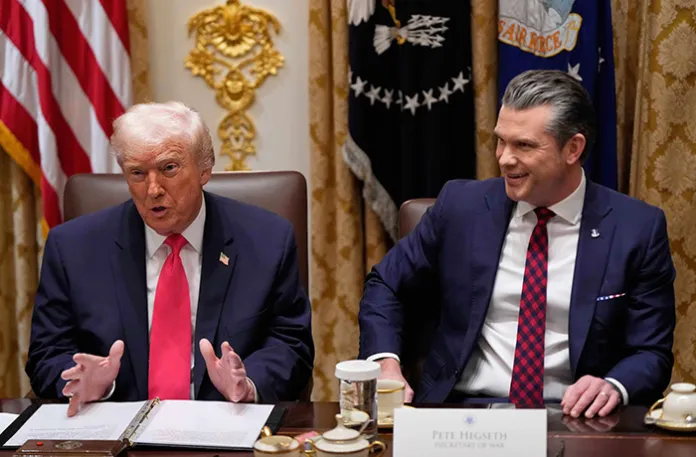
“We’ve only just begun striking narco-boats and putting narco-terrorists at the bottom of the ocean because they’ve been poisoning the American people,” he said at a Cabinet meeting, sitting next to Trump.
And there’s another belief that Hegseth and Trump hold in common, namely that all the handwringing over alleged war crimes is a load of woke nonsense.
In fact, it was Hegseth’s lobbying on behalf of service members accused of war crimes that put him on Trump’s radar during his first term and ultimately led to the president picking him to be defense secretary in his second.
In 2018, Trump credited the then-Fox News host in a tweet when he pardoned two soldiers and reversed the demotion of a Navy SEAL, all accused of murder, and who Hegseth argued at the time were prosecuted for making “tough calls on a moment’s notice.”
“They’re not war criminals, they’re warriors,” Hegseth said on Fox & Friends.
Trump overruled the military justice system, for what he saw as punishing troops for doing what they were supposed to — killing the enemy.
“I have to protect my warfighters,” Trump said at the time. “They had one young man in jail for six years. He had many years to go. And a lot of people think he shouldn’t have been there. And I gave him a pardon.”
Hegseth’s disdain for the law of armed conflict, and the military lawyers who advise commanders on its application, has been on full display since he took over the Pentagon.
One of his first acts was to fire the top judge advocates general, or JAGs, of each military service and declare an end to what he called “stupid rules of engagement.”
“We untie the hands of our warfighters to intimidate, demoralize, hunt, and kill the enemies of our country,” Hegseth told senior officers and enlisted leaders at his now-famous speech at the Quantico Marine Base. “No more politically correct and overbearing rules of engagement, just common sense, maximum lethality, and authority for warfighters.”
In his 2024 book, The War on Warriors, Hegseth devoted a whole chapter, titled “More Lethality, Less Lawyers,” trashing the Army’s JAG officers, who he noted were derisively referred to as “jagoffs” by soldiers like him who bristled at the restrictions on warfare.
“There are some good ones out there, but most spend more time prosecuting our troops than they do putting away bad guys,” Hegseth wrote, suggesting the military lawyers are more interested in furthering their careers than killing the enemy. “It’s easier to get promoted that way.”
In his book, Hegseth relates an anecdote in which, during his one combat tour in Iraq in 2005, his platoon was told by a JAG officer that they could not shoot a suspected enemy combatant armed with a rocket-propelled grenade unless he posed a direct threat by pointing the weapon at them.
As soon as the JAG officer left, Hegseth gathered his platoon together and countermanded the orders.
“I will not allow that nonsense to filter into your brains. Men, if you see an enemy who you believe is a threat, you engage and destroy the threat,” Hegseth told his soldiers, according to his account. “That’s a bulls*** rule that’s going to get people killed. And I will have your back — just like our commander.”
The idea that we treat even our worst enemies better than they would treat us does not come naturally, especially in the heat of battle. So, it is drilled into every recruit, and is something every officer is duty-bound to respect.
It’s why the Uniform Code of Military Justice outlaws war crimes and requires troops to disobey orders that are clearly and manifestly illegal.
It’s about what kind of nation America is, and the example it sets for others.
“We have to ensure that the military of the United States fulfills its legal obligations,” said Sen. Jack Reed (D-RI), a retired Army major and West Point graduate who is ranking member on the Senate Armed Services Committee. “And one of the fundamental reasons is because if we expect our personnel to be treated under laws of war, not to be abused or to be killed when they’re, as they say, ‘hors de combat,’ then we must insist that our troops follow the same laws.”
“Here’s why this is so important,” said Sen. Thom Tillis (R-NC) on CNN. “Our men and women get in situations where they may be blown out of the water, and we are putting our forces at risk if we’re setting or lowering the bar for actually honoring the rules of engagement.”
There is a video clip circulating on social media of a future defense secretary speaking at the Liberty Forum of Silicon Valley in April 2016, on the question of whether American soldiers are being imprisoned for just being soldiers.
The speaker, who at the time was a Fox News host, concedes that there are “some guys” in prison at Fort Leavenworth who made “really bad choices on the battlefield,” or may have been “a little bit overzealous.” The speaker also said, “There have to be consequences for abject war crimes. If you’re doing something that is just completely unlawful and ruthless, then there is a consequence for that.”
“That’s why the military said it won’t follow unlawful orders from their commander in chief. There’s a standard, there’s an ethos. There’s a belief that we are above so many things that our enemies or others would do,” he told the audience.
TOP BBC EXECUTIVES RESIGN AFTER LEAKED DOSSIER SHOWS OUTLET DECEPTIVELY EDITED TRUMP JAN. 6 SPEECH
That speaker, as you may have surmised, was Pete Hegseth, the same Pete Hegseth who labeled a half dozen Democrats in Congress the “Seditious Six” and called their video reminding troops of their duty under military law to refuse illegal orders, “despicable, reckless, and false.”
