

Sometimes the slightest crack in an otherwise solid foundation can trigger the wholesale collapse of an edifice. Such was the case with the trans-Atlantic slave trade, a practice that began in the 16th century but came to an abrupt end 300 years later. As Siddharth Kara demonstrates in The Zorg, his captivating and often stomach-churning account of a slave ship’s tragic misadventures on the high seas, a single event can give rise to titanic social change.
“The Zorg,” Kara argues, “showed the world for the first time that the Atlantic slave trade was a morally bankrupt system of greed and violence that unleashed incalculable misery on the people of Africa.” The exposure of the cruel depredations of the ship’s crew and the execrable suffering of its human cargo generated notoriety that was never attached to the practice of buying and selling people and transporting them across an ocean. Kara reckons that the Zorg “became the one slave ship to stand for them all.”
According to the author, the commerce in human bodies “generated tremendous wealth for the slave merchants who financed the forty-thousand-plus voyages that crossed the Atlantic, beginning in the early 1500s.” By the 17th century, an ascendant England dominated what became known as the “triangular trade,” or the shipment of goods, human and otherwise, between Europe, Africa, and the New World. “British slave ships,” Kara explains, “ventured to Africa, bartered tradable goods for slaves, carted them across the Atlantic, sold the survivors for proceeds that were used to purchase the sugar, rum, molasses, cotton, tobacco, and indigo produced through slave labor, and transported these goods back to England to sell for a profit, which made British slave merchants rich and financed their next triangle voyages.”
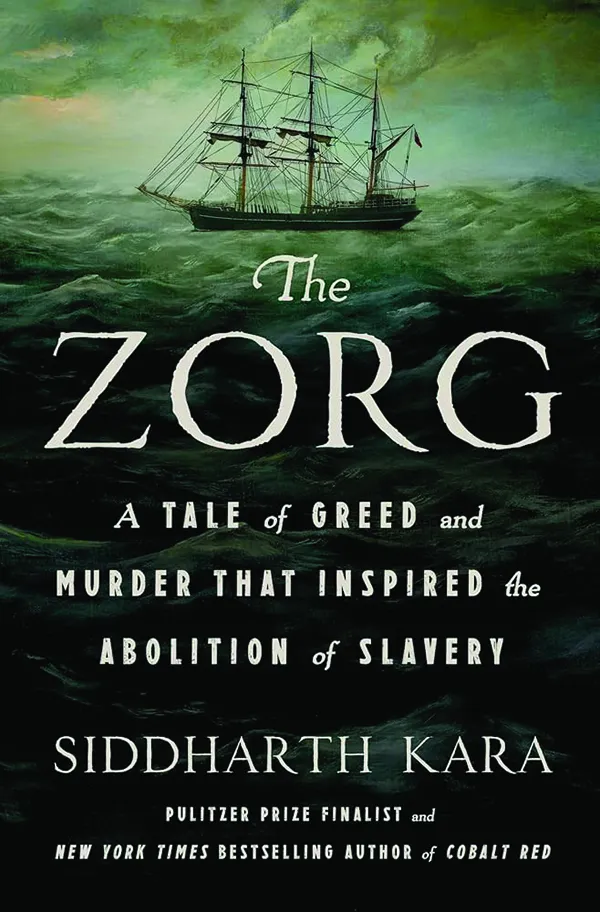
The Zorg unfolds with cinematic verve, beginning with the construction and outfitting of the ship, a 107-ton Dutch three-master with two unusual features: a barricado, or 10-foot-tall wooden fence crowned with spikes dividing the ship in half at the mainmast, and a 5-foot-tall “’tween deck” cut in half to accommodate a larger load — at the cost of preventing that human cargo from sitting upright. Kara’s narrative alternates between the perspectives of the ship and its crew, as well as two of its inmates, Kojo and Sia, who gave birth while on board.
The ship set sail from the Netherlands in October 1780 and was intercepted by the Royal Navy in February 1781 along the Windward Coast of Africa, a stretch of the Atlantic coastline from modern-day Liberia to Côte d’Ivoire. The navy escorted the Zorg southeastward, toward the Cape Coast, known today as the Ghanaian shoreline, where it awaited its load.
Meanwhile, Kara documents the grotesque migration of slave populations to the coast from inland Africa and the Arab-dominated Sahel region. These charges marched in “coffles,” or caravans, in a “wicker bandage round the neck,” restrained them, and their arms were “pinioned by a bandage” so that “they had sufficient room to feed, but not to loose themselves, or commit any violence.” Roughly a third of those setting out on these death marches did not survive; those who did arrived with little fanfare at a forbidding castle in Anomabu on the Cape Coast, in modern-day Ghana. (Kara does not shy away from noting that powerful African kingdoms like the Ashanti orchestrated the provision of slaves to the European powers, largely in exchange for advanced weaponry.)
And it was in Anomabu that they were collected by the Zorg, helmed by Luke Collingwood, a slaveship crew member and first-time skipper, and Robert Stubbs, the ousted governor of the Cape Coast outpost and a deeply depraved individual. “The lack of cohesion and competence in the Zorg’s crew would play a central role in the events that followed,” Kara contends.
As the ship began loading its human cargo — “passengers” is far too civilized a term to describe their treatment — the cruelty intensified. One captain described how female slaves arrived “naked, trembling, terrified, perhaps almost exhausted with cold, fatigue, and hunger.” They were whipped with the unspeakable cat-o’-nine-tails and issued meager provisions unsuitable for animals. For various reasons, the Zorg remained in port for more than half a year, with some of the slaves held immobile in their half-floor that entire time. One liberated slave described his ordeal belowdecks in unimaginable terms, noting that “the stench of the hold while we were on the coast was so intolerably loathsome, that it was dangerous to remain there for any time.”
The Zorg finally departed the Ghanaian coast on Aug. 18, 1781, badly overloaded with 442 slaves, and immediately headed east, not west, for São Tomé, a small island off the coast of modern-day Gabon, where naval vessels frequently outfitted themselves for the trans-Atlantic voyage. As the ship at long last sailed westward for Jamaica, Collingwood assessed the damage to his bounty, finding the ’tween deck had become “a slaughterhouse,” filled with “blood, filth, misery, and disease.” In a sign of cosmic justice, the untested captain apparently contracted one such disease and handed control of the ship to Stubbs, who had even less maritime experience.
The journey quickly went awry. The Zorg should have arrived at the Caribbean islands by late October, but an error in dead reckoning delayed its voyage by more than 20 days. When Stubbs finally sighted the French-controlled island of Tobago, he bypassed it, forgoing resupply of desperately-needed water and other supplies out of fear that hostile French forces would seize the ship. By this time, 62 of the slaves had died, along with six of the crew’s 17 members. His faulty navigation badly overshot Jamaica, believing it to be Hispaniola, and his mismanagement of the ship’s dwindling water supply augured even more death.
The only solution was the most macabre and inhuman of all: throwing 55 slaves overboard to save the remainder. Kara drily reasons that this brutal act of murder, which targeted women and children, including Sia and her newborn, “would have required a great deal of violence.” As the situation grew yet direr, the crew began hurling male slaves into the sea, even as Kojo, according to a surviving crew member, “begged that they might be suffered to live, and they would not ask for either meat or water but could live without either.” But Stubbs gave no quarter: another 40 slaves were cast overboard. When the Zorg finally reached Jamaica in late December, only half of the inmates had survived.
The stricken ship then completed the triangular voyage, returning to Liverpool, where its owners promptly filed an insurance claim to recoup the massive loss of its human cargo. The claim wound up in court and raised an unprecedented question: “Did maritime insurance in England cover the premeditated killing of Africans?” The ship’s owners said the slaves threw themselves into the sea, and the jury found in their favor. Mysteriously, both the Zorg’s logbook and the judge’s notes on the case vanished, but an anonymous letter circulated from an apparent witness at the trial, insisting there was evidence that the captain ordered the murder of the Africans. “What dreadful imprecations would he utter against such monsters,” the witness proclaimed, “and against the barbarous, unfeeling country that sent them out, or wished to profit by their trade.”
The insurance underwriters appealed in May 1783, led by the abolitionist attorney Granville Sharp, whose co-counsel invoked “the rights & essential interest of humanity” to argue poignantly that “the life of one man is like the life of another man, whatever the complexion is, whatever his colour!” Other members of the legal team revealed that Stubbs had coldly ordered the murders amid numerous rainstorms that had swollen the Zorg’s water stores and obviated the need to thin the ship’s ranks. The justices ordered a retrial, and the ship’s owners, embarrassed by the exposure, dropped their claim.
The slave trade limped on for several years afterward, but Sharp correctly observed that the Zorg episode “occasioned the disclosure of that horrible transaction which otherwise, perhaps might have been known only amongst the impious slave dealers of Liverpool, and have never been brought to light.” Along with fellow activist Thomas Clarkson and other like-minded advocates, Sharp formed the Society for Effecting the Abolition of the Slave Trade, which in 1788 enlisted the support of William Wilberforce, a prominent member of Parliament. A year later, the Commons limited slave trafficking and outlawed it outright three years after that, although only in 1807 did the practice actually come to an end. Not until 1833 did Britain abolish slavery outright, three decades before the United States finally followed suit.
None of this would have been possible absent the revelations in the anonymous letter, and, indeed, at the very end of the book, Kara definitively tracks down and identifies its author (no spoilers here). As he concludes, “the fire that was lit by his letter would not be extinguished, until an Empire’s slaves were free.” Amen.
Michael M. Rosen is an attorney and writer in Israel, a nonresident senior fellow at the American Enterprise Institute, and author of Like Silicon From Clay: What Ancient Jewish Wisdom Can Teach Us About AI.
