

When President Donald Trump went to Davos, Switzerland, Europe was wondering which Trump would show up.
Would it be the “FAFO*” Trump, who wasn’t bluffing when he told Venezuela’s Nicolas Maduro his days were numbered? (As in “F*** Around and Find Out).
Or would it be the “TACO” Trump, who caved after starting a tariff war with China’s Xi Jinping? (“Trump Always Chickens Out”).
The result was “chicken out” Trump, who talked big and carried a little drumstick.
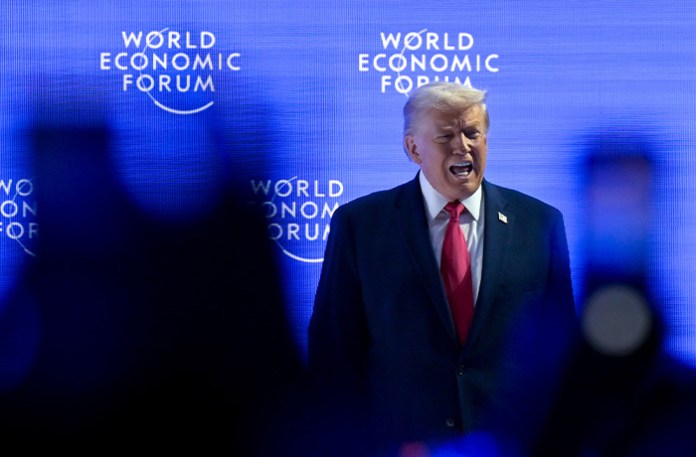
In his hourlong remarks, Trump quickly dropped the threat of military force. But he went through the motions of restating his other maximum demands.
“All we’re asking for is to get Greenland, including right, title, and ownership,” Trump said in his largely extemporaneous remarks. “They have a choice. You can say ‘yes’, and we will be very appreciative, or you can say ‘no’, and we will remember.”
What puzzled Trump’s critics all along is why the obsession with “owning” Greenland?
Why run roughshod over a loyal NATO ally and risk torpedoing the most successful military alliance in modern history, when Denmark was anxious to give the United States whatever basing rights it wants?
“When it comes to Greenland, the Americans haven’t made any demands of Denmark,” Ian Bremmer, president of the Eurasia Group, said in a post on X before the speech. “That’s because any demands the U.S would make, the Danes and the Greenlanders would be willing to accommodate … whether it’s intelligence and listening posts, surveillance, whether it’s you want to have a rocket base for SpaceX, that they’d be willing to provide that.”
And, in fact, when faced with the unyielding Danish refusal to give the U.S. full sovereignty over Greenland, Trump, in his trademark style, portrayed the failure as a roaring success.
“It’s the ultimate long-term deal,” Trump gushed after discussing a framework for negotiations.
“It gets us everything we needed,” he said.
But it’s far from a done deal.
Trump had demanded sovereignty over Greenland. What has been suggested as a face-saving gesture is that the U.S. could technically own the land on which it builds bases or military facilities.
In a statement, Danish Prime Minister Mette Frederiksen said Denmark welcomes discussion of security, investment, and economic issues, but flatly ruled out negotiating “on our sovereignty.”
For any other president, failure to achieve a core demand might be an embarrassment. But for Trump, who considers himself the consummate deal-maker, the bright lights and the fight itself are part of the attraction,” says Anthony Scaramucci, who was Trump’s communications director for 10 days in 2017.
“He wants your eyes and ears on him, and so that’s that, ” Scaramucci said in an interview in Davos.
Author Elizabeth Buchanan — who has written a cheeky history of failed efforts to acquire the self-governing island of 57,000 inhabitants titled So You Want to Own Greenland? — told Washington Post book reviewer Ron Charles she sees Trump’s fantasy of owning Greenland through the lens of his 1987 bestseller The Art of the Deal.
“Launch outrageous demands to re-anchor negotiations, create maximum uncertainty and exploit leverage,” Charles recounts.
And Buchanan accurately predicted the outcome, which she called the “boring” one: “Using arrangements already in place … Washington will increase its military and commercial presence on the island and attain ‘de facto control.’”
It’s straight out of the negotiating strategy Trump outlined nearly 40 years ago in his ghostwritten book: have a grand vision and aim high, use publicity and media to your advantage, never back down easily, understand and use your power, and importantly, always have alternatives.
Trump showed his weak hand the day before he left Washington for Davos.
“I mean, we have other alternatives,” Trump told reporters at the White House. “I think things are going to work out pretty well, actually.”
Questions remain. Did Trump really achieve anything that he couldn’t get by just asking nicely?
Why the threats and maximalist demands that would have been more suited to deterring an adversary than wooing an ally?
“What most of the European leaders I’ve been talking to think it’s about his ego,” said Bremmer. “That this is a legacy move for Trump, that he wants his name on it like he wants his name on the Kennedy Center on lots of buildings in the U.S.”
“Ego” is a word on the lips of a lot of Trump’s critics.
“The Danes have said … they will give us more bases. They will work with us on minerals, whatever we want,” Sen. Mark Warner (D-VA) told Fox anchor Bret Baier. “It feels now like American foreign policy, at least towards Greenland, is being driven by Donald Trump’s ego, not by our national interest.”
“Trump is doing this really as a vanity project to try and add to his record another piece on the Risk game board,” said Sen. Chris Coons (D-DE) on MS NOW. “But it is in fact threatening our relationships with NATO, our relationships with the EU — countries that have served and sought, in fact, sacrificed alongside us in Afghanistan and Iraq, countries that are a part of our prosperity and our economic future.”
Reporters who have covered Trump for years, sometimes decades, say he is feeling aggrieved and is “thinking big” about securing a legacy that can’t be erased after he’s gone, ergo the Trump ballroom, the Arc de Trump, and renaming the Kennedy Center and the Institute for Peace after himself.
Adding Greenland to the U.S. would have been the jewel in the crown.
“He is clearly in a phase where he believes he was harmed, and he believes that he should have some kind of compensation for that,” Maggie Haberman, a New York Times reporter, said in a recent podcast. “He felt like he didn’t get to enjoy his presidency the first time, because of the Russia investigation and impeachments and so forth and so on. Now, he feels like he is just going to do what he wants.”
Trump is clearly relishing his rise from the political ashes.
“What they did to me, nobody ever went through what I went through. And here I am in a place called the White House. It’s a beautiful place. Who would have thought, right?” he said on the anniversary of his first year back in office.”
“In this second term, he’s thinking a lot about legacy and building monuments to himself,” Jonathan Swan, another New York Times reporter, said on the same podcast. “So, that’s a big part of this. It’s putting his imprint, his physical imprint on Washington, D.C. You guys all screwed me last time. You stole the election. You tried to put me in jail. I’m back. Guess what? You have to reckon with me now. I’m just going to rub this in your faces.”
“In a way, I was the hunted, and now I’m more of the hunter,” Trump told NewsNation in an interview.
Trump insists he was simply thinking like a real estate developer with a preference to own, not to rent.
“Psychologically, who the hell wants to defend a license agreement or a lease, which is a large piece of ice in the middle of the ocean?” he said at Davos. “You can’t defend it on a lease.”
Trump cast doubt on whether NATO nations would come to the aid of the U.S. if it were attacked, “I’m not sure that they’d be there for us. If we gave them the call.”
But he seemed oblivious to the message he’s sending when he said Denmark and NATO can’t protect Greenland, a tacit admission that under Trump, the U.S might not fulfill its Article 5 treaty obligation to defend a NATO ally under attack.
In the end, it would seem Trump’s antagonism of NATO and insulting of Denmark and Norway was a manufactured crisis that was never going to end well.
But Trump also seemed to enjoy being at the center of the storm, and as ghostwriter Tony Schwartz said in Trump’s voice in his 1987 book, it’s not winning that excites him.
WHAT IS EUROPE’S ‘TRADE BAZOOKA’ BEING FLOATED AS AN ANSWER TO TRUMP’S GREENLAND THREATS?
“The real excitement is playing the game.”
Jamie McIntyre (@jamiejmcintyre) is the Washington Examiner’s senior writer on national security.
