

The Metropolitan Museum of Art took an emphatic tone in titling “Revolution!,” an exhibit commemorating a 250th anniversary that I probably need not spell out, and the result is emphatically good.
The quality and range of items on display are uniformly high, even if the show is not technically all that large. They are a testament to a large museum’s ability to mount a grand exhibit merely by combining its archives. (A nameplate thanks the 1924 donations of Charles Allen Munn, then-editor and publisher of Scientific American, for a plurality of works in the exhibit, many of which have rarely been exhibited.) A central accomplishment here is providing a sort of throughline, a yarn knitting together pieces in its permanent collection that revolve around Revolutionary themes.
The perfectly chosen gallery is directly in front of Emmanuel Leutze’s titanic Washington Crossing the Delaware, one of the most iconic if not especially accurate (the painting depicts the moment in daylight, though the crossing took place under cover of night) commemorations of the Revolutionary War at more than 21 feet by 12 feet. Just around corners, you will find John Trumbull’s paintings of Alexander Hamilton, George Washington, and William Lee (Washington’s “enslaved valet, groom, and military aide,” an unusual CV). There is also an ancient Roman-style bust of Washington by sculptor Giuseppe Ceracchi, who hailed from that city, and much more.
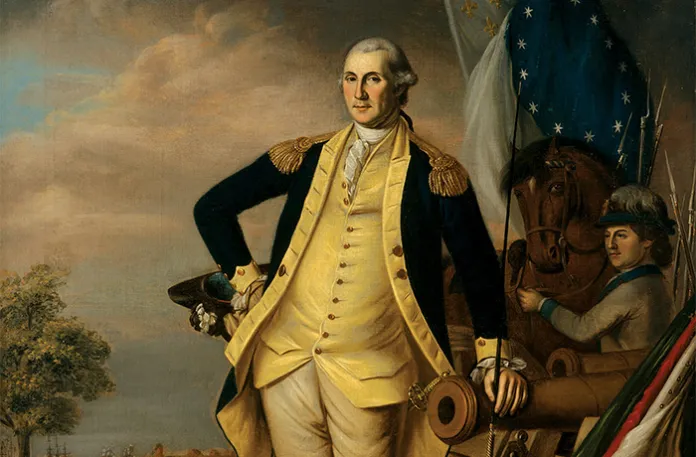
The strength of the Met’s collection in early American art is easy to forget amid everything else you will find in its corridors, a mirror of the ways it’s easy to forget about New York’s consequentiality to the American Revolution due to everything else that’s piled up in both locations since. The site of the Battle of Brooklyn, the largest battle of the war, is now a series of dense urban neighborhoods. There are no quaint colonial neighborhoods left, but there is all sorts of history hidden around. The Leutze painting fronts the last Met guide to its American Wing; beyond Trumbull, it contains excellent pieces by Gilbert Stuart, John Singleton Copley, and nearly every one of consequence in depicting those events at the time or subsequently.
The show provides an excellent artistic overview of these events. “Together,” it proclaims, “these artworks acknowledge multiple complex and intertwined histories-grounded in the aspirational human goals of (in Jefferson’s original words) ‘life, & liberty, & the pursuit of happiness’ — that continue to resonate in the United States and beyond, some two and a half centuries later.” These elements are and were complex. Pieces address the mixed or limited blessings of life and liberty to the enslaved and Native Americans. Yet the show is not characterized by 1619 Project-style self-loathing, but a proper sense of nuance. If the Met fully joined the self-lacerating “racial reckoning” rhetoric ubiquitous in museums around 2020, its curatorial tone tended to stop a bit short of the full-time activist tone others adopted, and this relative maturity remains appreciated.
A historical irony of conflicts is that there are not always artists around to commemorate them in proportion to their historical importance. Not every hinge moment of history has a Jacques-Louis David handy. War also often produces the reverse of celebratory art. Otto Dix and Max Beckmann’s combat service is a testament to that. And war art by relative amateurs is often of greater historical than artistic interest. You can see this in most history museums, which often end up with items that art museums won’t collect.
The Met’s exhibit does an excellent job stitching together a range of content of both historical and artistic consequence. It includes the first print of the Battle of Bunker Hill by Bernard Romans, a cartographer. It’s clearly not the work of an especially technically talented artist, yet it has a very real verve.
The 13 colonies were not exactly artistically mature in 1776. A particular quirk of fortune is that Stuart, John Singleton Copley, and Benjamin West were in London for nearly all of the war. Even John Trumbull went to London in 1780 to study art, after serving in the Continental Army, among other things, as an aide-de-camp to Washington. He was eventually arrested, but there were few other options for quality artistic education or work. None of these were active loyalists; most were keeping their heads down, but it is a fascinating peculiarity.
There is art here by non-artists you might have heard of otherwise. Paul Revere’s immortal agitprop print of the Boston massacre appears. Ben Franklin remains ever the greatest wit at the table, with a very funny etching titled Magna Brittania; Her Colonies Reduc’d, with limbs labeled New England, New York, Pennsylvania, and Virginia severed. And there are varied perspectives; amusing British prints by Philip Dawe portraying the rebels as a Hogarthian rabble, engaged in tarring and feathering and forcing the customs agent to drink tea.
These pieces take a global span, and often reflect an idea of events that artists could not possibly see. There are Franz Xavier Habermann engravings, such as one of the 1776 fire in Manhattan during the British siege, that present an imagined Manhattan that looks rather like a German town. Numerous pieces reflect the nature of the circulation of art at the time, namely, copies of other pieces. There is a superb later engraving by another German artist, Johann Gotthard Müller, modelled on Trumbull’s Battle of Bunker Hill.
While Copley painted Revere, John Hancock, and Samuel Adams before the war (his sympathies were with us, if he was balancing the difficult situation of his wife’s Loyalist family), most of the iconic depictions of the Revolution by our most notable artists were made after the war concluded.
The most accomplished works in the exhibit are largely of Franklin, who found an easy means to be lionized during the conflict by virtue of being in Paris. John Adams groused in a letter about Franklin possessing “a Passion for Reputation and Fame, as strong as you can imagine, and his Time and Thoughts are chiefly employed to obtain it, and to set Tongues and Pens male and female, to celebrating him. Painters, Statuaries, Sculptors, China Potters, and all are set to work for this End.” They did an excellent job. There’s a superb Franklin painting by Joseph Siffred Duplessis, a court painter to Louis XVI, known occasionally as the Van Dyck of France. It’s a rather more regal portrayal than the Duplessis that you will find on the $100 bill. The ornate frame is heavily classicizing but incorporates some down-to-earth details, such as a rattlesnake and a muskrat. There’s a great porcelain statue of Gabriel-Charles Sauvage of Franklin and Louis XVI. You will also find a very handsome snuffbox by Joseph Etienne Blerzy, presented by Louis to the envoy John Laurens. Naturally, it bears the king’s image.
HOW PUBLIC HOUSING PROJECTS MADE LIFE WORSE FOR THE URBAN POOR
There are other more demotic works, some of interesting origin. A “No Stamp Act” teapot, made in Staffordshire, or a patterned cloth, “The Apotheosis of Ben Franklin,” spun in Manchester. There’s a nameplate from Phyllis Wheatley’s Poems on Various Subjects, Religious and Moral, the first published volume of poetry by an African American. She praised the repeal of the Stamp Act while also pressing for emancipation, which she achieved personally before long, if others had to wait for some time.
The museum is holding a number of related events during the semiquincentennial year: Ken Burns is appearing to discuss his documentary on the Revolution, which uses several works from the exhibit. And there’s more down a few corridors or a stairway. A few galleries away is Trumbull’s monumental postwar The Sortie Made by the Garrison of Gibraltar, a commemoration of the largest battle of that same war, one of the few to occur in the European theater. Downstairs, the Alexandria Ballroom, an interior from a Philadelphia house visited by Washington and John Adams, contains an exhibit on Washington. There you will find one of Stuart’s Washington portraits, Trumbull’s George Washington Before the Battle of Trenton, and, naturally, a 1778 bust of Franklin by one of France’s foremost sculptors, Jean-Antoine Houdon. That fellow had all the luck. And it is ours to inherit, if we can keep it.
Anthony Paletta is a writer living in Brooklyn.
