

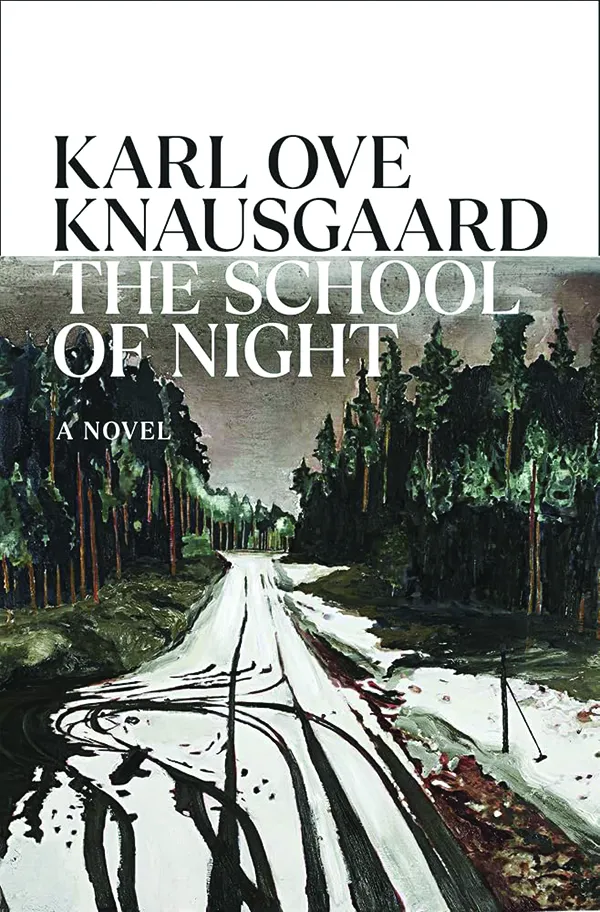
Toward the end of Karl Ove Knausgaard’s newly translated novel, The School of Night, the much-feted, but now uninspired, photographer Kristian Hadeland is told by his wife that he need not work so hard. Could he not, she says, spend more time with his son? “We’ve plenty of money, and you’ve already created a lifework.”
Knausgaard is now in a similar situation himself. He’s as rich as any novelist could reasonably hope to be. In fact, he might be considered famous, even outside literary circles. At a Prada-sponsored exhibition in central London that I visited last October — the kind of influencer-infested bash to which people don’t so much go to look at art as to be seen looking at art — they screened a film in which one bloke berates someone else for spending too much time cooped up in their room reading Knausgaard.
Since completing the shelf-straining My Struggle series, Knausgaard has written something like a book a year without really finding his form. Much of it has been fine, but more has been forgettable. The Night School is no exception; its 500 pedestrian pages are relieved only by Knausgaard’s flashes of observational honesty.
Kristain, who starts out as an insufferable photography student in mid-1980s London, is well placed to serve it up. He’s forever looking to let people know what he thinks of them. His girlfriends tell him that he’s incapable of loving anyone, to which he usually replies, “I’m only incapable of loving you.” “I thought you were a really nice guy,” one girl tells him when he’s back in Norway for Christmas. “But you’re not, you’re cold and callous.” You would not, in other words, want to spend the holidays in some provincial Norwegian cottage with him. His father takes much the same line. “He’s like a black hole,” he says. “Sucks all the energy out of the place. Gives nothing back.”
Kristian’s behaviour is not exactly commendable. When his sister tries to kill herself that same Christmas, he sets about photographing the family house on the grounds that it would be a shame to waste such a good subject. Only moments before she takes her overdose, he tells her, “You’re the failure out of us two, not me.” After that, he severs ties with his family, never to see or speak to them again.
Back in London, he’s in his habitual funk. He’s usually found slumped in Deptford pubs reading on his own, the very image of the self-pityingly misunderstood artist. “I’m alone here in the world, you see, and I can do exactly as I want. And now I want another pint.” His problem, as his father puts it, is that he has a “grandiose sense of self” but has thus far only produced mediocre photographs, as both his fellow students and complete strangers keep telling him. But then he meets the enigmatic Hans.
This is where The School of Night gathers pace. As with the preceding novels in the Morning Star cycle — this is the fourth installment, but it stands on its own and can be read as such — some kind of supernatural substrata runs through it. Hans introduces Kristian to his friends, including Vivian, who’s putting on a performance of Christopher Marlowe’s Doctor Faustus. You soon begin to suspect that Kristian, like Faustus, has sold his soul to the devil in return for earthly success.
But Hans is not exactly Mephistopheles, and Kristian is unaware that he’s struck such a bargain. And besides, his exes would point out that he does not have much of a soul to sell in the first place. That’s to say, the occult is more intimated than emphasised. Still, Kristian’s photography suddenly improves. He boils a cat he’s stolen from a nearby veterinary clinic, photographs the carcass, and pronounces it his first “masterpiece.” After that, his every photo is infused with some strange, unsettling energy.
But one evening, on his way to sleep with Vivian at her flat, he ends up in a scuffle with a tramp he’s lent some cigarettes to. He strikes the man, possibly killing him — either way, the body is found later that night. It happens in a side street, without witnesses, but Kristian’s caught near the scene by a surveillance camera; before long, the police handcuff him in front of his whole class. Things look bad for Kristian — handing out smokes to homeless people, he thinks, it would not have happened if I were not so nice — but he has Hans on his side, who somehow sees him through it, at least until he returns to redeem the bargain years later.
Knausgaard’s greatest strength is his unlacquered honesty. There’s no pretence in his writings, or so it feels. His narrators’ level unflattering observations upon each other, none of them terribly remarkable on their own, but with a cumulative effect. “If not exactly repulsive,” Kristian thinks of Vivian, “she wasn’t much to look at, had an ungainly way of walking and no idea about clothes.” Meeting his little cousin, he reflects that her “rather goofy appearance […] didn’t matter now, but in a few years it would.” When Vivian’s “gorgeous” friend Daniella tells him to be nice to Vivian, he’s sitting there regretting that he’s not going out with Daniella instead.
The My Struggle books were, strictly speaking, novels but were largely based on Knausgaard’s life — they followed the everyday humiliations of the main character, Karl Ove Knausgaard. As such, they had the frisson of confessed intimacy, which The School of Night very conspicuously lacks. Knausgaard is playing it safe. The three-page encyclopaedic entry on the Austrian occultist Paul Becker in The School of Night is nothing compared with the 400-page essay on Hitler in My Struggle. Instead of savaging his family members, in The School of Night, Knausgaard offers up a tame group of London students and New York gallerists.
As it is, Knausgaard’s prose simply limps on for 500 pages. Almost the only memorable flourish is of London’s rainy streets, with their “red rear lights like lanterns in an inky asphalt sea.” Descriptions resemble the flat language of police reports. Here’s Hans: “I’d noticed him the night before, a tall, skinny man with big hair the exact colour of which was hard to determine, a chiselled chin and narrow eyes, wearing a pair of faded jeans that looked like they’d once been black and at any rate were too short in the leg, a thin blue knitted jumper with a greenish pattern across the chest.” A tall, skinny man with narrow eyes — entirely forgettable.
Knausgaard’s no great stylist. The problem, though, is not that he tirelessly chronicles everyday boredom — there’s Kristian in the kitchen, making his coffee before taking out the trash — but that his prose is careless. Hans buys Kristian a round at the pub, who “downed a mouthful of the pint he’d put on the table in front of me.” Notice the redundancies: Knausgaard already said Hans bought Kristian a pint, so there’s no need to say that it’s on the table — where else would it be? — or that the table is in front of him. If Kristian picks up a cup, Knausgaard feels obliged to say that he “of course” later puts it down as well.
THE HUNT FOR THE KILLERS OF EINSTEIN’S FAMILY
Dross piles up every time Knausgaard’s characters move from one place to another: “Nevertheless, the following Friday I found myself placing a pile of selected photographs carefully in a cardboard box I then wrapped into a carrier bag — it was pouring down outside — before slipping it into my backpack, putting on my rainwear and carrying my bike down the stairs and into the street.” It reminds me of Martin Amis’s complaint that getting a character across town in a novel is more of a hassle than doing so oneself in real life.
Knausgaard has said that to get over writer’s block, he began writing whatever came to mind. I’m inclined to believe him. That carelessness works in some of Knausgaard’s confessional passages — it gives the illusion of honesty, like reading someone’s raw thoughts in their private notebook. But it’s failed him here.
Gustav Jönsson is a Swedish writer based in London.
