

In a recent interview with Fox News, President Donald Trump defended giving hundreds of thousands of Chinese nationals visas to study in the United States. He argued that the tuition fees from Beijing more than make up for the potential espionage risks. The president even claimed that his Republican base supported this open-door immigration policy.
“MAGA was my idea,” Trump said. “I know what MAGA wants better than anyone else.” But when it comes to China policy, Trump is perilously out of step with conservative voters.
New polling released by the Vandenberg Coalition revealed that, while Trump voters generally support his “peace through strength” approach to foreign policy, they have been disappointed by many of his moves toward China specifically. Shockingly, the polls found that “only 18 percent of Trump voters said they were most satisfied with his Indo-Pacific policy in 2025.” If Trump hopes to rally his base and save the Republican Party from a wipeout in the 2026 midterm elections, he should start by rethinking his relationship with America’s greatest adversary.
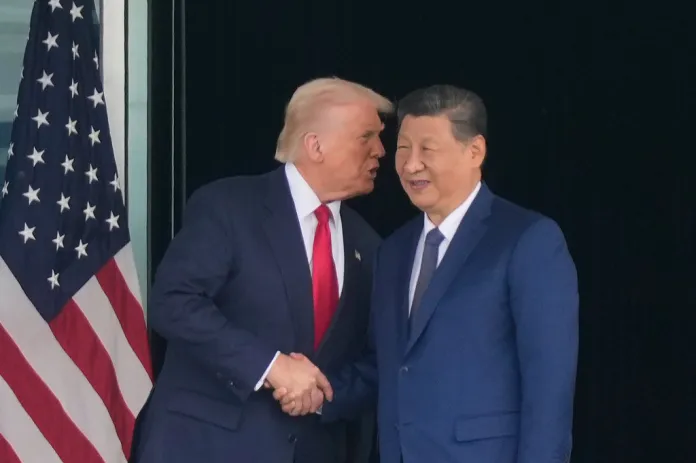
Trump voters clearly believe that the Chinese Communist Party presents the most clear and present danger to U.S. national security. According to the aforementioned poll, nearly three-quarters of the president’s supporters rated the CCP as an “extremely high” or “high” threat, outpacing both the Islamic Republic of Iran and Vladimir Putin’s Russia.
At the same time, though, 70% of respondents were not “completely satisfied” with the administration’s progress on responding to the CCP’s aggression. Evidently, certain policies are misaligned with voters’ priorities. Trump would be wise to correct his course.
One way voters said Trump could improve was regarding TikTok. In a rare act of bipartisanship, Congress passed a law, which Trump signed and the Supreme Court later upheld, to define the Chinese-owned social media platform as a “foreign adversary-controlled application” and mandate its divestment from CCP-controlled entities. But instead of enforcing the sensible measure, the Trump administration pursued a shady deal with China, the full details of which have not yet been released to the public.
Leaving aside the questionable constitutionality of the move, it is clear that unscrupulous dealings with the CCP could cost Trump dearly in terms of public trust.
According to the Vandenberg poll, 66% of Trump voters believe the public has a right to know the terms of the deal. A whopping 92% of respondents also said they have major concerns about TikTok, especially with the app’s collection of Americans’ data and how the CCP could use it. Forcing TikTok’s parent company to sell the app or banning it entirely would be far more popular than giving our most powerful rival a backdoor to American tech and culture.
Of course, the same is likely true for Chinese students in the U.S. While Americans are no doubt a friendly and welcoming people, the Vandenberg Coalition poll shows that we are also wary of Chinese espionage and influence operations, as well as intellectual property theft. There are better ways to support our higher education sector than to prop up failing institutions with the CCP’s blood money.
And if sending their students to American universities is so important to CCP officials, Trump should use that pressure point to secure bigger concessions from the regime on everything from trade to human rights. For a man with a reputation for driving hard bargains, Trump seems strangely conciliatory when it comes to China.
As important as TikTok and student visas are, what Trump voters worry about the most is Chinese President Xi Jinping threatening to invade Taiwan. Three-quarters of Vandenberg Coalition poll respondents said they “believe it is in America’s vital national security interest to prevent China from invading Taiwan,” while just 10% believe we should not respond at all to a potential invasion. Trump’s voters clearly understand that U.S. leadership is the key to a safer world. Simply giving in to the CCP’s demands would be a betrayal of their instincts.
Sadly, it seems some within the Trump administration are less convinced about the merits of defending Taiwan. In September, for instance, isolationist figures persuaded the president to halt a $400 million arms deal with the island nation. And last summer, Elbridge Colby, Trump’s Undersecretary of Defense for Policy, strained relations with the United Kingdom when he told the British to send an aircraft carrier stationed in the Pacific back home. These are not the kinds of actions an administration should take if it is dedicated to denying and deterring a Chinese invasion of Taiwan, or if it wants to convince voters it is pursuing “peace through strength.”
It is disappointing to see Trump adopt such weak policies, because it was during his first term that competing with China became America’s top strategic priority. From taking bold action to subvert China’s covert activities within the U.S. to building up our security architecture in the Pacific, the first Trump administration pushed for a whole-of-government approach to countering the CCP.
Trump’s successor, former President Joe Biden, failed to maintain the momentum. The Democrats’ China policy was defined more by bumbling incompetence and cowardly self-deterrence. Instead of putting the U.S. on a competitive footing, Biden and his team sought to appease China to avoid conflict.
During this period of weakness, China became more and more aggressive. From a series of attacks on Philippine vessels to threats against Japanese territory, Xi moved to shore up his geopolitical position in the South and East China Seas to prepare for an invasion of Taiwan. Even in recent weeks, CCP officials have made it very clear that their ultimate goal is revolution in Taiwan and beyond. And as Xi seeks to achieve regional hegemony in the Pacific, he has provided industrial, military, and diplomatic aid to America’s enemies, such as Russia and Iran.
Now, Trump is at risk of repeating Biden’s mistakes of appeasement. Zack Cooper, a senior fellow at the conservative American Enterprise Institute, recently warned that both potential and actual capitulations on trade, security, and other issues would be putting “China First.”
“We should hope for a genuine Sino-American stabilization,” Cooper wrote in a provocative Time magazine essay. “But the Trump Administration is falling into a classic trap of interpreting nice-sounding phrases and strategically meaningless Chinese promises as fundamental improvements in the bilateral relationship.”
Another part of what makes Trump’s pivoting on China so shocking is that it differs greatly from his approach to other national security threats. The Vandenberg Coalition poll has shown that, for months, voters have overwhelmingly supported the president when he stands up to America’s enemies and empowers its allies.
Eighty-six percent of his base said they agree with his strategy to contain Iran and restore peace in the Holy Land, and most appreciate the bolder steps he is taking to help Ukraine end the Russian invasion. Demonstrating strength and resolve in those regions energized his base. There should be no doubt that Trump could accomplish something similar by walking away from China’s bad deals and shoring up American power in the Pacific.
WHAT PEACE THROUGH STRENGTH REALLY MEANS
It is well past time for Trump to stop listening to the well-coifed establishment figures in his administration seeking to restrain him. As the president himself noted at a press conference last year, his position comes with truly global responsibilities. Despite the squawking of D.C. isolationists, the American people understand that putting America first means embracing leadership. As the Vandenberg Coalition’s poll found, 90% of Trump’s supporters, including 89% of those aged 18-29, said that it is vitally important that the U.S. remain the strongest country on earth.
While a crisis is certainly brewing in the Far East, it is not too late to reestablish deterrence through American leadership. And if one thing is clear, it is that the people elected Trump because they wanted him to be bolder than his Democratic predecessors on national security. They are tired of the D.C. elite’s decades of retreat and appeasement. They want their president to demonstrate real strength. The question is, will he listen to them?
Michael Lucchese is the founder of Pipe Creek Consulting, an associate editor of Law & Liberty, and a contributing editor to Providence.
