

“This family is just as terrible as everyone in this town believes it to be,” narrator Merit Voss seethes at the climax of Colleen Hoover’s 2017 novel Without Merit. “I’m sick of it. I’m sick of the secrets and I’m sick of the lies.” So Merit does the only sensible thing for a sad 17-year-old girl to do. “I reach to the nightstand and grab a pen,” with which she pours out a loathing, self-pitying torrent of a letter exposing every transgression and hypocrisy she’s collected from her kin. Her father is cheating on her stepmother with… her cancer-ridden mother, who lives as a recluse in their basement. Her step-uncle came on to her, her brother tried to kiss her, and they’re having an affair as well. And her sister Honor has a fetish for terminally ill men. It is not enough to have written the letter, which takes up six pages of the novel. She copies and distributes it before downing her mother’s pain pills with beer. Yet she lives, because there was one last, very unhelpful secret: her mother was taking placebos.
In the long and gnarled history of teenage suicide in media, this ludicrously elaborate scene sits somewhere between the dark lampooning of Heathers (1988) and the purple sensationalism of 13 Reasons Why. Yet this is just another day in Hoover’s world. It is so frequent across her novels that her small but algorithmically savvy cult of haters has made bingo cards of her habitual tropes that include incest, cancer, emotional abuse, love at first sight (“insta love” in their words), and comically on-the-nose character names. In their minds, Hoover is literature’s answer to Tommy Wiseau, the mysterious director of the so-bad-it’s-good 2003 cult classic film The Room. Like Wiseau, she weaves ripe melodrama out of an awkward narrative voice that tells more than it shows. She is a plot maximalist and a character minimalist. On top of that, she is painfully, unabashedly sincere. It results in behavior that veers between unintentional comedy and downright surrealism.
I’ve only seen this comparison made once, in a legally disclosed email from Blake Lively to Ben Affleck about her tumultuous 2024 adaptation of It Ends with Us. Even so, the comparison falls on a major difference. Unlike the anomalous Wiseau, Hoover is a bestselling author backed by a major publisher. She produces new novels at an almost industrial pace. For haters, each new one is worse than the last. But even among readers who don’t outright hate her work, it is difficult to single out a representative title. So I went into Hoover Country without a map, trying to sift through the dense forestry of commentary for something I could recognize. Ultimately, I found an early work that seems to baffle her most ardent critics and bore her fans senseless. That is how I came to Without Merit: A Novel.
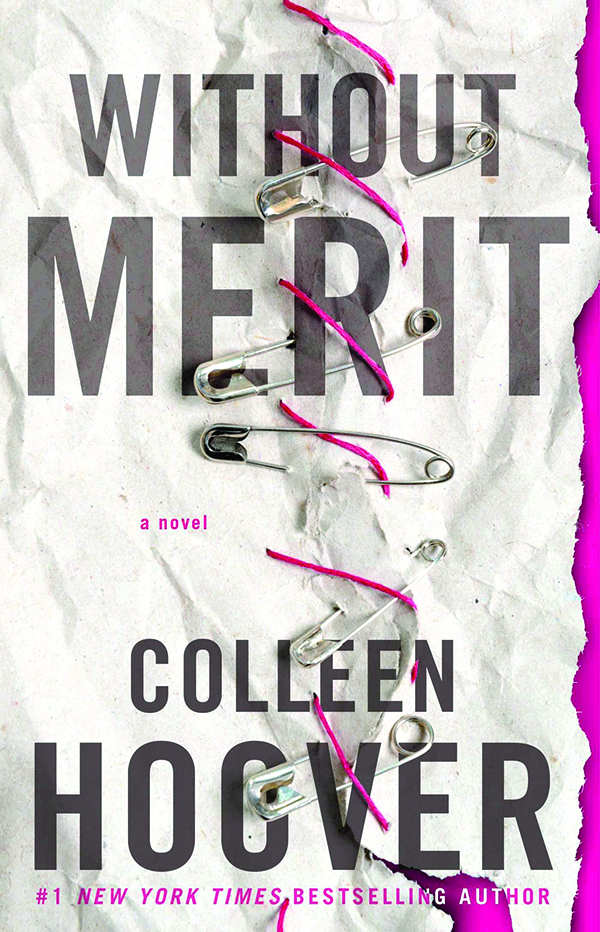
Merit Voss is the black sheep of a family that is itself in semi-exile, living in an old church on the edge of a small Texas town. She copes by skipping school and stealing trophies from thrift stores and yard sales. During one such pursuit in the first chapter, Merit catches the eye of Sagan, who approaches her with unusual warmth and even familiarity. Per the bingo card, attraction is immediate and mutual, and they kiss. But lo! A fateful phone call reveals that he’s mistaken her for his actual girlfriend, her much better-liked identical twin sister Honor. Merit is so riddled with guilt over this that she is already drinking NyQuil to process.
Hoover is a master of this brand of convoluted storytelling. Yet critics of Without Merit often think it’s too simple: it’s set in the same place and with the same unpleasant characters. Which is to say it is like most literary works. Hoover is unoriginal even at her worst. She does not beat Cornell Woolrich in illogical plots, Jacobean drama in shock tactics, Tennessee Williams in melodrama, the Brontës in antiheroes, or William Faulkner in gothic familial decay. In fact, almost every aspect of Without Merit can be found in Ivy Compton-Burnett’s 1935 novel A House and Its Head, just substitute the Edwardian English setting for flyover states and the corrosive, epigrammatic, dialog-heavy narrative for colloquial, irony-free prose.
That style, somewhere on the spectrum between Facebook overshare and email you instantly regret sending, may be at the heart of Hoover’s appeal. The improbable dramas of her characters’ lives are at once heightened and cushioned by the simplicity of everyday speech. It is brutally honest yet unburdened of any need for introspection. Things happen, they respond. It is both universal, at least to its Dateline belt target market, and subjective. It is matter-of-fact and vulnerable. Hoover is not a chaste writer, but she resists the stereotypical temptations of either romance’s vulgar grandiosity or the naive eloquence of such young adult classics as Stephen Chbosky’s 1999 novel The Perks of Being a Wallflower. What was seen as choked, crude, and awkward in Hoover was similarly seen in Theodore Dreiser and Sherwood Anderson.
But just as before, similar does not mean equal. Hoover writes a very televisual literature: driven by events rather than character. It lacks the observational capacity by which the novel continues to justify its existence in an age of declining literacy. A character named Merit compulsively stealing trophies is as heavy-handed as a florist named Lily Bloom (as in It Ends with Us). Yet this detail is also unexplored. Hoover either thinks her reader will catch the inference and move along, or she thinks they’re kind of thick. A character’s conflict between who she thinks she is and who she wants to be is perfect young adult fiction grist, yet the matter is instantly dropped because a boy is giving Merit attention. And it reappears more as a quirk, or a neurosis, than a trait or a metaphor.
Colleen Hoover would appear to be literature’s endpoint. Beyond her lie only pale imitators. And beyond them, artificially generated runoff. This seems to be the motivation behind her haters, who spend up to three hours retelling Hoover’s novels, chapter by chapter, as if they were spilling tea. One of them is so thorough that she washes off and reapplies her makeup while doing so. But this is less to criticize writing than to replace it with a revitalized oral tradition, albeit one rooted in Mystery Science Theater 3000-style snark that still has to say “unalive” in place of “kill.”
But it would be a mistake to assume that literature can no longer fight back when threatened or get even when wronged. It can still adapt, exploit weaknesses, and rise, because expectations are as low as they are. Sure, someone can come along and write better romance or young adult fiction. But someone can just as easily fill their voids to a more acerbic end, continuing a long-overlooked female-driven satirical tradition of which Compton-Burnett’s domestic psychodramas are only a part. They can imbibe of Jane Collier’s incisive how-to of social tormenting, or Maria Edgeworth’s 1800 takedown of her own Anglo-Irish class in Castle Rackrent. Jane Austen’s elaborate irony, these are not. Such authors, if they exist, will not be content with ruffling everyday manners or romantic foibles, but will expose literary merit as stolen valor.
Chris R. Morgan writes from New Jersey. His X handle is @CR_Morgan.
