

President Donald Trump has pummeled Federal Reserve Chairman Jerome Powell for years over interest rate policy. But in just mere months, Powell’s term will be up. Former Fed Governor Kevin Warsh has been nominated by Trump to succeed Powell as the central bank’s top official. Here is what to expect.
Powell, 73, is set to depart as Fed chairman in May, though he has the option to remain on the Federal Reserve Board of Governors until Jan. 31, 2028. Such a move would no doubt anger Trump, who chose Powell as Fed chairman during his first White House term.
Trump announced last month that he had chosen Warsh, 55, to be the next Fed chairman over National Economic Council Director Kevin Hassett. The pick came as a surprise to some, given that Hassett was seen as the front-runner for the job for some time.
The backdrop
Trump has been hounding Powell and the Fed to cut interest rates more aggressively since he entered his second term. Trump’s push for lower interest rates was undoubtedly a top agenda item in interviews that the president conducted for the role.
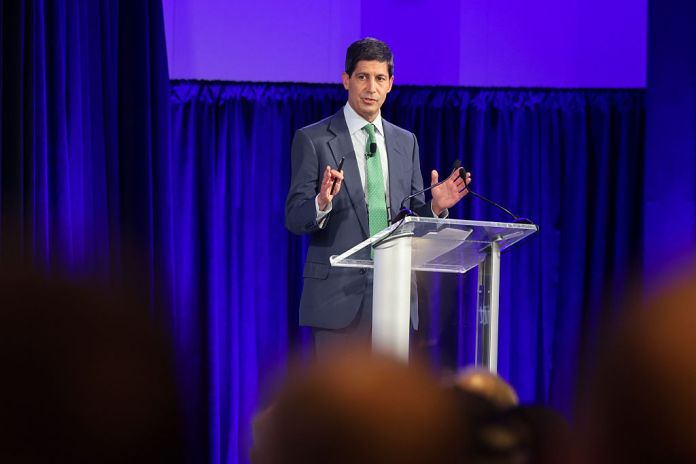
But the pick also comes at a time when Fed independence is being closely scrutinized.
POWELL DEFENDS FED INDEPENDENCE IN FIRST QUESTIONS ABOUT DOJ INQUIRY
In January, Powell announced that the Justice Department was investigating him, and that the central bank recently received grand jury subpoenas related to testimony he gave to the Senate last year about renovation cost overruns at the Fed headquarters building in Washington.
Powell tied the blame squarely to Trump’s crusade for lower rates and said the inquiry was simply a pretext to pressure him on monetary policy. The extraordinary accusation sparked some concern even from some congressional Republicans.
Retiring Sen. Thom Tillis (R-NC), a member of the Senate Banking, Housing, and Urban Affairs Committee, threatened to block any of Trump’s Fed nominees until the legal matter concludes. Tillis reiterated that the threat still holds after Warsh’s nomination, but called Warsh a “qualified nominee with a deep understanding of monetary policy.”
Who is Warsh?
Warsh has experience at the Fed, but is a bit of an outsider in the sense that he hasn’t been a public policymaker for over a decade. Still, the Stanford and Harvard Law School graduate was a member of the Federal Reserve Board of Governors during the Great Recession and has long been a prominent figure in finance and economics.
President George W. Bush nominated Warsh, a one-time Morgan Stanley banker, to the Fed board in 2006. Warsh held that role under both Bush and President Barack Obama. After leaving the central bank, Warsh worked as a distinguished visiting fellow at Stanford University’s Hoover Institution.
He was also a partner at billionaire Stanley Druckenmiller’s Duquesne Family Office, which has lent some credibility to his pick in the markets, according to Jonathan Burks, executive vice president of economic and health policy at the Bipartisan Policy Center.
“He has been a market participant in a real way that gives him that, just the inherent trust and recognition from folks that he’s going to be attentive to concerns coming out of the markets and coming out of the economy,” Burks, who has known Warsh since working together in the Bush White House nearly a quarter-century ago, said in an interview. From 2002 to 2006, Warsh was Special Assistant to the President for Economic Policy, and Executive Secretary of the National Economic Council.
Warsh has faced some criticism for his handling of the 2008 financial crisis and its fallout. At that time, the Fed took extraordinary measures to intervene in the economy and prop up markets. Unemployment was spiraling, and then-Fed Chairman Ben Bernanke spearheaded looser money policies that Warsh at the time panned as being potentially inflationary.
Interest rates and monetary policy
Unlike Hassett, who has been somewhat of the economic spokesman for the Trump administration in recent months, Warsh is a little bit more of an unknown on monetary policy.
When he was back at the Fed earlier in his career, Warsh developed a reputation as an inflation hawk, meaning he was seen as more hesitant about looser money policies and more concerned with rising prices. That is notable because inflation is still running above the Fed’s 2% goal.
The key question is what Warsh will signal, or push for, on interest rate policy, should he be confirmed by the Senate. Warsh’s nomination hearings will be closely scrutinized, and he will certainly face many questions on where he thinks interest rates should be. Despite his past hawkishness, last year, Warsh dinged the Fed for its “hesitancy” to cut interest rates.
Warsh has notably criticized the Fed for the size of its footprint on the economy and called for shrinking the central bank’s multitrillion-dollar balance sheet.
“Warsh has also made a lot of comments about wanting to reduce the Fed balance sheet, wanting to have the Fed pull back from some of the roles that it’s played in terms of providing liquidity to the market, for being a backstop for some of the banking system and whatnot,” said Stephen Kates, a financial analyst at Bankrate, in an interview.
Kates said that doing so might be challenging, given that there have been multiple rounds of quantitative easing since the financial crisis nearly two decades ago.
“What Warsh has said, in a way, is that he thinks we can have lower interest rates, but at the same time not let conditions get too easy in the market by reducing the Fed balance sheet,” Kates said. “I think that’s going to be easier said than done.”
But don’t expect immediate rate cuts or anything dramatic right out of the gate. That is because, while the Fed chairman leads the Fed board and messaging, interest rate decisions are made by a 12-person board called the Federal Open Market Committee.
“Anybody who’s saying we’re going to get a 50-basis-point cut right off the bat in that June meeting, they’re dreaming,” Kates said.
Burks said that Warsh has always been very data-driven and will be attentive to what the numbers are saying.
“There’s been a lot made recently of the fact that he was more hawkish earlier in his career, and that recently he’s been somewhat more dovish,” Burks said. “And I think in both cases, they’re driven by his interpretation of the data.”
“And I think he’ll be open about sort of, what are the puts and takes that he’s considering in leading policy there,” Burks added.
Steve Kamin, a senior fellow at the American Enterprise Institute and former Federal Reserve official, said that Warsh may also argue that the proliferation of artificial intelligence will lead to a productivity boom that would allow for lower interest rates.
Stephen Moore has advised Trump and is chairman and a co-founder of the group Unleash Prosperity, which supports free markets, repealing regulations, and more. Moore said that he hopes that the Fed under Warsh will prioritize maintaining dollar dominance. The dollar has seen notable declines over the past year or so.
“The most important thing is to make sure that … the dollar retains its world reserve currency status. And I don’t think we’re going to lose that, but that’s just so critical to the well-being of the United States,” Moore said in an interview.
Fed independence
Fed independence is a major concern for Trump critics as we pass the one-year mark in Trump 2.0. Some hope that Warsh will ensure the central bank is insulated from what many perceive as undue influence from the White House.
While Warsh will face many questions about monetary policy and interest rates at his confirmation hearing, senators are also expected to press him about Fed independence, along with what Democrats and some Republicans see as the Trump administration pushing against this too much.
Still, Kamin pointed out that there is a major question mark over the confirmation process given Tillis’s promise to block any Fed nominees that Trump nominated contingent on the investigation into Powell.
THE TWO KEVINS: WHY TRUMP MAY HAVE PICKED WARSH FOR FED CHAIRMAN OVER HASSETT
Ahead of the Warsh pick, some Fed watchers were concerned that Hassett could have been more of a yes-man for the administration. The Warsh choice might also make confirmation easier, particularly in light of the ongoing Powell investigation.
“I think the general public doesn’t focus on this, but the ability to get confirmed is something that the White House has to be thinking about very carefully … so Warsh is probably an easier path to confirmation,” Dennis Lockhart, former president of the Federal Reserve Bank of Atlanta who worked with Warsh for several years at the Fed, said in an interview.
Zach Halaschak (@zhalaschak) is the economics reporter for the Washington Examiner.
