

February’s Munich Security Conference delivered not one, but two major developments.
First, Secretary of State Marco Rubio successfully rebranded the “America First” foreign policy agenda into a trans-Atlantic vision that made Europeans in attendance stand and applaud. The rhetorical feat restored a degree of diplomatic harmony between the United States and Europe following President Donald Trump’s failed Greenland gambit and aggressive tariff regime. Key European leaders reacted with relief, calling Rubio a “true partner” and a “strong ally” within the Trump administration.
This is significant because, despite what many on the New Right claim, maintaining strong relations with Europe remains vital to American interests. The U.S. and Europe together account for nearly half of global GDP, and our economic relationship supports millions of American jobs. NATO deters Russia and China from threatening American security and undermining our long-term economic dominance. The partnership is a foundation of America’s global strategy.
Rubio’s address didn’t erase tensions overnight. But it was a badly needed, and well-received, step in the right direction.
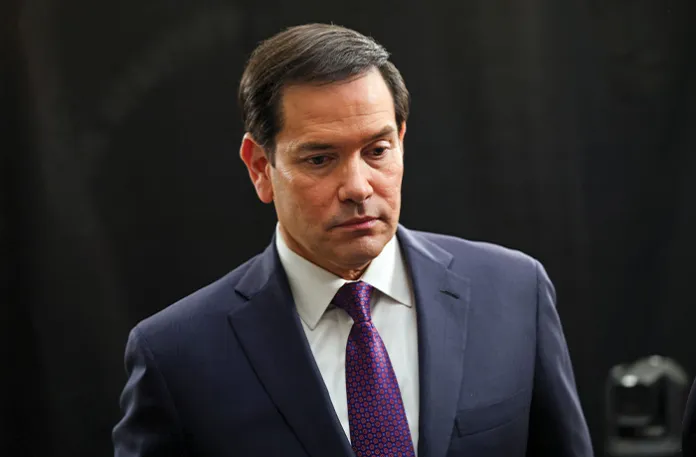
Remarkably, the speech didn’t sacrifice an ounce of Trump’s foreign policy vision. He framed the notion that we had entered into a borderless, nationless “end of history” following the fall of the Soviet Union as a “dangerous delusion.” He indicted the United Nations’s ineffectiveness at solving major international crises while extolling unilateral American action. He cast deindustrialization as a “decadeslong economic undertaking that stripped our nations of their wealth, of their productive capacity, and of their independence.” He took a shot at the “climate cult” whose energy policies impoverish Americans and Europeans alike, sidelined the “rules-based global order,” and called mass migration “an urgent threat to the fabric of our societies and the survival of our civilization itself.”
It was perhaps the most complete articulation of Trumpism ever uttered on the world stage.
Yet despite all this, the audience, composed mostly of European diplomats and foreign policy hands, gave Rubio a standing ovation. It was diplomatic alchemy.
How did Rubio pull it off? Through tough love — with equal emphasis on both words. Threaded through every hard truth was a reminder of America and Europe’s shared civilization and heritage, and their common fate.
“We are connected spiritually, and we are connected culturally,” Rubio said. “We want Europe to be strong. We believe that Europe must survive. … Our destiny is and will always be intertwined with yours, because we know that the fate of Europe will never be irrelevant to our own.”
Rubio’s speech set off the second big development at Munich. It had nothing to do with Europe — and everything to do with 2028.
Vice President JD Vance‘s ascension as Trump’s successor and the GOP’s standard-bearer has long seemed like a foregone conclusion — and for good reason. On paper, Vance looks like a Republican primary juggernaut.
He has commanded a massive polling lead for the 2028 Republican presidential nomination, often securing support from over 50% of respondents. He serves as the Republican National Committee finance chairman, giving him ample face time with major conservative donors beyond his significant Silicon Valley base. His barnstorming of the country on behalf of 2026 Republican candidates will deepen his ties to local organizers and activists, building the kind of truly national infrastructure that wins presidential primaries.
Meanwhile, endorsements from A-list Republicans are already pouring in. Turning Point USA’s Erika Kirk pledged to throw the full weight of her influential organization behind him. Former Virginia Gov. Glenn Youngkin, himself often the object of presidential speculation, said Vance would make a “great, great presidential nominee.” Even Rubio, whom Vance calls his “closest friend in the administration,” has vowed to support the vice president if he runs.
The one person keeping the question of succession open is the only person whose endorsement could be definitive: Trump. The president has repeatedly paired Vance and Rubio as possible successors without picking one over the other.
His reaction to Munich made it appear more of an open question than ever. Aboard Air Force One, Trump told reporters: “JD is fantastic, and Marco is. They’re both fantastic, I think, really. And I think Marco did a great job in Munich.” Behind the scenes, reports revealed that Trump was increasingly asking advisers and confidants whom they preferred, with his praise of Rubio growing louder still.
Then, while hosting the first meeting of his new “Board of Peace,” Trump made his admiration public: “Marco, you really did yourself proud two days ago in Munich. In fact, so proud that I almost terminated his employ, because they were saying, ‘Why can’t Trump do this?’ I do, but I say it differently. But, Marco, don’t do any better than you did, please. Because if you do, you’re out of here.”
Later in the same meeting, Trump went further, comparing the two men directly. Of Vance, Trump said, “he gets a little bit tough on occasion. We got to slow him down on occasion.” And of Rubio, “We have the opposite extreme. … Marco does it with a velvet glove. But it’s a kill.”
The sense that Rubio’s influence over Trump had eclipsed Vance’s grew stronger in the aftermath of his decision to wage war against Iran. Rubio has long been hawkish on Iran, while Vance repeatedly dismissed the idea of military confrontation. Only days before the launch, Vance insisted to the Washington Post that there was “no chance” Iran strikes would result in the U.S. becoming involved in a drawn-out war.
The seating arrangements on the night of the launch spoke volumes. While Rubio monitored Operation Epic Fury from Mar-a-Lago alongside Trump, White House chief of staff Susie Wiles, and CIA Director John Ratcliffe, Vance was dialing into a secure conference line from the White House Situation Room — seated beside Director of National Intelligence Tulsi Gabbard, one of the administration’s most vocal skeptics of military action against Iran.
These rapidly shifting power dynamics in the White House have scrambled what once seemed like a settled question about succession. Vance entered February as Trump’s inevitable heir. In March, with American bombs falling on Tehran and Rubio at the president’s side, his path to 2028 looks less certain.
***
Trump’s comparison of Vance and Rubio at the Board of Peace meeting is useful for the Republican primary electorate that may need to choose between the two. But there’s a sharper analogy: Vance as the conservative movement’s conqueror, and Rubio as its missionary. Should both run, Republican voters will be tasked with deciding which archetype provides the surest path to retaining power — and which will make for a more effective president.
Vance, known within the White House as the administration’s enforcer of the MAGA agenda, is a political heat-seeking missile. Dispatched by the White House to deliver uncomfortable truths and do battle with hostile journalists, Vance lands punishing blows. Anyone who doesn’t understand the full force of the Trump position understands it completely after meeting with the vice president.
Ukrainian President Volodymyr Zelensky learned in real time to show due respect in the Oval Office. CBS News’s Margaret Brennan received an education on biased questioning — memorably summarized in five words: “I don’t really care, Margaret.” And at the 2025 Munich Security Conference, European diplomats learned that the Trump White House would not tolerate hypocritical lectures about “democratic norms” from nations that criminalized speech.
For conservatives long dismissed and condescended to by the establishment elite, the emotional satisfaction of such moments is considerable. After all, who among conservatives hasn’t imagined themselves dismissing the biased premise of an activist journalist? Or telling the European countries that arrest comedians at airports for telling jokes that they have no business lecturing anyone about democracy?
But that emotional satisfaction is not the same as winning — or positioning the conservative movement for future wins at the ballot box. It’s fair to suggest that Vance’s heat-seeking strikes, spectacular as they are, have not strengthened the administration at home or abroad. In fact, it’s easier to argue that they have done nothing to advance the administration’s priorities — and in some cases, even undermined them.
Vance’s impetuous decision to repost Stephen Miller’s false characterizations about the death of Alex Pretti in Minneapolis, that Pretti was a “domestic terrorist” who had “tried to assassinate federal law enforcement,” contributed directly to the administration’s most unambiguous political black eye thus far. Such moments, which Trump has admitted to noticing, reflect a politician still developing the judgment that high-stakes politics demands. It is easy to forget that Vance, 41, has not even been in national politics for four years.
By contrast, the far more seasoned Rubio is unfailingly disciplined. Despite juggling the most demanding portfolio in the executive branch — in addition to serving as secretary of state, Rubio also serves as national security adviser, the first person to hold both roles simultaneously since Henry Kissinger — he has managed to accumulate influence without accumulating enemies.
The result has been a historic run as America’s chief diplomat. In a little over a year, Rubio has managed to overhaul the State Department, slashing waste and redirecting funds toward “America First” priorities such as border security, ramping up visa vetting, and countering China. He enacted the “Donroe Doctrine” by barnstorming through Latin America and delivering immediate results on countering migration and fentanyl while blunting China’s Belt and Road Initiative. He brokered de-escalations in numerous global hot spots, including a potentially cataclysmic faceoff between nuclear powers India and Pakistan. He orchestrated the capture of Venezuelan dictator Nicolas Maduro and has been the administration’s point person on the Iran strikes that led to the death of Ayatollah Ali Khamenei.
He’s even managed to visit the Sunday shows now and again to battle with liberal journalists. But that’s not his primary domain, as it can appear to be for Vance. Rubio only does it when he has the time.
Who has done more to advance the MAGA agenda in Trump’s second term than Rubio — save Trump himself? No one comes to mind. Certainly not Vance.
The contrast between the two men’s Munich speeches makes the choice plain. Vance’s address delivered the emotional satisfaction conservatives crave. Rubio’s, without sacrificing an ounce of the same policy or values, won converts to the cause.
As satisfying as it would be to watch Vance launch his ballistic strikes at former Vice President Kamala Harris or Gov. Gavin Newsom (D-CA) on a 2028 debate stage, it’s more important that the Republican ticket wins. Winning means persuading voters, especially the Latinos and independents who catapulted Trump into a second term, who are skeptical of Republicans, but not unreachable.
THE GOSPEL ACCORDING TO JAMES TALARICO
Vance has proven he can conquer a room. Rubio has proven, on the biggest stages in the world, that he can convert one. Could he do the same with the American electorate in 2028?
That’s the most important question in Republican politics.
Peter Laffin is the senior editor for In Focus and Restoring America at the Washington Examiner.
