

Only a select few coaches ever restore a floundering college football program to national prominence with the kind of discipline, wit, and unrelenting drive that Lou Holtz brought to the sideline. There are others, though, who become so synonymous with revival that their careers themselves take on legendary status. Lou Holtz, the coach who led Notre Dame to its last national championship and died March 4 at the age of 89, was one such figure.
Louis Leo Holtz was born on Jan. 6, 1937, in Follansbee, West Virginia, and grew up in East Liverpool, Ohio. He graduated from East Liverpool High School in 1954 and walked on to the football team at Kent State University as a linebacker, where he played two seasons for the Golden Flashes. Coaching called early. Holtz began as a graduate assistant at Iowa in 1960 before contributing to Ohio State’s 1968 national championship team. In 1969, he took his first head coaching job at William & Mary. Though the overall record stood at 13-20, he guided the team to a conference title and the program’s first bowl appearance. Success came quickly at North Carolina State from 1972 to 1975, where Holtz captured the 1973 ACC championship and led the Wolfpack to four bowl games. Three of those teams finished in the final Top 20 rankings, including a No. 10 spot in 1974.
A single season in the NFL with the New York Jets in 1976 ended in a 3-10 record and a memorable resignation. Holtz later explained his departure with characteristic bluntness: “God did not put Lou Holtz on this Earth to coach in the pros.” (Though, let’s be honest — helming the Jets has probably caused many coaches to question their life choices.)
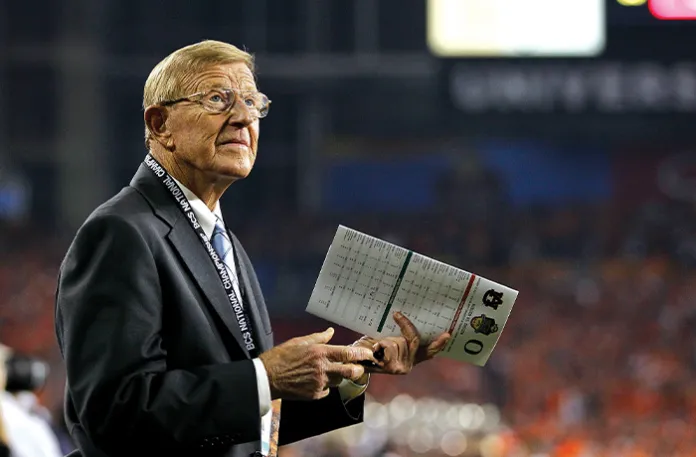
Holtz returned to the college ranks at Arkansas in 1977 and immediately delivered results, taking the Razorbacks to six bowl games and upsetting Oklahoma in the Orange Bowl to claim a share of the national championship. After a brief stop at Minnesota, where he led the Golden Gophers to the 1985 Independence Bowl, Holtz arrived at Notre Dame in 1986 to take over a program that had fallen on hard times. His impact was immediate. The 1986 Irish finished 5-6, but five of those losses came by a total of just 14 points, and the season closed with a dramatic upset of USC.
By 1988, everything clicked. Holtz’s team went 12-0, capped by a 34-21 victory over West Virginia in the Fiesta Bowl to secure the consensus national championship — Notre Dame’s first since 1977. The season’s signature moment came on Oct. 15 when fourth-ranked Notre Dame upset top-ranked Miami 31-30 in the legendary “Catholics vs. Convicts” game. Holtz had delivered one of his trademark motivational talks beforehand, urging his players to “save Jimmy Johnson’s a** for me.” Earlier that year, against Michigan, 5-foot-5 kicker Reggie Ho drilled four field goals — including the game-winner — to spark a 19-17 victory.
Holtz’s Notre Dame teams played with a distinctive edge. He removed players’ names from the backs of jerseys to stress collective effort rather than individual stardom, a practice that briefly influenced school policy. From 1988 through 1993, the Irish posted a staggering 64-9-1 record, including a school record 23-game winning streak and the program’s first pair of consecutive 12-win seasons. Over his 11 seasons, Holtz compiled a 100-30-2 mark at Notre Dame, led the Irish to nine straight bowl games, and became the second-winningest coach in school history behind only Knute Rockne at the time of his departure.
He returned to the sidelines in 1999 at South Carolina after two years as a CBS analyst. The Gamecocks had gone 1-10 the previous season. In 2000, Holtz engineered one of the greatest single-season turnarounds in college football, improving to 8-4 and winning the Outback Bowl. The 2001 team went 9-3 and repeated as Outback Bowl champions. Holtz became the only coach in NCAA history to lead six different programs to bowl games and the only one to guide four programs to final Top 20 rankings.
After retiring from coaching following the 2004 season, Holtz spent a decade as an ESPN college football analyst, bringing the same sharp insight and humor (as well as a distinctive voice) that defined his sideline presence to television audiences until 2015.
Holtz was inducted into the College Football Hall of Fame in 2008. His statue stands outside Notre Dame Stadium, a permanent reminder of the man who restored the program’s swagger. Even after stepping away from the field, he remained a sought-after speaker whose stories mixed tough love with self-deprecating wit.
Although God may not have put Lou Holtz on this Earth to coach in the pros, in the college game, he had found exactly the place he was meant to be — and left every program he touched far better than he found it.
Daniel Ross Goodman is a Washington Examiner contributing writer and the Allen and Joan Bildner Visiting Scholar at Rutgers University. Find him on X @DanRossGoodman.
