

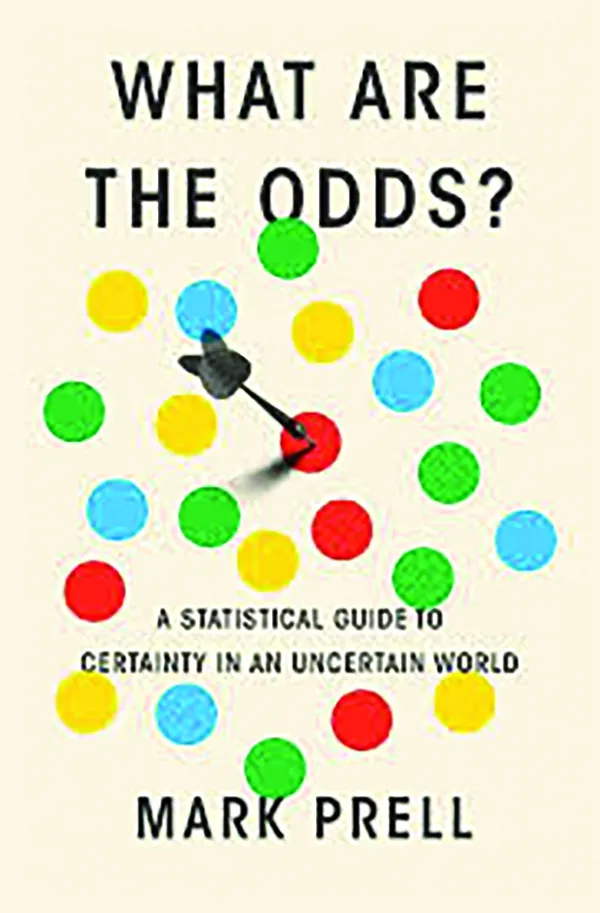
Deciding how fast to drive, brewing better beer, and winning bar bets — Mark Prell, a respected statistician, offers a modern guide to probabilistic thinking in What are the Odds?: A Statistical Guide to Certainty in an Uncertain World. Following in the footsteps of Darrell Huff’s 1954 classic, How to Lie with Statistics, Prell underscores that probabilistic literacy is essential for everyone, not just mathematicians, to navigate a world rife with complexity and ambiguity.
Recommended Stories



Many books have addressed uncertainty. Charles Wheelan’s Naked Statistics, from 2013, and Carl T. Bergstrom and Jevin D. West’s Calling Bulls***, from 2020, echo Huff’s witty exposé of data misuse. Daniel Kahneman examines cognitive biases in Thinking, Fast and Slow (2011) and Noise (2021). And works such as Nate Silver’s The Signal and the Noise (2012) and Cathy O’Neil’s Weapons of Math Destruction (2016) explore the dangers of overconfidence in predictive models. Prell’s approach is less witty than that of Huff, less psychologically illuminating than that of Kahneman, and less alarmist than that of O’Neil, but it is highly practical. His message is clear: Mastering statistics is crucial to avoid being misled and to make informed decisions.
In What are the Odds?, Prell contrasts the deterministic mindset common in everyday thinking with the stochastic perspective of statisticians. Through memorable examples, he illustrates the pitfalls of assuming certainty and the benefits of grasping randomness. One such example is the “Sailor’s Dilemma,” used to explain frequency distributions. In the scenario, a sailor frequently traveled for long periods. While he was away, his wife, who had recently given birth, read an article stating that pregnancy lasts 266 days. Her own pregnancy, however, lasted 10 months and five days — over a month longer than the duration printed in the article. Concerned, she wrote to the newspaper: “Please print a retraction about the 266-day carrying time because otherwise I am in a lot of trouble.” Time, Prell explains, is a continuous variable often converted into discrete units — seconds, minutes, hours, or, in the case of pregnancy, months — and the reported 266 days is an expected value with variability, not a guarantee.
Throughout the work, Prell provides other small, practical examples that help readers understand statistics and uncertainty. Polls conducted using landlines rather than cellphones show how sampling bias may distort results. Weather forecasts predicting a 30% chance of rain illustrate how subjective interpretations of probability — 30% of the region, 30% of the time, or 30% of days like tomorrow — can affect weekend plans. A patient’s choice between two surgeries may be influenced by confounding variables, such as age, sex, or underlying health conditions, as aggregated data might suggest one surgery is safer, whereas subgroup analysis could indicate the opposite.
A more complex application of probabilistic reasoning is seen in the story of the USS Scorpion, a nuclear-powered submarine lost in the Atlantic in May 1968. Navy analysts applied Bayesian search theory, assigning prior probabilities to possible locations and updating them as the search progressed. This probabilistic approach focused resources on the most promising areas, ultimately locating the submarine near the Azores, but, tragically, not before the sailors perished miles below the surface. The story vividly demonstrates probabilistic reasoning applied to high-stakes real-world problems.
By the book’s end, readers are familiarized with core statistical concepts — confounding and response variables, point and interval estimates, null and alternative hypotheses — through numerous engaging scenarios and stories. Prell, rightly, leaves the grittier details on Bayes’s formula, binomial distributions, and linear regression for the appendix. While Prell asserts that no statistics background is required, the 480-page book includes roughly 100 tables and figures and frequently presents equations littered with Greek letters, making it more of a reintroduction to statistics than an entry-level primer. Only dedicated readers are likely to finish the book, which is a shame because Prell has an aptitude for teaching.
Those who are not intimidated by the book’s mathematics may find themselves frustrated by several examples Prell chose to illustrate concepts. Chapters on COVID-19 mortality and MMR vaccine misinformation provide statistical points but touch on polarizing subjects without a nuanced or thorough treatment. While Prell cites American Statistical Association guidelines advising the removal of personal bias, these unbalanced examples risk undermining the book’s broader educational goals. Less contentious examples would have better aligned with his intention of teaching probabilistic thinking.
Nevertheless, What are the Odds?: A Statistical Guide to Certainty in an Uncertain World successfully makes statistical concepts accessible, demonstrating how probabilistic reasoning informs everyday decisions and critical situations. The book emphasizes a crucial lesson: People often expect certainty where none exists. Expected outcomes are not guarantees, events follow probability distributions, not deterministic paths, and data are often muddled by confounding variables.
While some sections may be dense, mathematically demanding, or controversial, the book remains a valuable resource for those willing to engage seriously with numbers. As Mark Twain famously quipped, possibly quoting Benjamin Disraeli, “There are three kinds of lies: lies, damned lies, and statistics.” Prell shows that mastering statistics is essential not only to avoid deception but also to make informed decisions. For those unafraid of equations, What Are the Odds? is a practical, insightful guide to thinking like a statistician.
Matthew Phillips is a research and development engineer in New Mexico.
