

Inside Fallujah
Recommended Stories



The Unembedded Story
by Ahmed Mansour
Olive Branch, 360 pp., $20
Fallujah is a gritty semi-industrial city west of Baghdad, set squarely in the Sunni triangle, former proud home to such Baathist playgrounds as the Dreamland resort. The city was a major source for the Iraqi Army during the Saddam years and, when things started to go sideways in 2004, became a stomping ground for Abu Musab al-Zarqawi and a staging area for thousands of terrorist attacks against Baghdad. Paul Bremer called it a “tough town.”
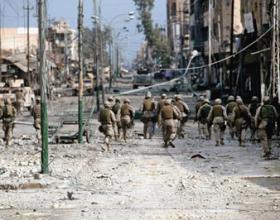
Most Americans, even those who did not follow the Iraq war in the press, remember the battle for Fallujah, the months of buildup, the departure of most residents, and finally the bloody clearing operation led by the Marines with the Black Watch. Fallujah was bloody for many reasons, not least the poor advice the various insurgent groups received from their Chechen advisers, who told the Iraqis to hole up in hundreds of houses, confident that the Americans would not have the intestinal fortitude to root them out, room by room, compound by compound.
This turns out to have been what the military terms a “bad tactical choice.” Fighting the Marines is like playing with lawn darts dipped in curare: Someone’s going to get hurt. As recounted in The Strongest Tribe, Bing West’s history of the surge, the fight for Fallujah was really “more than 200 fights inside concrete rooms against jihadists determined to kill an American and die a martyr.” West claims that the Marines engaged in “more than all of the fights by all of the police SWAT teams in the [United] States in the past three decades.”
The Marines would clear some 30,000 compounds. One Marine died and 11 were wounded in a four-hour battle for just one such target, the “House from Hell,” defended by Chechens. Sergeant Major Brad Kasal, who led the attack, ended up with seven gunshot wounds and 40 shrapnel wounds—and a Navy Cross. Marines like Sergeant Rafael Peralta jumped on grenades to spare their buddies, the act of heroism that almost always ends with one’s own death. Marines poured in to house fights to pull out wounded squad members, then called in precision airstrikes. Then-Captain Doug Zembiec, an All-American wrestler at the Naval Academy, held off hundreds of insurgents in a graveyard. Fallujah cost 151 American and perhaps 2,000 insurgent lives.
John Kael Weston, the State Department official assigned to Marine Lieutenant General James T. Conway, joined the Marines sorting through the human detritus after the Ulema Council in Baghdad contacted the American embassy to ensure Muslim burial procedures were in place. The dead were housed in a refrigerated building that had been used for storing potatoes. The Marines, who dubbed the improvised morgue “the Potato Factory,” found only a modest number of foreign fighters; contrary to expectations, most of the dead were Iraqis.
Fallujah was a decisive victory, but there was an earlier battle of Fallujah, mostly forgotten except for the casus belli. A small and changeable U.S. presence had already meant five different battalions in six months, and the city had already erupted once, in 2003. Then on a sunny day in March 2004, four American Blackwater employees, newly arrived in the country, were led into a trap.
The ambush area had been cleared of civilians minutes earlier by an insurgent grenade; the four Americans were cornered, shot to pieces, dismembered, set ablaze, dragged behind vehicles, and hanged from the nearest bridge. The Marine Expeditionary Force based outside the city and unable to do anything but cause vastly greater Iraqi casualties in an operation to retrieve the bodies, watched through a drone downlink and waited for the mob to burn itself out.
Coming as this did just days before the anniversary of the American occupation, the attack was viewed as (and probably was) a challenge to the United States. A decision was reached, hastily in hindsight, and over the objections of the Marine commander: Take Fallujah. The battle that followed saw one Marine tactical success after another followed by widespread rioting in the southern cities of Kut and Najaf, and a collapse of political support from the Iraqi Governing Council, a creature of the Coalition Provisional Authority that had finally found a way to assert its own legitimacy. The curiosity of sympathetic uprisings in the Shia south is the more remarkable considering that a caravan of medical supplies would be sent to Fallujah from Sadr City, a degree of interconfessional solidarity that would have been unthinkable even a year later.
In the end, the Marine advance was halted within days of making mission as the feared 6,000-mile screwdriver started turning, with Condoleezza Rice, then national security adviser, at one point reaching down to the Fallujah civilian-military operations center to talk to a colonel about reports of civilian casualties. A ceasefire was followed by an incomprehensible series of negotiations.
The bloody and almost contemporaneous battle for Ramadi generated virtually none of this indignation over its five hard-fought days. The difference? In the hours before the “clear” phase of the Fallujah operation began, a resourceful Al Jazeera camera crew, led by Egyptian correspondent Ahmed Mansour, found a smuggler’s trail into the city and managed to sneak in and set up shop, satellite dish and all. The tone of the coverage that followed was set by Al Jazeera and the network’s claim of 600 civilian deaths. While completely unsubstantiated, the number was quickly accepted as gospel by a press corps lacking other information. Newly minted facts followed in due course, as when Al Jazeera gave air time to a member of the Iraqi Muslim Ulema Council in Baghdad, who said he had “heard” that “more than 157 women were killed, mostly by snipers.” In Bing West’s words, Al Jazeera “portrayed the battle as a slaughter of the innocents.” General Conway put it more crisply: “Al Jazeera kicked our butts.”
Al Jazeera’s tone was All-Spanish-Civil-War-all-the-time. The coverage portrayed popular “resistance” against the “occupation forces” and failed to distinguish among insurgents, foreign fighters, local thugs, and hopped-up squads of Sunni youth practicing “shoot and scoot” with AK-47s and RPGs. On April 8, for example, Mansour noted that Fallujans had asked him to send a “message” that “we either live with dignity or die as martyrs and we will not surrender to the U.S. forces, even if we remain under siege for a year.” The next day, Mansour reported that a “real war is taking place in Fallujah between the defenders of Fallujah, who are determined to defend it until the last drop of blood, as they say, and the U.S. forces, which are deployed on the outside of the city.” Insurgent motives were invariably praised:
Despite the tough talk, Al Jazeera’s coverage suffered from a tendency to oscillate between grossly exaggerated accounts of Marine brutality (Fallujans as helpless mice) interspersed with grotesque descriptions of the would-be conquerors having their heads handed to them. A typical example of this is where Mansour describes the Marines as being
So weak, yet so deadly. General Conway describes snipers as “our most discriminate weapon, a Marine firing three ounces of lead at a precise target.” Time and again, Mansour reported as fact rumors that those same Marine snipers were deliberately targeting civilians, especially teenage girls, and had “orders to shoot anyone on sight.” In one of many such Al Jazeera reports, Marine snipers are blamed for shooting two children in the Nazzal neighborhood: The parents call for an ambulance, but no dice. Mansour reports that the hospital told them that the Marines “had bombed every ambulance the hospital had sent to the Nazzal neighborhood.”
On April 9, Mansour reported that the Marines were using cluster bombs: “An hour ago, fighter planes dropped containers, which the people of Fallujah affirm, through their distinctive noise, are containers for cluster bombs,” a loaded charge calculated to resonate with viewers familiar with Israel’s conflict in Lebanon: The United States and Israel are targeting Arabs everywhere. Get it? In Al Jazeera’s style manual, the words “shelling” and “bombing” are invariably preceded by “indiscriminate.”
But in the conquerors-having-their-heads-handed-to-them department, Al Jazeera broadcast triumphalist accounts of downed helicopters: Four American helicopters were lost in or near the city (at that point two-thirds of the actual rotary wing losses in Iraq since the fall of Baghdad). In a rare reference to insurgents, on April 7, Mansour reported, “Dozens of meters away, masked armed men from the defenders of the city were deployed, carrying rockets.” In fact, these brief examples are just about the only appearance the insurgents make in Mansour’s coverage and in this book, perhaps because there is no way to write around them. Mansour is defensive about this, but he has an explanation: The Americans were easy to spot, with their aircraft and their snipers. The insurgents—numbering in the thousands—were stealthy and did not want to be interviewed, even if their names were withheld.
Of course, the problem with this explanation is that it is absurd. It would have been easier for Mansour to interview the insurgents than not. There were literally thousands of part-time insurgents running down Fallujah’s boulevards firing AK-47s and RPGs at all hours, many of them local toughs, as part of this “popular uprising.” Yet not even an attention-seeking ibn shuwaria, “son of the streets” in Iraqi parlance, apparently agreed to be interviewed. Mansour chose not to, in order, one can only presume, to maintain the story line that the battle pitted murderous snipers and F-16s dropping cluster bombs against a unified populace.
Al Jazeera was banned from news coverage for one month in 2004 when it transpired that the network had received advance notice of bombings and had failed to notify the authorities. The network was also known for airing “snuff” videos. Bing West describes the scene in Fallujah when Marines uncovered Al Qaeda in Iraq head Abu Musab al Zarqawi’s torture studio, where six months earlier Nicholas Evan Berg’s head had been sawed off on camera:
Over the course of the battle, Mansour becomes convinced that the Marines are targeting his crew. For instance, he hears that a person who had aided the crew has been injured in an airstrike and forms the immediate conclusion—after all, people had been “telling him” that Al Jazeera was being “targeted”—that the man’s house had been demolished as part of an effort to go after the news crew. This turns out to have been a misunderstanding. The man was hit while walking in the streets, but the conviction that the Americans were targeting Al Jazeera remains.
This leads to one of the book’s moments of unintentional hilarity, when Mansour and his crew are taping a funeral and end up being pursued by a mob convinced that they are “agents of the murderous occupation.” Mansour is shocked by the sheer ingratitude of it all and threatens the crowd with decamping to another part of town. “My cameraman and my crew are here in Fallujah to convey your hurt and suffering to the rest of the world,” Mansour protested, “not to help the American forces.”
The lessons of Fallujah are several. The Marines have assimilated tactical “lessons learned” and are putting them to use to good effect today in Afghanistan: Know the neighborhood, build a census, develop a localized intelligence collection capability, many repeat tours across the ranks. The public affairs lessons are straightforward, for instance, in the way the second battle for Fallujah was telegraphed for weeks, and broad media coverage was supported by the military.
Colonel (now Brigadier General) Larry Nicholson was the regimental commander of the 5th Marine Regiment in Fallujah during 2006-07, a terrible year to be a Marine in Iraq. Nicholson will be remembered for the work he did to help jump-start the Anbar Awakening; but two years prior, during the run up to Fallujah II, Colonel Nicholson commanded the 1st Marine Regiment until a rocket attack killed one of his staff officers and sent him to Bethesda Naval Hospital for two months. His summary of the lessons learned for the second Fallujah battle is concise: “This time there would be no timeouts and cease-fires where the enemy held interviews with the media, no time for the enemy to do anything except fight, die, or run.”
James F. X. O’Gara served on a provincial reconstruction team in Iraq’s Wasit province during 2007-08, and recently returned from a year in Afghanistan supporting the Combined Joint Interagency Task Force-Nexus, a military-led intelligence fusion center based in Kandahar.
