

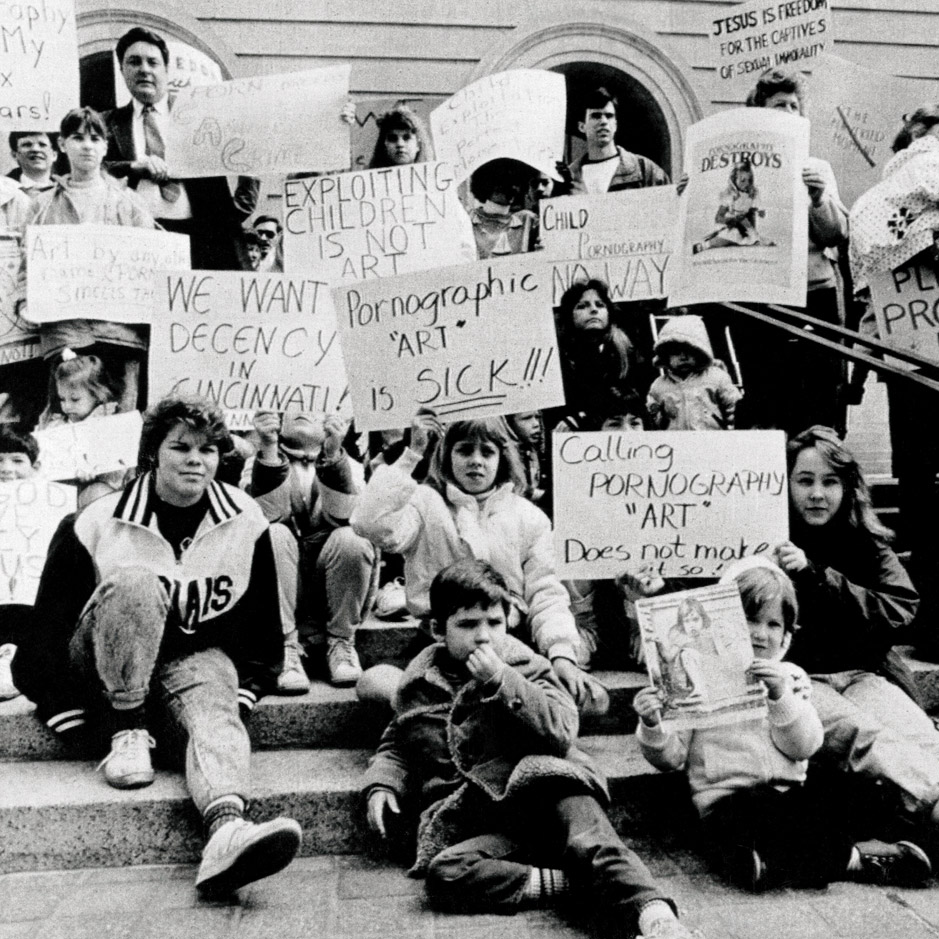
In the early 1990s, amid public outrage over Robert Mapplethorpe’s sexually explicit photographs, including several of private parts, Sen. Jesse Helms (R-N.C.) would settle arguments on the matter by pulling out his own. That the most avowedly conservative politician in America felt the need to carry around such a photograph shows how controversies over public morality were then dominating politics. When Mapplethorpe’s photos went on display in Cincinnati, local authorities prosecuted the museum director for obscenity and child pornography. “I’ve been here four times already,” one patron wrote in the visitors’ book of a Mapplethorpe exhibition in Washington, “and this show disgusts me more each time I see it.”
Between the administrations of Ronald Reagan and Bill Clinton, there were dozens of such controversies—over constitutional amendments to ban flag-burning and permit school prayer, over Andres Serrano’s art installation “Piss Christ,” over the semi-millennial commemoration of Christopher Columbus’s voyages, over museum exhibits about Hiroshima, over feminist-authored parietal laws that required university students to give written consent before jumping into bed.
Recommended Stories



The Culture Wars, as they were known even at the time, pitted jargon-spouting pseuds from college Critical Race Theory departments against sour old housewives from organizations with names like the National Federation of Decency.
Received opinion is that the Culture Wars were picturesque, entertaining, and irrelevant—a distraction from emerging problems of inequality, globalization, and terrorism. Andrew Hartman of Illinois State University disagrees. For him, the Culture Wars were a series of jousts over the legitimacy of the 1960s “counterculture,” with its new views of race, sex, and God. The counterculture won. Mapplethorpe beat Helms. Multiculturalism beat One Nation Under God. The Bra Burners beat the Founding Fathers.
Hartman is right. But the victory was Pyrrhic. It is early to be writing its history.
The culture wars arrived amidst propaganda and threats. The first programs in black studies (at San Francisco State College in 1969) and women’s studies (at San Diego State the following year) were not proposed by anyone. They were dreamed up by panicked university administrators as a concession to protesters, who were given a free hand in designing them. Such programs remained ideological as the years wore on. Nobody in the educational or political establishment dared oppose them.
When the Black Student Union at Stanford complained in the 1980s about the university’s “racist” Western Civilization program—which started with the Bible, Homer, and Plato and ended with Marx, Darwin, and Freud—out Western Civ went. At the height of Reaganism, the conservative president’s Equal Employment Opportunity Commission was bullying Sears Roebuck with sex-discrimination lawsuits based on flimsy evidence.
Hartman nicely distinguishes two pockets of intellectual resistance to this remaking of American institutions: Christians complaining about moral decline, and urbane “neo-conservatives” complaining about the decline of intellectual standards.
Professor Hartman attempts to write a balanced account. He accurately lays out conservative positions (e.g., the antifeminist Phyllis Schlafly’s case that “if men and women were legal equals, fathers had no obligation to provide for mothers”). He sees that conservatives were engaged in battles over curricula partly because they “believed the Western canon unlocks the wisdom upon which a free society is based.” But there is no mistaking his sympathies. His summations of George Will’s columns and Patrick Buchanan’s speeches are humdrum, but he quivers with enthusiasm when writing about the gender theories of Judith Butler or the race parables of filmmaker Spike Lee.
Academic argot is Hartman’s native tongue. Things are performative and have valence. Declension is a fancy way of saying decline, and two things put together for any purpose are conflated. Playful is the highest term of praise. In a logical jam, he will describe other viewpoints as evidence of moral panic, a term professors use for any moral judgment they feel safer dismissing than debating.
There are many canards here. Conservatives did not object to Hillary Clinton’s health care task force because “Hillary did not assume the matriarchal role expected of those in her position” but because it was a secretive use of government resources by someone with no health expertise, and who had never (at that point) been elected or appointed to anything. The entertainer Madonna was named by her parents; Madonna is not an “ironic stage name she gave to herself.”
Hartman sees that cultural controversies since the 1980s have allowed universities, bureaucracies, and courts to reorder society. He sees less well that this reordering has often left the country less democratic and less free. He finds it “perplexing” that “religious authority dwindled even as the vast majority of Americans doggedly persisted in religious belief.” Occam’s razor will tell you that if authority is getting more distant from public sentiment, the country is getting less democratic. Noting that progressives have had more success imposing their views in universities than in museums, Hartman suspects the reason might be “traditions of academic freedom.” But there is another difference: Public museums are, at least indirectly, accountable to voters, and universities are not.
The counterculture killed certain prejudices—but it did so by killing off the antiquated-looking frameworks that once gave modestly situated people a bit of leverage against the powerful.
Hartman applauds the dismantling of these frameworks on the grounds that “the nation’s cultural gatekeepers were protecting racist, sexist, homophobic, and conservative religious norms.” Perhaps he is young enough that, writing for the newer and narrower spectrum of the ideologically acceptable, he does not miss the freedom, or does not see it as freedom anybody would want. He describes an observation the dissident University of Chicago philosophy professor Allan Bloom once expressed (about the failure of black students) as having been made “with no effort to hide his sarcastic tone.” Hartman often sounds like a Soviet loyalist, circa 1935, tut-tutting over the variety of things Russian intellectuals were permitted to say in 1905.
The culture wars were about not just whether the 1960s reforms were good or bad, but whether they were sustainable. The dust has not yet settled on this debate. The battles of the 1990s offered Americans the chance to decide how much of their traditional culture they should be willing to part with in order to achieve race and gender equity. The answer that progressives have thus far imposed—“All of it”—does not appear to be the basis of a durable peace.
Christopher Caldwell is a senior editor at The Weekly Standard.
