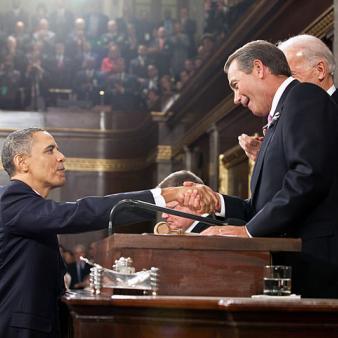
Chinese president Xi Jinping and U.S. President Barack Obama doffed their ties, rolled up their sleeves (well, at least Obama did), and even took the now-obligatory stroll around the Sunnylands Estate in Rancho Mirage, California, in the manner of Eisenhower and Khrushchev at Camp David, and Reagan and Gorbachev in Switzerland. This enabled the leaders to “establish and deepen their personal relationship,” according to Tom Donilon, Obama’s national security adviser at the time of the meeting. It “laid a reasonable basis for cooperation,” enthused the pro-Obama New York Times. “A relatively upbeat encounter,” according to the Financial Times.
Good news but, unfortunately, largely irrelevant to the future of relations between the emerging superpower and the incumbent. Xi did agree to join Obama in fighting greenhouse gasses — but did not announce the cancelation of any of the almost 400 coal plants under construction that will add hundreds of times the coal-burning capacity planned in the U.S. Yes, there will be future meetings of high-level officials, most notably at the next round of the on-going China-U.S. Strategic and Economic Dialogue in Washington shortly after the Fourth of July holiday. But aside from the few agreements always announced to avoid a communiqué that admits failure, there is little prospect that China can or will make the concessions necessary for an agreement on the nettlesome issues of trade and theft of intellectual property. These issues are rooted in institutional differences that make comity a virtual impossibility, no matter how chummy Xi and Obama become.