

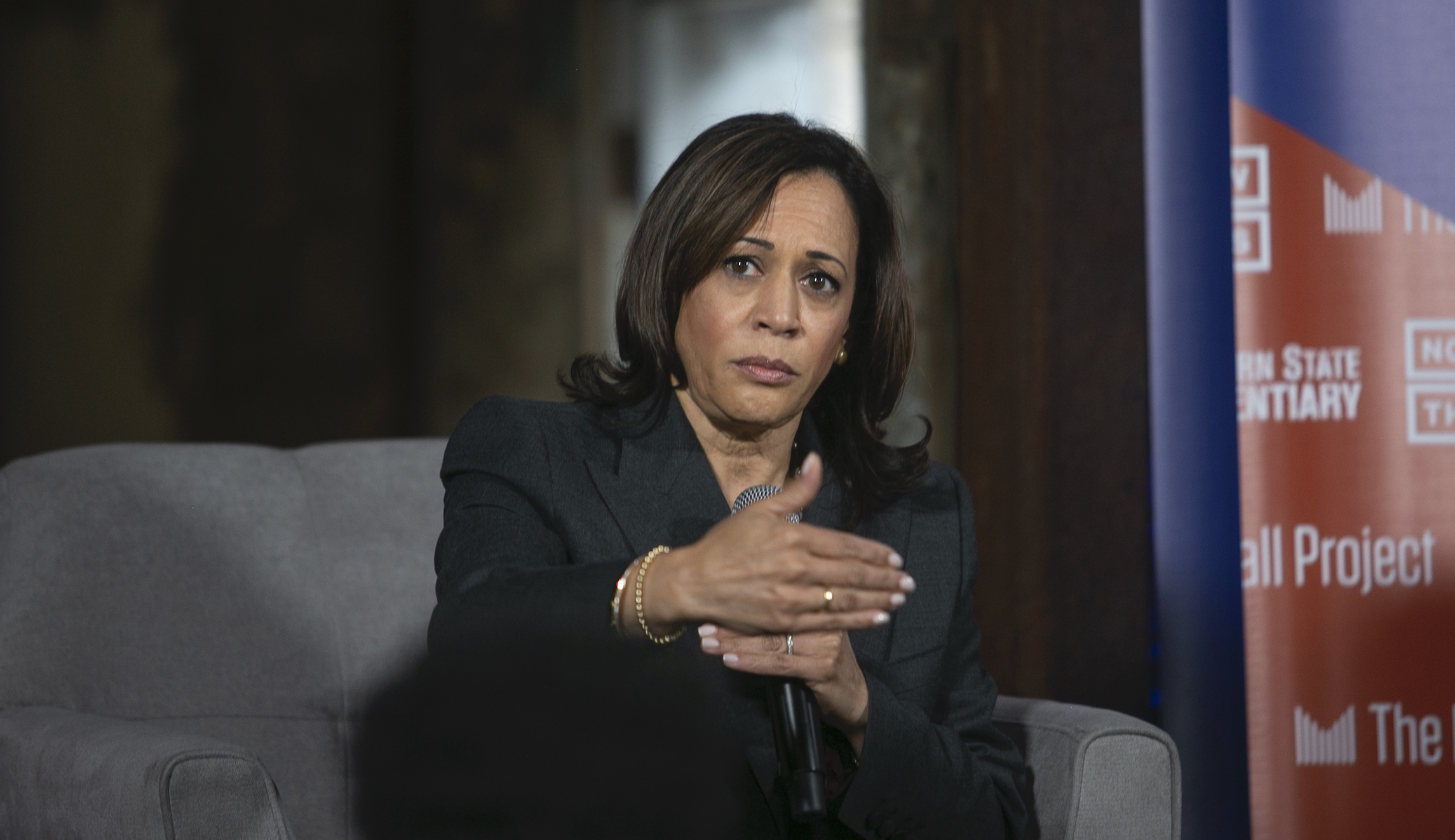
Supreme Court Justice Stephen Breyer’s reported retirement this year set off a flurry of speculation on whom President Joe Biden could pick as a replacement, with many raising the possibility of Biden nominating his vice president, Kamala Harris.
Biden promised during his campaign that he would nominate a black woman to be on the Supreme Court. Harris, who is of Jamaican and Indian descent, fits that requirement. And while she does not have experience as a judge, she was the attorney general of California and San Francisco’s district attorney.
Recommended Stories



Political commentator Bill Kristol floated the idea of putting Harris on the court and replacing her with Republican Sen. Mitt Romney as unity candidate in order to help Democrats in the midterm elections. Fox News host Harris Faulkner also floated the idea of Harris getting the nomination, with former Trump White House press secretary Kayleigh McEnany adding that Biden could nominate Harris in order to get rid of his vice president. CNN analyst Jeffrey Toobin floated Harris as a long-shot nominee earlier this month.
But a Harris nomination to the Supreme Court is politically unlikely, as well as tactically tricky.
WHITE HOUSE: BIDEN STANDS BY PLEDGE TO NOMINATE BLACK WOMAN TO SUPREME COURT
Harris and White House officials have batted down the idea of Harris being nominated to the Supreme Court.
Asked whether Harris might be in the running for the nomination, White House press secretary Jen Psaki said in a press briefing on Wednesday, “The president has every intention, as he’s said before, of running for reelection, and for running for reelection with Vice President Harris on the ticket as his partner.”
In a December interview with Face the Nation, Harris said she has not had the aspiration to sit on the Supreme Court.
“I’m much more active, I think, in terms of — not that — that Supreme Court Justices don’t have huge impact,” Harris said. “But right now, I like what I’m doing, the ability to travel around the country, to talk with folks, to push for policy that has impact in more a — in a very direct way.”
Even if Harris were interested, the proposal would put the Biden administration, which is already struggling to turn around flagging approval ratings, in a tactically tricky position.
Getting any Supreme Court justice confirmed will be tricky for Biden and Senate Majority Leader Chuck Schumer, even before the added complication of nominating the president of the Senate.
There are 50 Republican senators and 50 senators on the Democratic side (including independent Sens. Bernie Sanders of Vermont and Angus King of Maine, who caucus with Democrats). Court nominations need only a simple majority to be confirmed, and today’s polarized Senate and Supreme Court mean that it is possible that no Republicans vote for Biden’s Supreme Court nominee.
A Supreme Court justice has never faced a tied vote on confirmation before. But if that happened, it would Harris in the position of casting a tiebreaking 51st vote, which she has done for several of Biden’s appointments. She would presumably do the same if Democrats moved to confirm a justice without any Republican support. However, left-wing legal scholar Laurence Tribe argued in 2020 that the vice president could not pass a tiebreaking vote, and Harvard Law Professor Emeritus Alan Dershowitz also said the prospect of Harris breaking a tie vote raises serious questions.
It is unclear whether Harris could vote for herself. Legal experts and historians have previously said that there is no rule preventing senators, some of whom were mentioned as potential Supreme Court picks, from voting to confirm themselves. But it could create a poor perception if the vote is close or a tie.
Regardless of whether Harris would vote for herself in a tiebreaking confirmation vote or if she would step down from her position before such a vote, that would leave a vacancy in the Office of the Vice President — and the support of at least one Republican senator would be needed to confirm her replacement.
The 25th Amendment to the Constitution states that when there is a vacancy in the Office of the Vice President, the president shall nominate a replacement who is confirmed by a simple majority vote of both the House and the Senate.
Gerald Ford and Nelson Rockefeller were confirmed to the vice presidency to fill vacancies with overwhelming bipartisan support, but the modern, divided political climate could mean that Republicans stand uniformly against any potential Democratic vice president.
The result: Two major, highly watched Senate confirmation battles for Biden instead of one. Biden could be forced to try to nominate a compromise vice president in order to get the pick confirmed, but that could outrage the Democratic base if the pick is seen as too centrist.
Before the 25th Amendment was adopted, the Office of the Vice President was unoccupied for long periods of time due to vacancies. A tie on partisan lines could theoretically result in the position staying vacant for years.
There is also the possibility that Harris is not well-liked enough by senators to garner 50 votes at all. Reports have described her staff as “rife with dissent” and said that Harris has “refused to wade into briefing materials.”
CLICK HERE TO READ MORE FROM THE WASHINGTON EXAMINER
If selected, Harris would join a minority of Supreme Court justices who have no prior judicial experience. She was the attorney general of California prior to becoming a senator and then vice president. Current Justice Elena Kagan had no prior judicial experience before joining the court.
Harris would also be part of a minority of Supreme Court justices who did not attend Harvard Law School or Yale Law School. Justice Amy Coney Barrett is the only current justice who did not attend either prestigious institution and went to Notre Dame Law School. Harris has a law degree from the University of California, Hastings College of the Law.
