

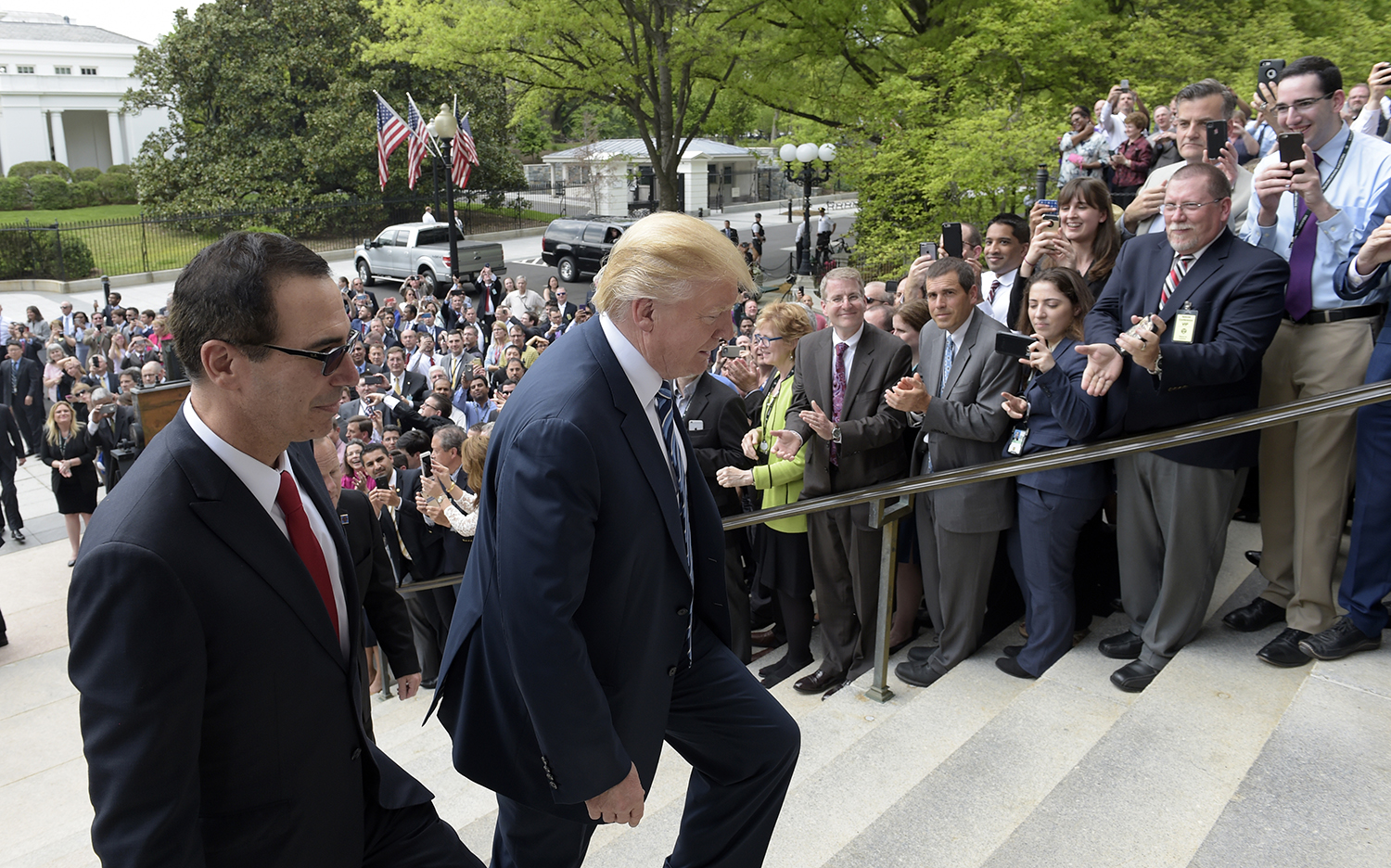
Republicans on Wednesday applauded President Trump for producing a tax blueprint that could turbocharge the economy even as they conceded flaws that might stall the plan in Congress.
Proponents of conservative reform were gushing over Trump’s proposals to cut the corporate tax rate to 15 percent — a 20 percent reduction — and simplify the code for individuals and married couples. The burdensome “Alternative Minimum Tax” would go. So would all deductions except mortgage interest and charitable giving.
Recommended Stories


The plan is expected to hit turbulence on Capitol Hill as projections that it could explode the federal deficit emerge and opposition to eliminating popular tax breaks mobilizes. Republicans could be acutely sensitive to the pressure, and face procedural hurdles, given that Democrats are likely to oppose the effort in lockstep.
The potential fracture lines were immediately apparent, as were the opportunities. Rep. Leonard Lance, R-N.J., lauded Trump’s outline for its potential fiscal benefits but made clear he would oppose slashing the deduction for taxes paid to state and local governments.
That part of Trump’s proposal would cost voters in high-tax states like New Jersey millions. Several House Republicans from blue states are in Lance’s predicament and would be hard-pressed to support a plan that could amount to a tax increase on their constituents.
“I am pleased the president outlined a plan today. There are parts of it I favor and there are parts of it I think need further debate,” Lance said in a statement. “One provision I oppose is the elimination of the state and local tax deduction. New Jersey taxpayers would lose under that plan. I will be a leading voice in negotiations for maintaining that deduction.”
Tax reform was last accomplished in 1986 under President Ronald Reagan and a Democratic House. The Trump blueprint, among his many ambitious campaign promises, was broad in scope but light on details.
How much revenue through economic growth would flood into federal coffers? How much revenue would be lost before accounting for an increase in Gross Domestic Product? How much money per year in taxes would average Americans save and what would their new tax rate be?
The blueprint, unveiled by Trump’s chief economic adviser Gary Cohn and Treasury Secretary Steven Mnuchin, didn’t say.
“We’ll work out lots of details,” Mnuchin told reporters. “We have over 100 people in the Treasury that have been working on tax and scoring lots of different scenarios. This will pay for itself with growth and with reduction of different deductions and closing loopholes.”
For some on the Right, that was good enough.
One GOP senator, speaking on condition of anonymity, said in an email exchange with the Washington Examiner: “Growth > deficit concerns.” Influential conservative groups shared that view, among them Club for Growth, and Freedom Partners, a Koch brothers organization.
Upscale suburban voters could also find Trump’s plan appealing, allowing the president to improve his political position in 2018 with this crucial bloc.
Professionals in the suburbs have historically voted Republican but strayed in 2016 because Trump’s blue-collar bombast turned them off. Georgia’s suburban Atlanta 6th District, one such battleground, is now being contested in a competitive special election.
Republican territory since 1978, the seat voted for Trump over Hillary Clinton by just 1.5 points. Canceling the Alternative Minimum Tax, which hits upper-middle-class voters hard in the pocketbook, and other provisions of Trump’s tax plan could help him shore up his moderate flank.
“The hole in Trump’s political golf swing is upscale educated suburban Republicans. If he had those folks strongly in his corner, to go with the passionate support he has in rural and industrial areas, he’d be a pretty potent force,” Republican strategist Brad Todd said.
There’s a reason tax reform was last accomplished 31 years ago.
The politics and the policy are complicated, possibly more so than healthcare. The GOP’s recent travails in trying to repeal and replace Obamacare is tempering enthusiasm among many Republicans who would like to take advantage of full control of the government and get something done.
Trump’s plan is part of the problem.
Republicans who have been working on tax reform for several years say that, as much as they wish economic growth would pay for the president’s massive tax cut, it won’t. And the lack of specificity in Trump’s blueprint isn’t inspiring confidence.
“It’s not a plan, it’s phony,” a veteran House Republican told the Examiner, on condition of anonymity in order to speak candidly. “They’re going to lower the rate to 15 percent but it’s going to be revenue neutral? It’s not going to work. That’s not even well thought out.”
House Republicans, led by Speaker Paul Ryan, R-Wis., have been working on their own plan, and there’s no indication yet that they have thrown in the towel.
The “pay-for” to cover the money lost to the treasury through tax cuts isn’t the only challenge for the president. Overhauling the tax code impacts nearly every corner of the economy.
Trump has to contend with industries that will wage a vigorous battle to protect their carveouts, members of Congress with parochial concerns and political accusations that the White House is favoring the rich, including the occupant of the Oval Office, at the expense of the middle class.
“Ask the average voter if corporations are paying too little or too much in taxes, I can tell you what the answer would be,” said Jon Selib, who served as chief of staff to Montana Democrat Max Baucus when he was Senate Finance Committee Chairman. “That’s why other administrations have wanted to tackle corporate reform with a bipartisan approach because the politics of it are tricky.”
