President Obama on Wednesday rejected a transcontinental pipeline project that proponents say could have created more than 100,000 jobs and reduced the nation’s dependence on foreign oil by as much as a million barrels a day.
Congressional Republicans are now promising to keep the Keystone XL pipeline project alive through legislation, including a bill that would take the final approval out of the president’s hands and transfer it to the semi-independent Federal Energy Regulatory Commission.
In rejecting the pipeline, Obama said he wasn’t ruling on the merits of the $7 billion project, which would stretch from Canada to Texas. Instead, he said congressional Republicans forced his hand because they gave him only 60 days to evaluate the project and approve it. The State Department, which is overseeing the project because it crosses international borders, said that wasn’t enough time to study the safety issues and the environmental effects of the project.
“This announcement is not a judgment on the merits of the pipeline, but the arbitrary nature of a deadline that prevented the State Department from gathering the information necessary to approve the project and protect the American people,” Obama said in a statement.
The pipeline company, TransCanada Corp., will be allowed to submit a new plan that re-routes the pipeline around Nebraska’s environmentally sensitive Sand Hills area.
The 36-inch crude oil pipeline would link the oil sands of Alberta, Canada, to Gulf Coast oil refineries, traveling underground through Montana, South Dakota, Nebraska, Illinois, Missouri and Kansas, Oklahoma and Texas.
The president’s announcement came after several confusing hours in which administration officials provided conflicting accounts of the decision. The State Department earlier in the day discounted media reports that Obama was about to reject the pipeline, insisting no decision had been made. Hours later, the White House announced the decision.
The president’s announcement didn’t kill the pipeline project, but it did ignite what promises to be a bitter partisan fight with congressional Republicans that could stretch well into the election year. Republicans were quick to pounce on Obama’s announcement as a lost opportunity to create badly needed jobs. They argued that he was putting politically important liberal supporters and environmental groups ahead of the nation’s needs.
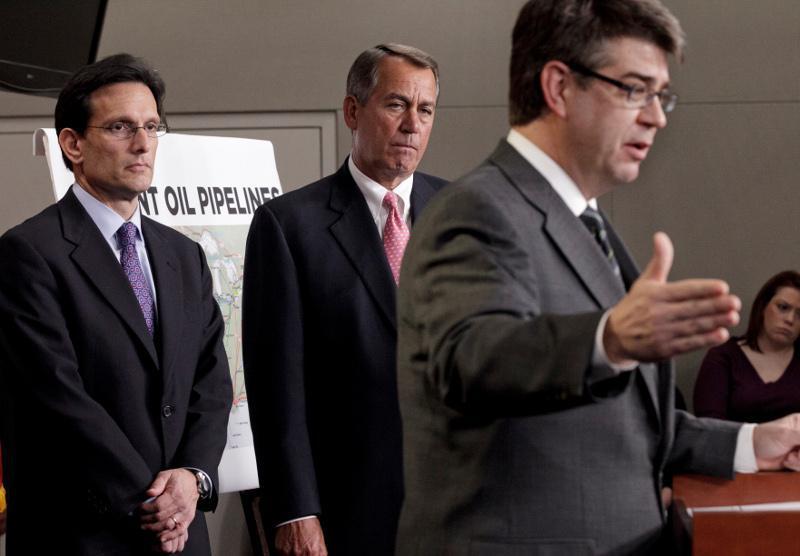
“There is no other way to put it,” House Speaker John Boehner, R-Ohio, said. “The president is selling out American jobs for politics.”
There’s no agreement on how many jobs the pipeline project would create. A study conducted by an affiliate of TransCanada Corp., the pipeline owner, claims more than 100,000 jobs would be created from the pipeline construction and oil production. A liberal-leaning group released a study claiming the pipeline would actually kill jobs and potentially devastate the environment.
House Minority Leader Nancy Pelosi, D-Calf., said the project wouldn’t increase domestic oil.
“It would go from Canada, through the United States and then overseas,” Pelosi said.
Rep. Lee Terry, R-Neb., a proponent of the project, said legislation will be brought up in the House “in a matter of weeks” to revive the Keystone project.
Republicans will likely put a pro-Keystone provision in the upcoming, must-pass payroll tax cut bill that is needed to extend a payroll tax cut and unemployment benefits that expire in February.
“All options are on the table,” Boehner said. “This fight is not going to go away. You can count on it.”
White House statement on Keystone