

Canadian truckers and protesters demonstrating against COVID-19 restrictions have now jammed up several border crossings along the U.S. border.
Truckers, who have dubbed themselves the “Freedom Convoy,” first began protesting last month over a rule that requires truckers returning from the United States to show proof of vaccination. The demonstrations have since morphed into more general protests against vaccine mandates and COVID-19 restrictions.
While the convoy’s physical presence has been largely concentrated in the Canadian capital of Ottawa, this week, opponents of the government’s coronavirus restrictions took to a new strategy: blocking international borders.
Protesters blocked traffic from crossing the Ambassador Bridge, one of the busiest crossings between the U.S. and Canada. The bridge, which connects Windsor, Ontario, to Detroit is a crucial outlet and accounts for about a quarter of all trade between the two countries.
OTTAWA POLICE WARN TRUCKERS: LEAVE NOW OR FACE ARREST
U.S. and Canadian authorities are reportedly working to direct some of the backlogged traffic through the Blue Water Bridge, a border crossing located about 60 miles north of the Ambassador Bridge.
The city of Windsor on Thursday announced that it is seeking a court order to remove the demonstrators from the bridge. Windsor Mayor Drew Dilkens said the city plans to take its case before a judge with the hope of clearing the roadway.
“The economic harm that this occupation is having on international trade is not sustainable, and it must come to an end,” Dilkens said during a news conference.
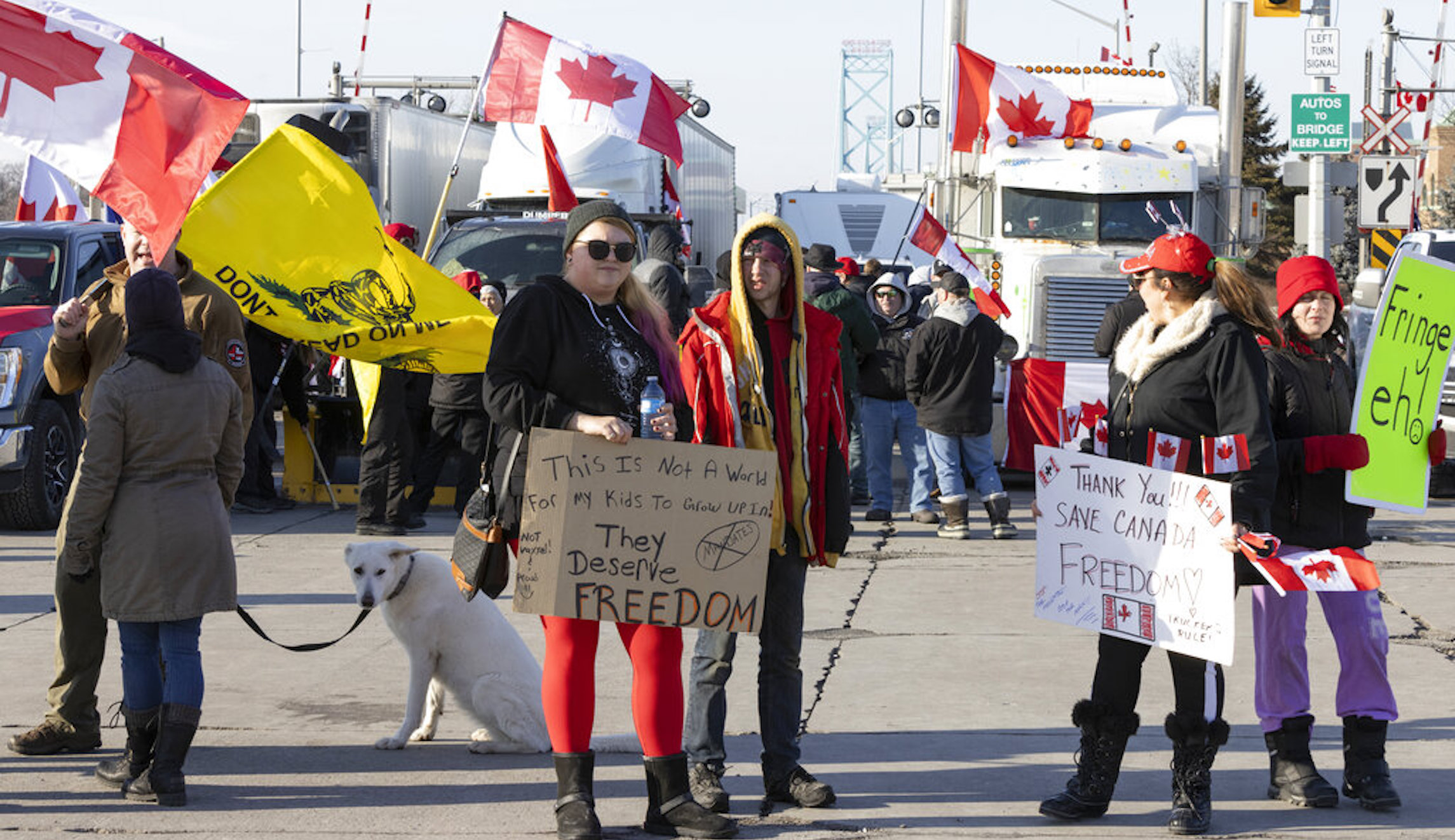
Demonstrators have also congregated at two additional crossings.
Police in Manitoba said on Thursday that protesters have “shut down” the Emmerson point of entry between Canada and North Dakota. Police said that the blockade is “involving a large number of vehicles [and] farm equipment” and that traffic is no longer flowing in either direction.
Law enforcement in Alberta also said Wednesday that the Coutts crossing, which is a point of entry between Montana and Alberta, was impassable, with northbound and southbound traffic blocked. Police there have been doling out tickets to those parked on the roadway and encouraging them to move, although so far, their efforts have fallen flat.
“Our concern is the safety of the public as well as those that are protesting,” said Royal Canadian Mounted Police Superintendent Roberta McKale.
White House press secretary Jen Psaki addressed the blockage on Wednesday. She noted that “the blockade poses a risk to supply chains for the auto industry because the bridge is a key conduit for motor vehicles components and parts.”
Psaki said that White House homeland security adviser Elizabeth Sherwood-Randall has already held a meeting over the matter.
“The president is focused on this, and we are working very closely with the team at DHS, with Canadian officials, and others to do everything we can to alleviate the impact,” she said.
The tactic has created headaches for law enforcement and commuters who rely on the crossings for work. U.S. law enforcement is also keeping an eye on the situation in the U.S. amid reports that anti-coronavirus-restriction protesters are organizing a similar effort stateside.
The Department of Homeland Security issued a bulletin this week warning about the possibility of a trucker convoy from California to Washington, D.C., although it described the current situation as in the “aspirational” phase.
CLICK HERE TO READ MORE FROM THE WASHINGTON EXAMINER
The bulletin said that the DHS “has received reports of truck drivers planning to potentially block roads in major metropolitan cities in the United States in protest of, among other things, vaccine mandates for truck drivers.”
“The convoy will potentially begin in California as early as mid-February and arrive in Washington, D.C., as late as mid-March, potentially impacting the Super Bowl scheduled for February 13th and the State of the Union Address for 1 March,” it added.
