

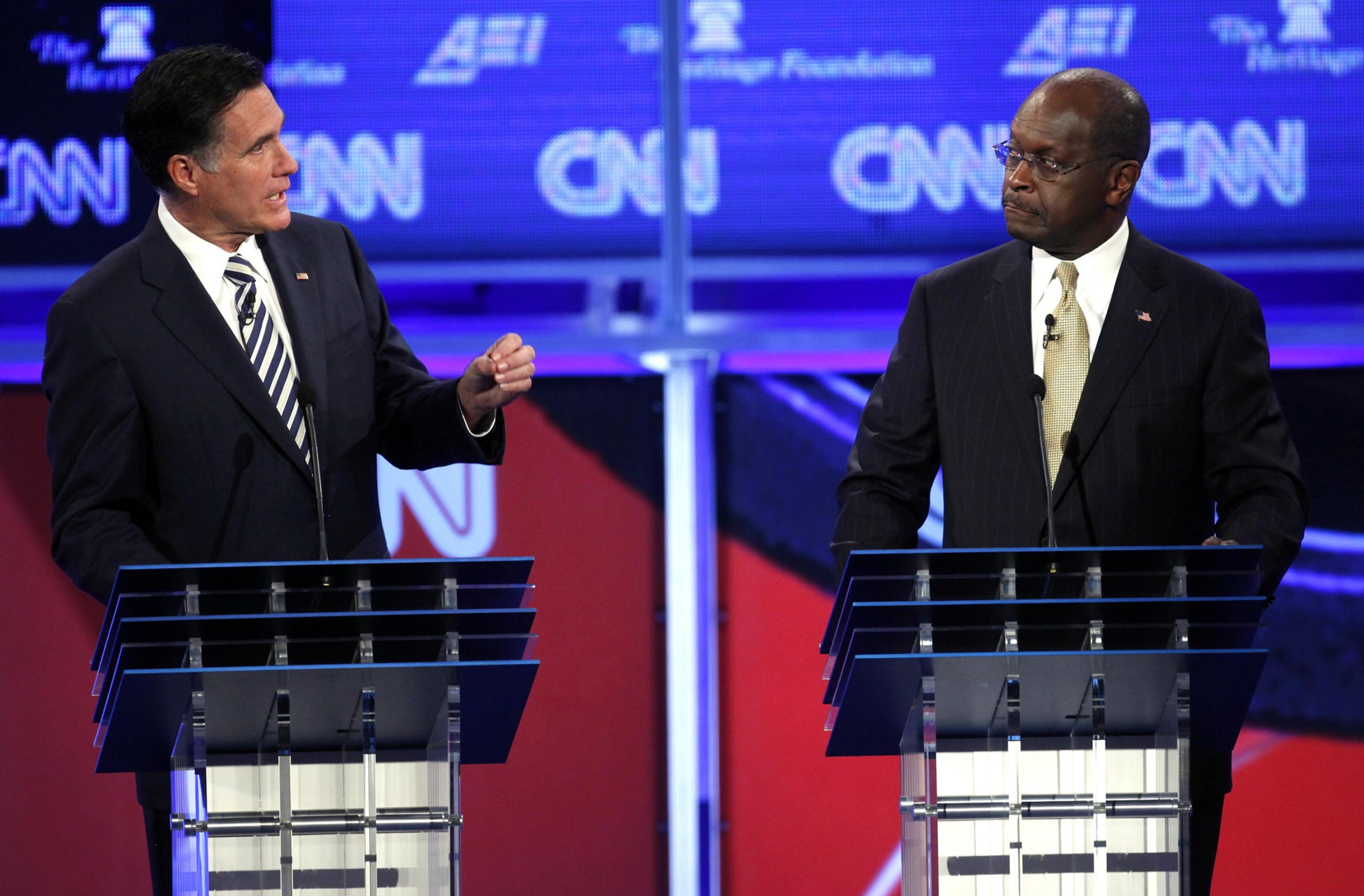
Republican presidential front-runner Mitt Romney sought to distinguish his foreign policy ideas from those of President Obama on Tuesday, sidestepping his GOP rivals in hopes of cementing his status as the candidate best equipped to carry the party’s torch in the 2012 election.
During a Republican presidential debate in Washington that focused on national security, Romney accused Obama of “harming the capacity of America to defend itself” by slashing the Pentagon budget by $350 billion — with an additional $600 billion on the chopping block amid congressional deadlock — and advocating a “cut and run” strategy in Afghanistan.
While national security isn’t likely the paramount issue for the general public amid high unemployment, the commander-in-chief test will still largely influence voters as they head to the polls next year.
And though Obama has received poor marks for his handling of the economy, his foreign policy credentials have been bolstered by the killing of Osama bin Laden and an array of major terrorist leaders across the Middle East, the ouster of Libyan dictator Moammar Gadhafi and the announced drawdown of troops from Iraq.
Obama’s recent foreign policy successes appeared to inhibit some of the GOP contenders from taking him on directly on issues of war and national security. But Romney attacked Obama for risking American investments in Afghanistan by calling for a 2014 handover of power to the Afghan government. In a debate where most of the candidates shared similar positions, Romney clashed with Utah Gov. Jon Huntsman, who is less hawkish about the need for U.S. troops in Afghanistan.
“Our effort there is to keep Afghanistan from becoming a launching point for terror,” Romney said, calling for a “gradual transition” of power and defending the need for the 100,000 U.S. troops stationed there.
Despite the fluidity in the Republican primary, the Obama campaign has focused its attacks almost entirely on Romney, whom they view as the most likely candidate to emerge as their opponent.
Much like their criticism of Romney’s domestic agenda, the Obama camp painted the former Massachusetts governor as a political opportunist whose opinions are shaped more by convenience than conviction.
“This penchant for changing positions is of particular concern on matters of national security,” Obama campaign manager Jim Messina said of Romney. “A commander in chief only gets one chance to get it right. But Mitt Romney has been on all sides of the key foreign policy issues facing our nation today.”
The Obama campaign hit Romney for “flip-flopping” on a timetable for withdrawing troops from Afghanistan, and said he had no clear strategy for the military intervention in Libya.
In recent weeks, Romney outlined a foreign policy agenda without a withdrawal date for troops from Iraq, also criticizing Obama for his promise to end the war there.
Romney has repeatedly cast himself as the CEO in chief, of sorts, harping on his business experience as the main reason to send him to the White House. When delving into foreign policy, though, he accused Obama once again of damaging U.S. standing on the global stage.
“President Obama apologizes for America,” he said. “It’s time for us to be strong as a nation.”
