

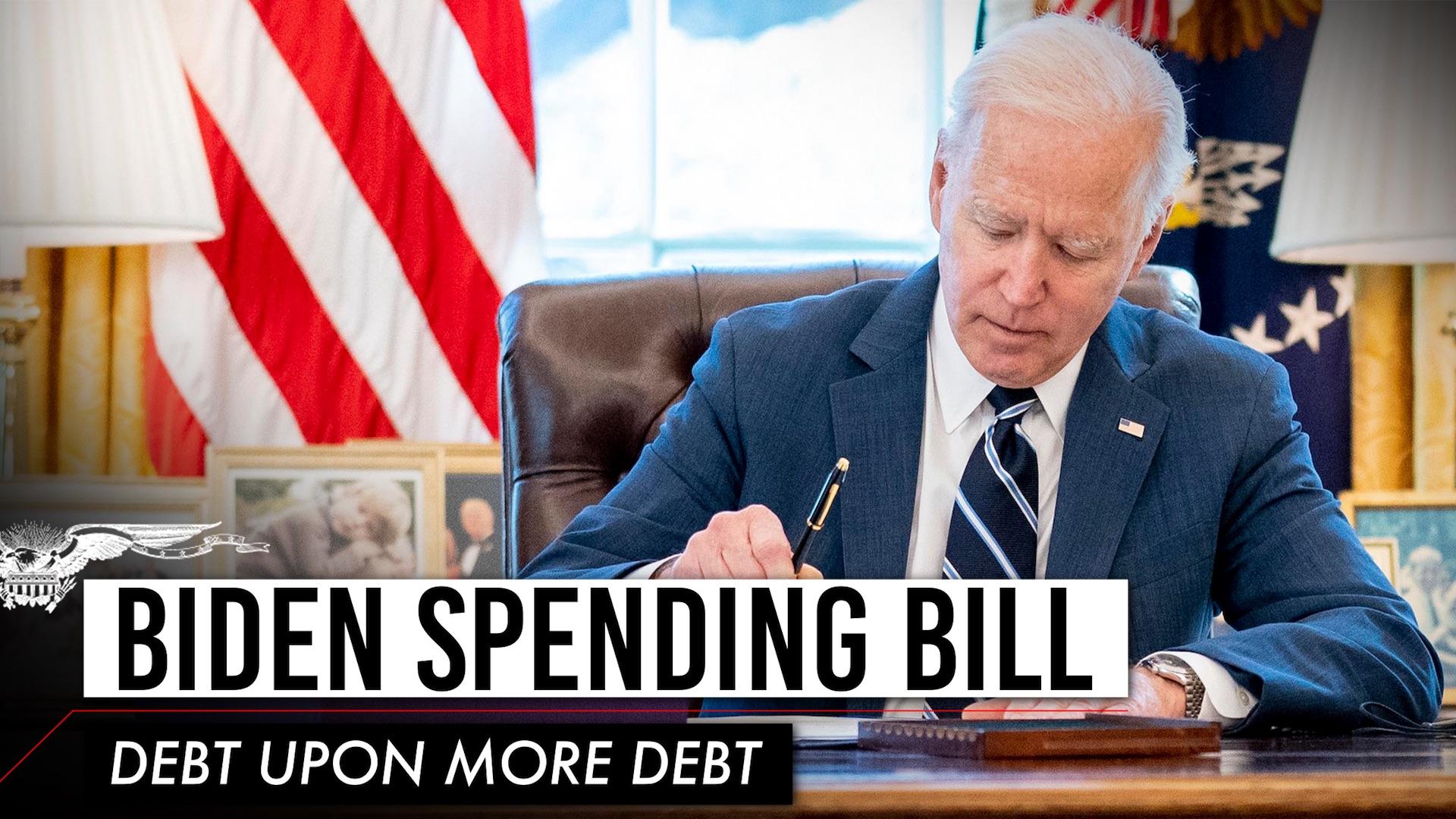
With the $1.9 trillion “American Rescue Plan” now signed into law, President Biden soon begins a nationwide tour touting its many benefits and favors. His White House prime-time speech on Thursday night delivered smoothly and calmly highlighted the hardships of the last year and the hard-fought advances made possible by the record-breaking speed of vaccine development, production, and distribution.
“It means simply this: Millions and millions of grandparents who went months without being able to hug their grandkids can now do so,” Biden said.
His victory lap, made easy by a fawning press, virtually ignored the previous president’s massive vaccine mobilization and Operation Warp Speed and was seemingly incurious about why less than 10% of that $1.9 trillion actually goes to coronavirus relief.
Author Molly Hemingway said, “The difference between our media and how they handled the Trump administration, in which they were relentlessly hostile to literally every single thing that administration did, and their sycophantic generosity and encouragement of everything that the Biden administration is doing is a constant reminder of their corruption.”
It may help explain why polls consistently show that a majority of people favor the bill.
Washington Examiner columnist Byron York said, “Most people don’t know that a very small portion of the bill is specifically devoted to COVID relief that it’s an enormous remake of our national welfare system, in the sense that it severs the connection between work and welfare that was created with welfare reform by Bill Clinton in the 1990s.”
The American Rescue Plan will send $1,400 checks to millions of people, extend unemployment benefits, and hand billions of dollars to states, even to those running budget surpluses.
Despite tremendous progress in the return to normalization, the president struck a cautious tone, suggesting that there’s “a good chance” that by July 4, small groups of families and friends can get together for celebrations in backyards and neighborhoods.
“Conditions can change. The scientists have made clear that things may get worse again as new variants of the virus spread. We’ve got work to do to ensure that everyone has confidence in the safety and effectiveness of all three vaccines,” Biden said.
He again called for unity, and he implored people to take the same advice he takes, saying, “Listen to Dr. Fauci, one of the most distinguished and trusted voices in the world.”
But some critics suggest that Fauci is increasingly revealing his political leanings with his recent criticism of public health policy under former President Donald Trump, recently saying, “We had such divisiveness in our country that even simple, commonsense public health measures took on a political connotation. It wasn’t a pure public health approach. Mixed messages were coming from Washington.”
Mark Meadows, Trump’s White House chief of staff, said, “Yeah, so Dr. Fauci is the same one that said that every recommendation he made to President Trump, that President Trump followed. You know, it’s interesting now that we have a new administration, we have a new Dr. Fauci that seems to forget some of the conversations that he and I had.”
Fauci recently told CNN that he does not always “follow the science.”
Alex Berenson, a former New York Times reporter, said, “Honestly, it was stunning in its honesty. The truth is, all of this is a judgment call. … We know that this virus is much less dangerous than we initially thought, and what that should have led to over the last 12 months is an understanding that we didn’t need the society destroying and, you know, in school closing measures, these very tough restrictions that have really worked our society. Yeah, instead of backing down, people like Fauci are doubling down.”
Meanwhile, many Republican governors have been encouraging their citizens to fire up backyard barbecues and reject lockdowns for weeks.
It’s not just barbecues that are firing up again — so is the economy. If that brings with it a rise in interest rates, which are now at record lows, that $1.9 trillion expenditure and its contribution to an ever-increasing national debt becomes a lot more expensive as the cost of servicing it rises.
