

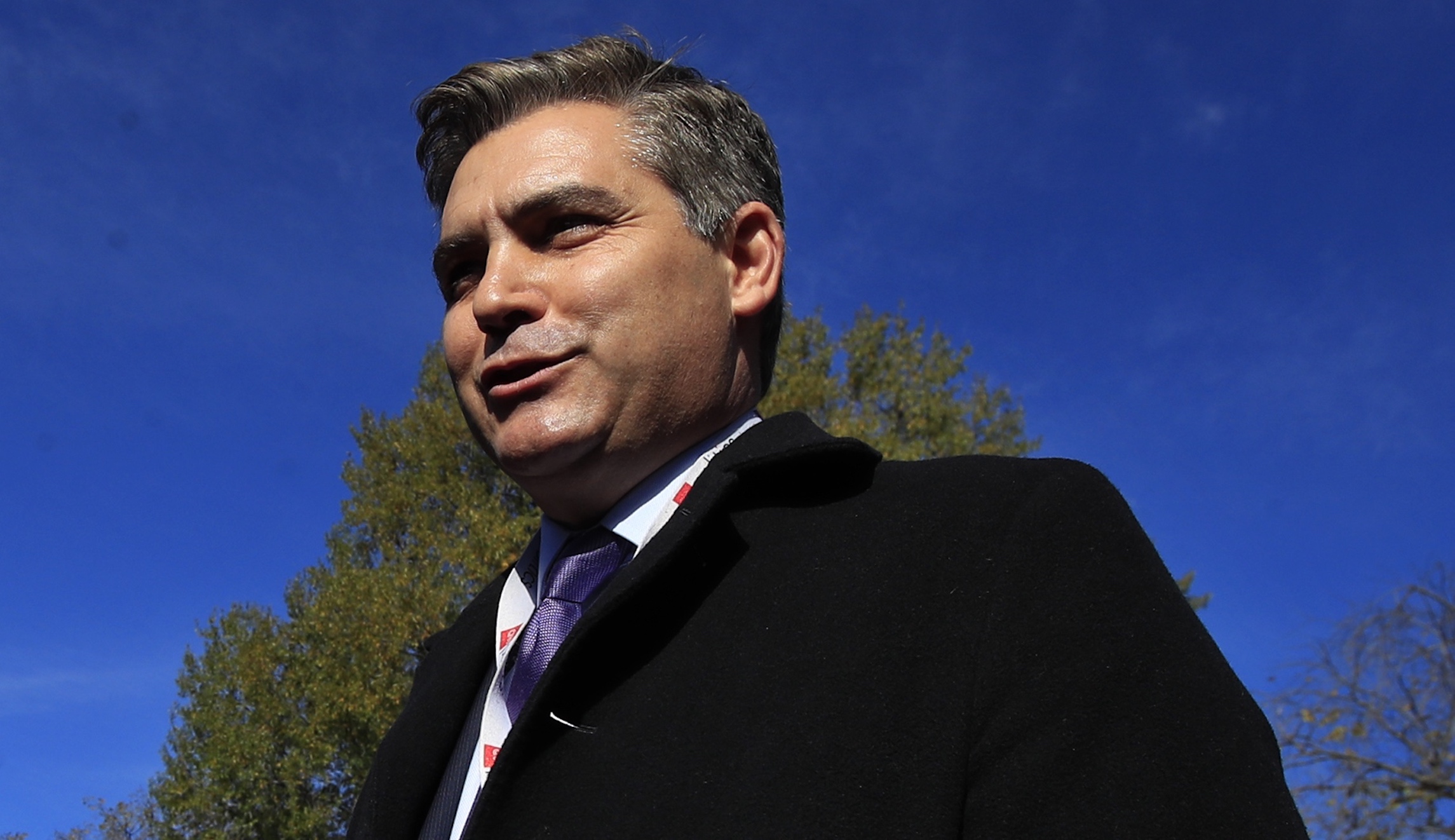
The decision by U.S. District Court Judge Timothy Kelly in Cable News Network v. Donald J. Trump ordering the White House to restore the press pass of reporter Jim Acosta has been hailed as a victory not only for CNN but for the entire press and the cause of journalism. But the end result of Kelly’s ruling, and of the CNN lawsuit, might not be happy for reporters and the news organizations that employ them.
The transcript of the Nov. 16 court session in which Kelly delivered his oral ruling was released in group of court papers on Monday. Kelly declared that the White House could not eject Acosta without first providing him due process — specifically, notice of the revocation of his press pass, a chance for Acosta to respond, and a written decision.
Recommended Stories



In short, the judge said to the White House: You can’t throw out a reporter without going through a process. But if you go through a process — which you, the White House, can design — then you can throw the reporter out. In the end, it could be that Kelly’s ruling will make it easier for the White House to oust reporters in the future — and to make the decision stick.
Throughout the court session, Kelly referred to the only real precedent in the Acosta matter, a 1977 case from the U.S. Circuit Court of Appeals called Sherrill v. Knight. In that case, the court ruled that the White House — specifically the Secret Service — could not deny a press pass to a “bona fide journalist” without due process. The court defined due process as “procedures whereby an applicant is given notice of the evidence upon which the Secret Service proposes to base its denial, [and] the journalist is afforded an opportunity to rebut or explain this evidence, and the Secret Service issues a final written decision specifying the reasons for its refusal to grant a press pass.”
In court, Kelly told lawyers for CNN and the government that he would use Sherrill as a guide in the Acosta matter. In his view, the due process arrangement outlined in Sherrill should apply to the Trump White House’s treatment of Acosta or any other White House reporter. “The court in Sherrill held that this process must include notice, an opportunity to rebut the government’s reasons, and a written decision,” Kelly said.
The judge’s clear implication was that if the White House takes those actions, if it jumps through those hoops in the future, it can expel a reporter without raising due process concerns.
Of course, CNN raised another issue in the suit, which is that the White House violated Acosta’s First Amendment rights by throwing him out over reporting the White House views as too negative. On that, Kelly offered no opinion. “In resolving this [restraining order] … I haven’t had to reach the the plaintiff’s First Amendment claim at all in which they alleged that the government engaged in viewpoint or content discrimination,” Kelly said. “So I want to make very clear a couple of things. I have not determined that the First Amendment was violated here; I have not determined what legal standard would apply to the First Amendment claim here … and I haven’t determined what portions of Sherrill, if any, would bind me on those questions.”
But the White House said it revoked Acosta’s pass, not because of the content of his reporting, but because of his behavior at a Nov. 7 news conference. In court, Kelly described that behavior this way: “After Mr. Acosta asked several questions about the caravan of migrants heading to the U.S.-Mexican border, the president indicated that he wanted to move on to call on another reporter, but Mr. Acosta would not be seated and continued trying to ask his question, and then he would not give up the microphone, even when approached by an intern employed by the White House Press Office who attempted to retrieve it from him.”
Kelly might view the White House action as conduct-based, as the White House contends, rather than as content-based, as CNN alleges.
In any event, even if Acosta keeps his pass, Kelly said the president would be within his rights to freeze the CNN correspondent out forever. “Sherrill explicitly recognizes the president’s right to engage with whomever he pleases,” Kelly said. “Certainly, he need not ever call on Mr. Acosta again.” The only issue in the case was that, according to Sherrill, “The government must provide Mr. Acosta due process if it is to revoke his hard pass.”
Beyond that, Kelly noted that the White House would be on firm legal ground if it ousted all reporters from the building. “The government also made the point that there is case law for the proposition that the public doesn’t have a general First Amendment right to enter the White House,” the judge said. “I have no quarrel with that at all.”
The issue in the Acosta case, Kelly continued, was predicated on the fact that the White House currently allows reporters in. “Sherrill holds that once the White House opens a portion of it up to reporters for their use, some kind of First Amendment liberty interested protected by a due process right is created,” Kelly said, “and I simply have no choice but to apply that precedent here.”
The White House quickly took Kelly’s ruling to heart and began work on a process to deal with reporters in future Acosta-like situations. The president discussed it in an interview with Fox News over the weekend.
“What [the judge] said, though, was that we have to create rules and regulations for conduct, etc. , etc.,” Trump said. “We’re doing that. We’re going to write them up right now, it’s not a big deal. And if [Acosta] misbehaves, we’ll throw him out or we’ll stop the news conference.”
When Fox’s Chris Wallace asked what the rules would be, Trump answered, “We’ll have rules of decorum. You know, you can’t keep asking questions. You have — we had a lot of reporters in that room, many, many reporters in that room and they were unable to ask questions because this guy gets up and starts doing what he’s supposed to be doing for him and for CNN, and, you know, just shouting out questions.”
The rulemaking process didn’t take long. On Monday afternoon, the White House released a set of rules that “will govern White House press conferences going forward.” The list:
2. At the discretion of the president or other White House official taking questions, a follow-up question or questions may be permitted; and where a follow up has been allowed and asked, the questioner will then yield the floor;
3. “Yielding the floor” includes, when applicable, physically surrendering the microphone to White House staff for use by the next questioner;
4. Failure to abide by any of rules (1) – (3) may result in suspension or revocation of the journalist’s hard pass.
“We would have greatly preferred to continue hosting White House press conferences in reliance on a set of understood professional norms, and we believe the overwhelming majority of journalists covering the White House share that preference,” press secretary Sarah Sanders said. “But, given the position taken by CNN, we now feel obligated to replace previously shared practices with explicit rules.”
At the same time, the White House announced it had “restored” Acosta’s press pass, and CNN announced it was dropping the Acosta lawsuit. CNN did a celebratory dance; the network’s media commentator, Brian Stelter, called it “a victory for CNN and for America’s free press.”
But the situation wasn’t that simple. After CNN’s action, it took just days for the White House to create a structure, which had not existed before the lawsuit, by which journalists can be evicted from the White House. No doubt any future alleged violation will involve a formal accusation that a reporter has violated the written standards, a chance for the reporter to respond, a written decision revoking the reporter’s credential, and eviction — all within the guidelines set up by a federal judge.
Of course, the press will protest and perhaps go to court if the White House acts on the new standards. But future judges might be less inclined to dictate to the president the substance of what he can and cannot do with regard to the press, once he takes care to recognize due process rights. And if that happens, CNN will have played a significant role in new limits on the press.
