

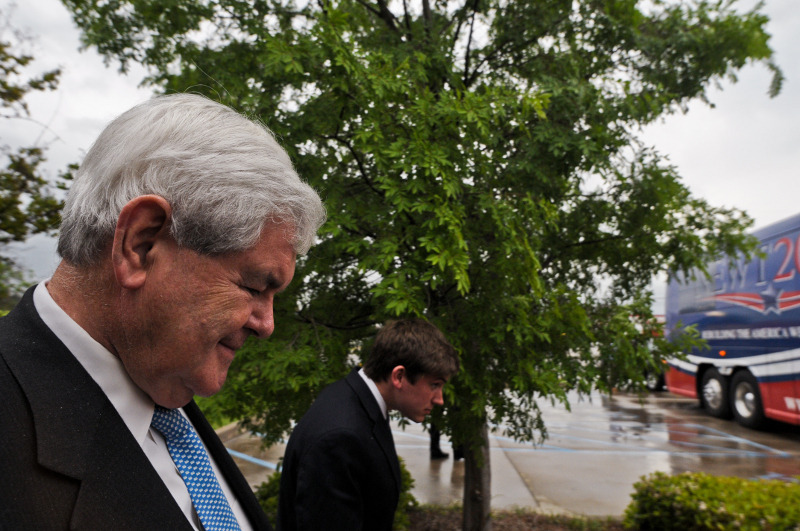
For Republican presidential hopeful Newt Gingrich, the math simply isn’t adding up.
Gingrich, running a distant third in the GOP delegate race, has virtually no chance of securing the 1,144 delegates needed to win the nomination after a string of losses this month, most recently a resounding defeat in last weekend’s Louisiana primary. The former House speaker once again finished behind Rick Santorum and Mitt Romney, with just about 16 percent of the vote and zero convention delegates.
For Gingrich, who plays up his Southern roots but won only two Southern primaries, the string of recent losses leaves him with just 141 convention delegates, compared to Santorum’s 256 and Romney’s 565. The only candidate in the race doing worse than Gingrich is Rep. Ron Paul of Texas, who has 66 delegates despite having won no primaries or caucuses but who is being propelled forward by the most loyal and enthusiastic following of any candidate.
“There is no path for Gingrich,” said G. Terry Madonna, director of the Franklin and Marshall College Poll. “His strategy has come and gone and that’s the bottom line.”
Despite a primary calendar that’s headed to unfriendly territory in the north and calls from some conservatives for him to leave the race, Gingrich pledged to stay in. He insists he’ll take his candidacy to the Republican National Convention in Tampa, Fla., this summer, where he predicts there will be a floor fight for the nomination.
Gingrich’s strategy is based on the assumption that Romney won’t be able to get enough convention delegates to lock down the nomination before the convention. Gingrich’s daughter, Jackie Cushman, told CNN Monday that “it’s not a definite fact” that Romney would get the nomination, despite his delegate lead, his superior fundraising and his organizational edge.
But beyond delegates, Cushman said, Gingrich has helped the party by remaining in the race and arguing for party priorities, including a pro-drilling energy policy.
“Those ideas have driven the White House to respond,” Cushman said. “That is huge. We have a Republican candidate who is driving the national narrative with the White House.”
Gingrich, who has struggled with fundraising, has put his plans to remain in the race in writing — at least in the form of a campaign schedule. He’s planning stops in Maryland, North Carolina, Washington, D.C., and Wisconsin. On Monday, he traveled to Delaware, where he narrowly beat Romney in a December straw poll and hopes to win the April 24 primary.
Gingrich isn’t alone at the bottom of the polls. Paul, the libertarian congressman from Texas, is doing even worse, but remains in the race. Paul finished last in Louisiana and polls show him doing just as badly in upcoming primary states. He has virtually disappeared from the campaign trail.
But Paul will likely remain in the race and pick up enough delegates from a base of loyal followers that he would be given some role in shaping the party’s platform at the convention or, in the case of a brokered convention, end up being a kingmaker, Davidson College political science professor John Putnam told The Washington Examiner.
“I think Ron Paul is much more likely to stay in than Santorum or Gingrich,” said Putnam, who runs the delegate-count blog Frontloading HQ.
