

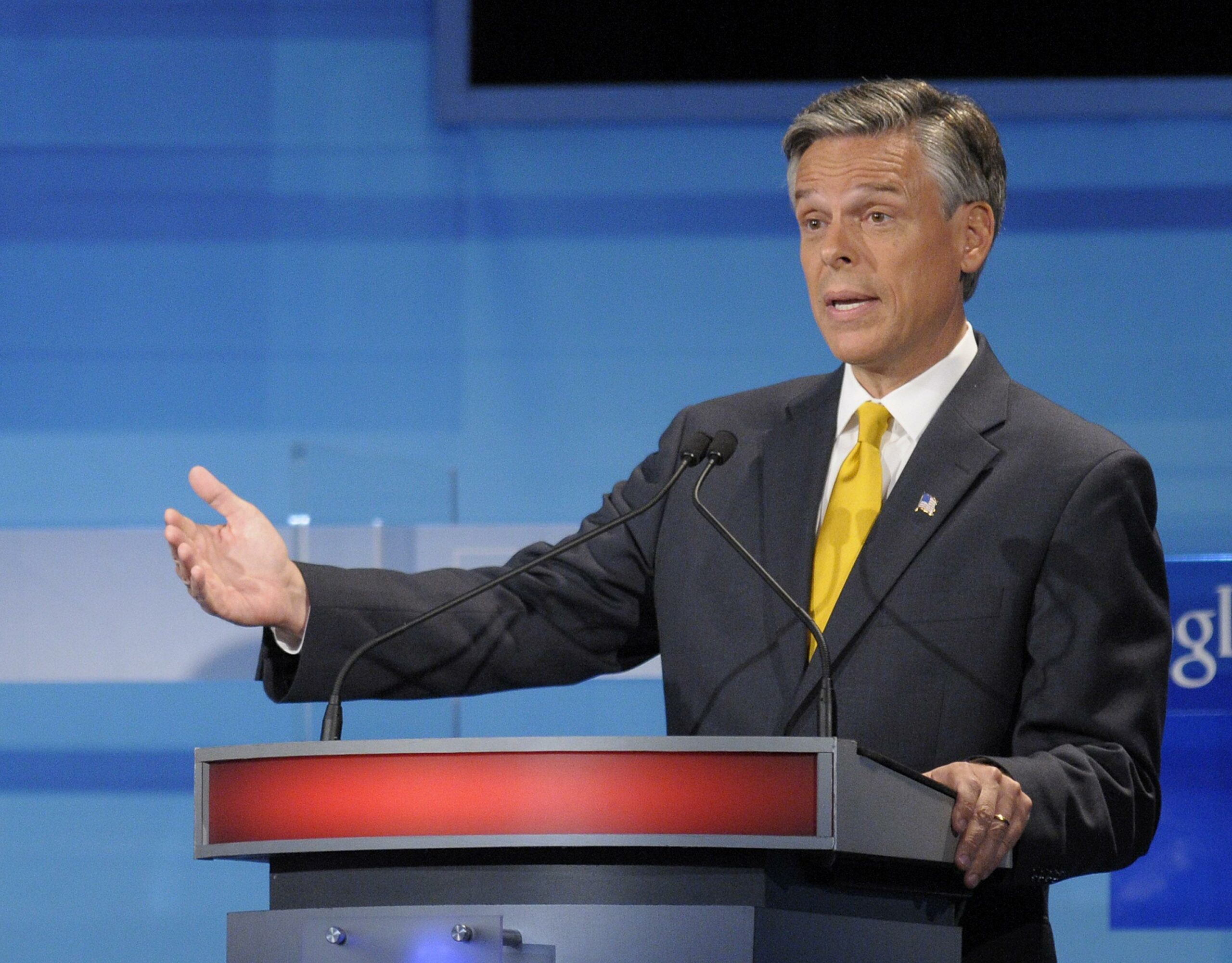
Republican presidential candidate Jon Huntsman this week celebrated new poll numbers that show him in third place in New Hampshire just five months before ballots are cast in the first-in-the-nation primary.
But now the former governor of Utah and President Obama’s former ambassador to China faces a quandary. Even as he is breaking out in New Hampshire, where he has invested his entire campaign, Huntsman lags so far behind in national polls that he may be excluded from an upcoming national debate, a critical platform he needs to sell himself to a national audience.
Huntsman has been campaigning heavily in New Hampshire since June and polls show his effort is paying off. He placed third in a Suffolk University poll with 10 percent of the vote, trailing only former Massachusetts Gov. Mitt Romney, who enjoys a favorite-son status in neighboring New Hampshire, and Rep. Ron Paul. Huntsman leads Texas Gov. Rick Perry, the national front-runner, in the Granite State.
Team Huntsman hopes a victory in New Hampshire, or at least a top-three finish, will boost Huntsman’s standing in other key primary states such as South Carolina and Florida, where he has spent less time.
“Our top priority is campaigning successfully in New Hampshire so we can leave that state with a head of steam,” Huntsman’s spokesman, Tim Miller, told The Washington Examiner.
Yet Huntsman now faces new difficulties. A change in the way candidates qualify for a series of nationally televised debates threatens to bump Huntsman from the spotlight. Previous debates were open to any candidate with 1 percent support or more in select national polls, allowing as many as nine candidates to participate in each forum. The same rule applies to the next debate on Oct. 11.
But an Oct. 18 debate sponsored by CNN is requiring candidates to have at least 2 percent support in national polls, which means Huntsman has until Oct. 16 to effectively double his showing nationally. Being knocked from the forum — and possibly future debates that could adopt the same higher standard — could undercut Huntsman by signaling to voters and donors that he’s a less viable candidate.
Huntsman operatives derided the 2 percent standard as unfair.
“You would have nearly excluded the winner of the Iowa caucuses if they had used that standard four years ago,” said one top Huntsman staffer, referring to 2008 GOP presidential candidate Mike Huckabee.
Huntsman is a moderate Republican who has yet to catch on with the largely conservative voters who dominate the Republican primary process. He scored second-to-last in Saturday’s GOP straw poll in Florida, earning just 60 votes out of more than 2,600 cast. And a recent poll of GOP voters in South Carolina showed Huntsman with just 2 percent of the vote.
But in New Hampshire, Huntsman appeals to the state’s growing population of independent voters, University of New Hampshire political science professor Dante Scala said.
“Right now, Huntsman is appealing to some moderate Republicans,” Scala said. “The question is whether there is a way in which he will be able to appeal to mainstream, right-of-center conservatives, who are now in Romney’s camp.”
