
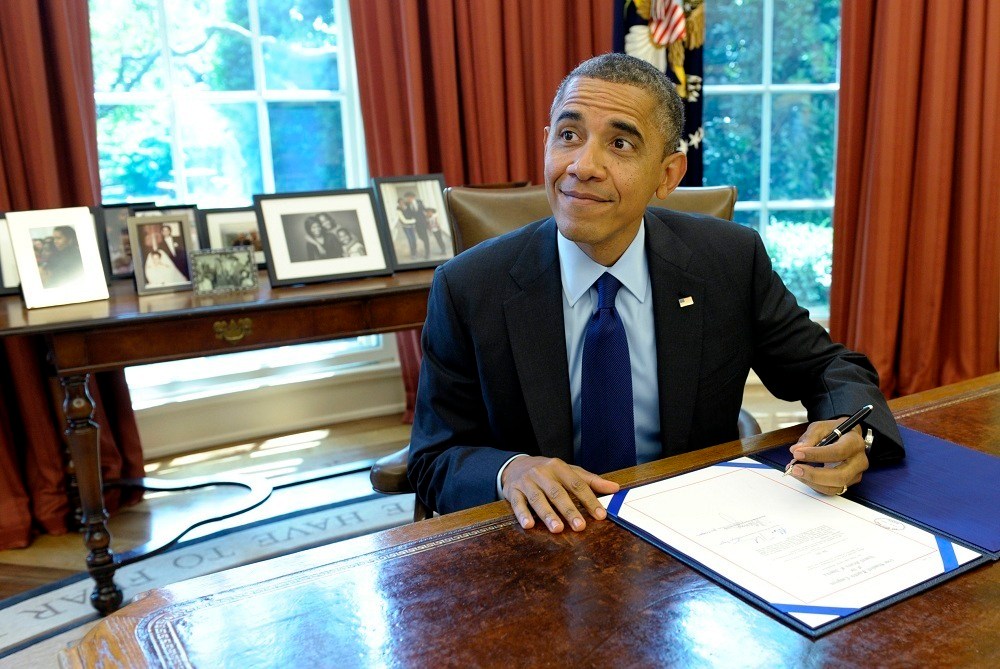
At a Tuesday campaign event in Baltimore, responding to Republican charges that he exploded the debt, President Obama lamented, “It’s like somebody goes to a restaurant, orders a big steak dinner, martini all that stuff, and then just as you’re sitting down — they leave — and accuse you of running up the tab.”
The very concept of grading a president on a curve for the conditions he inherited could cut both ways. For instance, when President Bush was sworn into office, while the economy was much stronger than when Obama took over, there were still headwinds from the bursting of the tech bubble months earlier. More significantly, al Qaeda had grown steadily during the 1990s, which all culminated with the Sept. 11 attacks.
The Sept. 11 attacks not only plunged the economy into a recession in the fall of 2001, but also led to an inevitable spike in military spending after the defense budget had undergone a decade of post-Cold War decline. Bush’s decision to invade Iraq may have accelerated that trend, but there’s no doubt there would have been higher than anticipated defense spending no matter who was president.
This isn’t to defend Bush’s atrocious spending record, but only to point out what it would mean to apply the “inherited” logic to prior presidencies.
That said, it’s true that just before Obama was sworn into office in January 2009, the Congressional Budget Office projected that that year’s deficit would be $1.2 trillion. Yet after Obama came into office, it went up to $1.4 trillion. In that same report, the CBO projected deficits during Obama’s first term (2009 through 2012) of $2.6 trillion. That cumulative number is now expected to reach $5.2 trillion, or about double.
Also in Baltimore, Obama boasted that, “spending under my administration has grown more slowly than under any president in 60 years.” But what makes it possible to theoretically make that argument is that between fiscal years 2008 and 2009, spending skyrocketed by 18 percent to over $3.5 trillion. So after 2009, Obama could claim that spending grew at a slow rate, but that was only relative to the historically elevated levels.
Obama’s defenders argue that Bush should be held responsible for the huge spike spending in 2009, because he was president for the first four months of the fiscal year, which began Oct. 1, 2008. Yet 2009 includes Obama’s economic stimulus package and several spending bills that were OK’d under Obama’s watch. Furthermore, though Bush signed the $700 billion Wall Street bailout, Obama voted for it as senator, advocated for it as a presidential candidate and lobbied the Democratic Congress to release the second batch of money while he was president-elect.
On the one hand, Obama has routinely blamed congressional Republicans for contributing to the deficit problem by forcing him to extend all of the Bush tax cuts, when he only favored preserving about 80 percent of them. On the other hand, he wants to take credit for $2 trillion of spending cuts, which Republicans forced him into, kicking and screaming, during the debt ceiling showdown.
Obama’s national health care law, meanwhile, is now expected to cost $1.76 trillion over a decade. Though this spending is supposed to be financed by Medicare cuts and tax increases, any money generated to support this new spending could have otherwise been used for debt reduction.
By Sept. 30, 2008, the nation’s public debt stood at $5.8 trillion, but by the end of this September, it is expected to reach $11.3 trillion, or nearly double.
Obama may have inherited the bill for a steak dinner. But after sitting down at the table, he piled on large helpings of shrimp cocktail and stuffed lobster, and then washed it all down with several magnums of rare French wine.
Philip Klein ([email protected]) is senior editorial writer for The Examiner. Follow him on Twitter at @philipaklein.
