

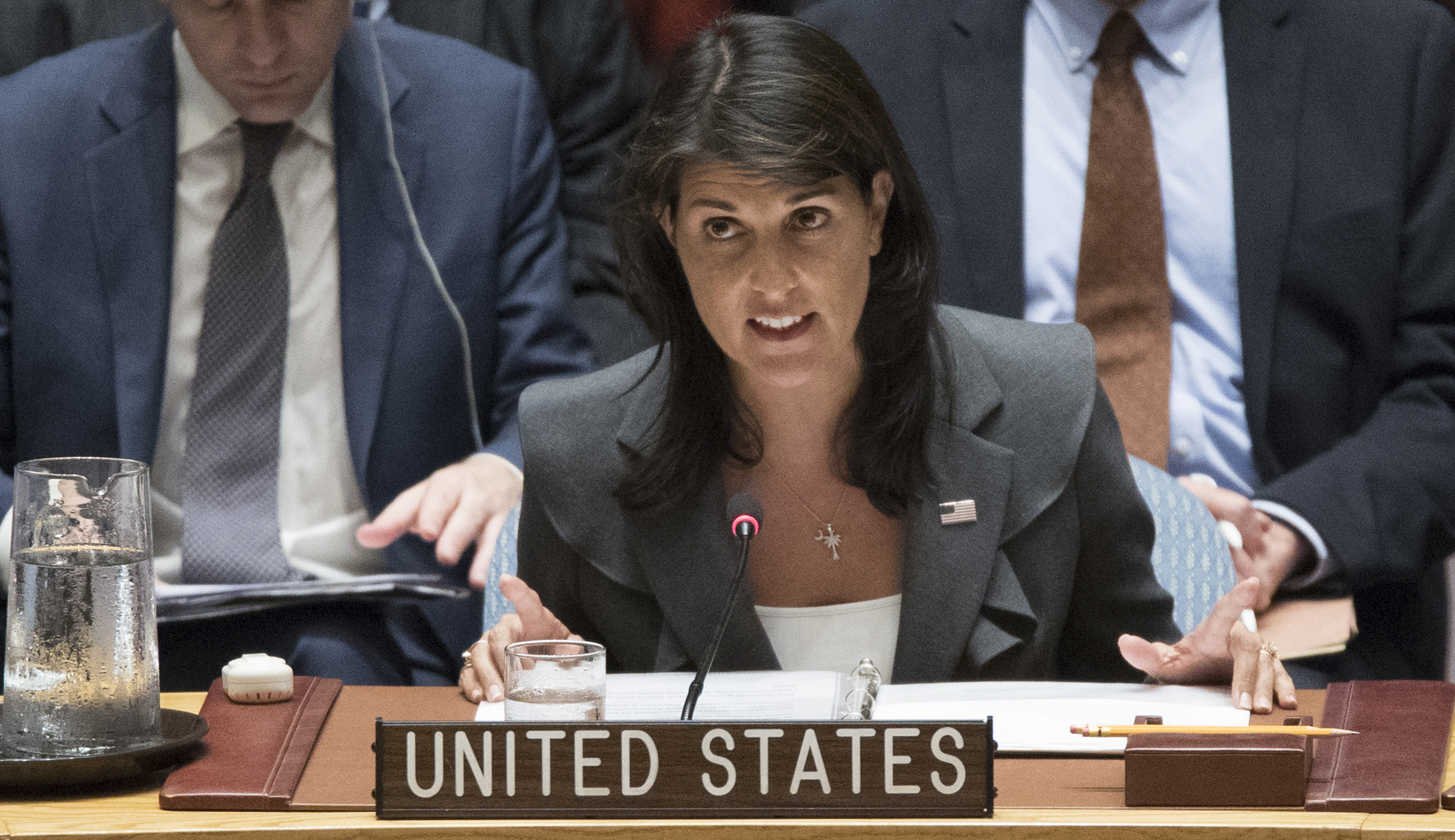
International leaders must recognize corruption as a key driver of conflict in hotspots around the globe, Nikki Haley, the U.S. ambassador to the United Nations, argued Monday.
“[N]ine out of the ten countries that Transparency International considers the most corrupt in the world are on the Security Council agenda,” Haley told council. “But instead of reflecting on why this is the case, the United Nations is too often willing to ignore corruption.”
Recommended Stories


Haley, who holds the presidency of the Security Council for the month of September, convened a panel devoted to the the relationship between corruption and geopolitical instability. The session featured testimony from U.N. Secretary General Antonio Guterres and activist John Prendergast. But the anti-corruption panel proved controversial, marked by the recurring clash between Russia and the United States over the ongoing crisis in Ukraine.
“Examples of corruption leading to conflict are all around us,” Haley said. “The estimates of how much the corrupt government of Victor Yanukovych stole from the Ukrainian people run as a high as $100 billion over the course of less than four years … And when Yanukovych was eventually ousted for his crimes, the ripple effects were global. Russia occupied Crimea and began the most serious confrontation between Moscow and the West since the end of the Cold War.”
That drew a bitter response from Haley’s Russian counterpart, who insisted that Yanukovych was ousted through a coup by corrupt rivals, in addition to faulting Haley.
“In the United States, which today lectured us about corruption, corruption exists,” Ambassador Vassily Nebenzia, Russia’s representative at the U.N., said in response. “It would be more logical to begin with themselves and specifically with lobbyism which has entangled the highest levels of the U.S. government.”
Prendergast urged the U.N. Security Council to counter government corruption by cracking down on money laundering and financial crimes, in a way that targets not only individual officials but their support networks.
“Ultimately, these tools of financial pressure are not an end in themselves, but should be deployed in the context of a comprehensive strategy that intensifies diplomacy and supports institutions of accountability and transparency,” he said. “As it stands now, war crimes pay.”
His proposals dovetailed with some of the recommendations developed by British officials, who are specifically concerned about how Russian oligarchs use the London financial industry to shelter their wealth.
“To those of my colleagues who are serious about fulfilling their duties as members of the Security Council, I urge that we take a longer view,” Haley said. “If we fail to take seriously the issue of corruption now, we will doom ourselves to deal with the violence it creates in the future.”
