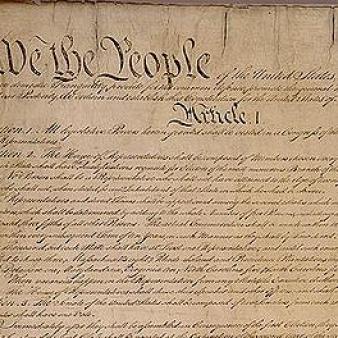
It’s rare to have a governing philosophy that usually hides behind a carefully constructed rhetorical justification be laid bare for all the world to see, but that’s exactly what happened when Justice Ruth Bader Ginsburg recently shared her thoughts about the document that she’s duty-bound to apply. Ginsburg, who’s been on the Supreme Court since President Clinton appointed her in 1993, recently said on Egyptian television, “I would not look to the U.S. Constitution, if I were drafting a constitution in the year 2012.” The justice then added, “I might look at the constitution of South Africa. That was a deliberate attempt to have a fundamental instrument of government that embraced basic human rights, have an independent judiciary. It really is, I think, a great piece of work that was done.”
Many Americans would presumably describe their own Constitution in similarly glowing terms. However, Ginsburg’s views, which she didn’t choose to express at her confirmation hearings, help explain why she has felt so free over the years to read foreign law into our own Constitution, using it to bind our elected representatives and force them to adopt policies more to her liking. More broadly, her comments help to explain why it’s necessary, in her mind, to view our Constitution as a “living” document; why unelected judges must be the ones to breathe continued life into that document; and why — in the words of the late Justice William Brennan, himself a leading “living constitutionalist” — judges must actually “give meaning” to the Constitution. The reason for all of this, so plainly stated by Ginsburg, is that the old document — written by the Founders and amended by later generations — simply wouldn’t be worth “looking to” today if one could help it. Therefore, it must be modified from the bench.