

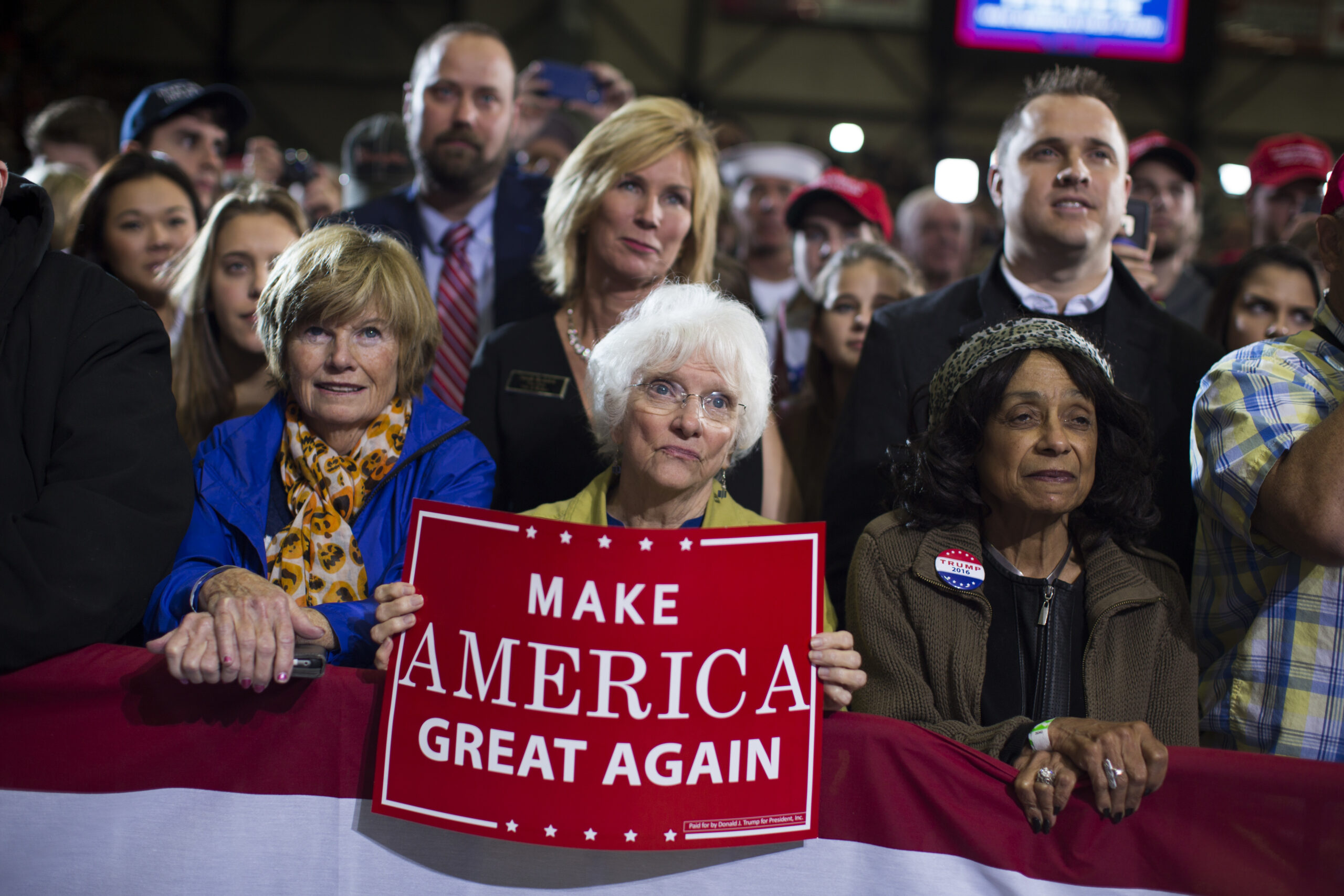
Donald Trump has seized the momentum with one week to go before Election Day.
The Republican nominee was gaining on Hillary Clinton — movement that began prior to Friday’s bombshell that the FBI was making additional inquiries into the Democrat’s use of a private email server when she was secretary of state.
Recommended Stories



The development, revealed in a letter to Congress from FBI Director James Comey, energized what had been a moribund Trump campaign and renewed Republicans’ hopes of winning the White House and holding their majorities in Congress.
But Clinton still led as of Tuesday morning and was better positioned to win the White House. Clinton has an easier path to victory in the Electoral College and her voter turnout operation is superior to that being run on Trump’s behalf by the Republican National Committee.
Those two factors could give Clinton the edge in the final days if Trump turns the race into a true tossup.
“She’s still the favorite,” said Stu Rothenberg, a nonpartisan political analyst who founded the Rothenberg Gonzales Political Report and writes for the Washington Post. “He has a very hard job on his hands.”
Clinton’s lead over Trump nationally was down to 3.1 percentage points (48 percent to 44.9 percent); and 3.2 points (45.6 percent to 42.4 percent) when third party candidates were included in surveys.
Trump’s numbers were improving in Florida and Ohio; Clinton was holding her ground in North Carolina and Pennsylvania.
The impact of the FBI revelations remained uncertain and there are whispers of more “opposition research” stories to come on Trump that could shift the uncomfortable spotlight back toward the combative New York businessman.
Political analysts were debating whether Trump was on a natural uptick.
Are Republican voters long skeptical of the their party’s nominee deciding to back him after all? Or, is Trump benefiting specifically from a backlash against Clinton as voters are reminded of her use of a homebrew server that might have exposed classified material?
Seven days before the voting concludes, it was hard to tell.
A confident Trump has embarked on a campaign swing through blue states that by all accounts are out of reach, including New Mexico and Michigan, plus swing states that have never looked as competitive as advertised: Colorado and Wisconsin.
Clinton’s path to 270 Electoral College votes, the threshold required for victory, remains easier than Trump’s. And, some weekend surveys suggested that while Clinton lost some of her lead due to the news about the FBI, she hadn’t suffered a mortal wound.
She leads or is in a statistical tie with the Republican in most swing states, and has been stockpiling votes at a healthier clip than Trump in early and absentee voting. Clinton can afford to lose a few battlegrounds given her advantage in the Electoral College broadly.
Trump has to run the table, and he has to do it without the help of a unified party to campaign for him. That is in stark contrast to Clinton, who is able to deploy President Obama and other high profile Democrats to encourage voter turnout across the battleground states.
The varying points of view about the state of the race were evident in two tweets, one posted by David Plouffe, an architect of Obama’s two victories, the other posted by Nate Silver, the closely watched elections analyst at FiveThirtyEight.com
“Clinton path to 300+ rock solid,” Plouffe tweeted on Sunday. “Structure of race not affected by Comey’s reckless irresponsibility. Vote and volunteer, don’t fret or wet.”
“On balance the evidence suggests Clinton was slightly (not severely) hurt by Comey but hard to say because Trump was gaining on her already,” Silver tweeted on Monday.
Barely a week ago, Clinton was poised to run away with the race. She had gained on Trump in reliable red states like Arizona and Georgia and had come from behind to catch him in swing states like Iowa and Ohio, where he had been the strongest.
Clinton’s strength has been built on overwhelming support from non-white voters and historically unprecedented support from white voters with college degrees. This cohort has delivered its vote to the Republican nominee since modern polling began measuring its performance.
The byproduct of Clinton’s success was that Democrats were in position to win control of the Senate and maximize their gains in the House. The pro-Clinton super PAC, Priorities USA, even began advertising in congressional races.
Rothenberg said Clinton’s late struggles were likely to take pressure off of down ballot Republicans, putting the GOP in a better position to hold their Senate majority and minimize their House losses. Rothenberg called the latest trend in the contest “very good news for down ballot Republicans.”
Still, Republicans were cautious in their assessments of the final week, unsure if they could depend on Trump not to generate controversy and steal the negative attention from Clinton.
Trump has trailed Clinton since the outset of the race, coming close to catching her in the polls only a couple of times since early May, because of his habit of spouting offensive rhetoric or allowing himself to be baited into politically damaging confrontations.
“Trump has always stood to have the best chance when the race is about her. He needs to do everything in his power to make the race about her this week,” GOP consultant Brad Todd said. “That means discipline and plowing no new rhetorical ground. He needs to ride the news and not take the bait when they flash shiny objects at him.”
