

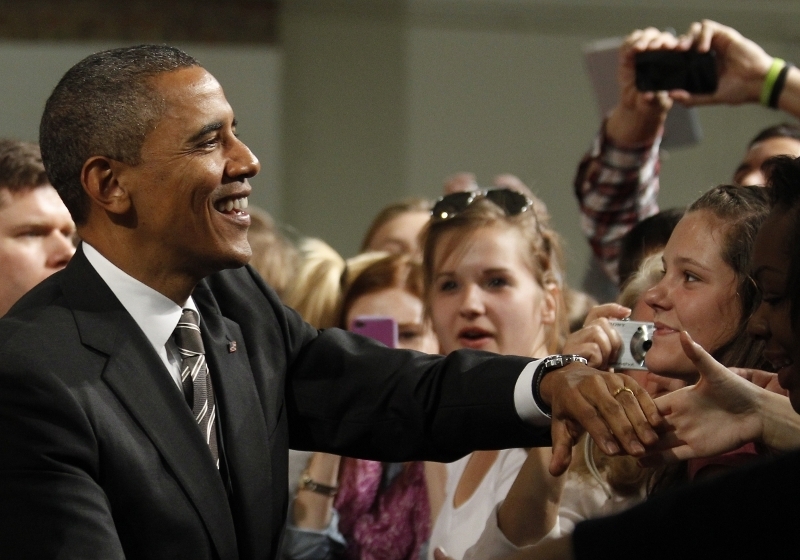
Young voters, who helped propel President Obama to victory over Republican John McCain in 2008, appear less enchanted with Obama’s bid for a second term as they prepare to enter a job market that has little room for them, burdened by student loan debts they’ll carry for years.
And while Obama remains in desperate need of their support, it’s not at all clear they’ll be there for him this time.
Blame the economy, or shifting political affinities, but Obama is in trouble with young people, who in 2008 accounted for 18 percent of the vote.
A recent Harvard University poll found Obama has 43 percent of the youth vote. That’s a slight increase from earlier in the year, and still considerably better than youth support for his Republican opponent, Mitt Romney, who has 26 percent.
But the Democratic-leaning Harvard poll showed a sharp enough decline in Obama’s support among young voters since 2008 that Harvard University Institute of Politics Director Trey Grayson concluded the president “continues to struggle with key segments of the Millennial demographic.”
Democrats face a considerable task in recapturing that under-30 crowd and motivating them enough to vote in November, particularly in key swing states, and the Obama camp is wasting no time reaching out to them.
Beginning Saturday, Obama will formally kick off his re-election campaign in earnest with rallies at Ohio State University and Virginia Commonwealth University, in battleground states considered critical to Obama’s bid for a second term.
Last week, Obama traveled to college campuses in three other swing states — Colorado, Iowa and North Carolina — to promote legislation that would freeze student loan interest rates. The president used the trips to denounce Republicans as indifferent to the struggles of young people and unwilling to act to prevent Stafford Loan rates from doubling to 6.8 percent on July 1.
Democratic strategist Christopher Hahn said Obama’s campaign is targeting the youth vote differently than it did in 2008, when a protracted Democratic primary forced the party to work all 50 states to register voters.
This time, Hahn said, the push to get young people to the polls for Obama will center on tossup states like Ohio, Florida, Virginia, Colorado and Pennsylvania.
“I expect the Obama team is going to organize in those five states on college campuses and get those people to vote,” Hahn said.
One problem Obama faces in wrangling the youth vote is that it’s mobile, Hahn noted. “Of the people they registered in North Carolina in 2008, 40,000 are no longer on the rolls,” he said. “That’s a big number.”
In addition to his recent focus on college campuses, Obama is targeting young people through social media, an arena he dominated in 2008. The Obama campaign has been aggressive in reaching out through Facebook, Twitter and email, sending missives from “Barack Obama” entitled “Hey” and asking the recipient to “Give $3 or whatever you can,” to his campaign.
So prolific are the Obama social media messages that they earned him some friendly chiding from “Daily Show” host Jon Stewart.
“Seriously,” Stewart joked on a recent show, “there are exiled Nigerian princes getting Obama campaign emails going, ‘Ease up on the money thing, fella.’ ”
