

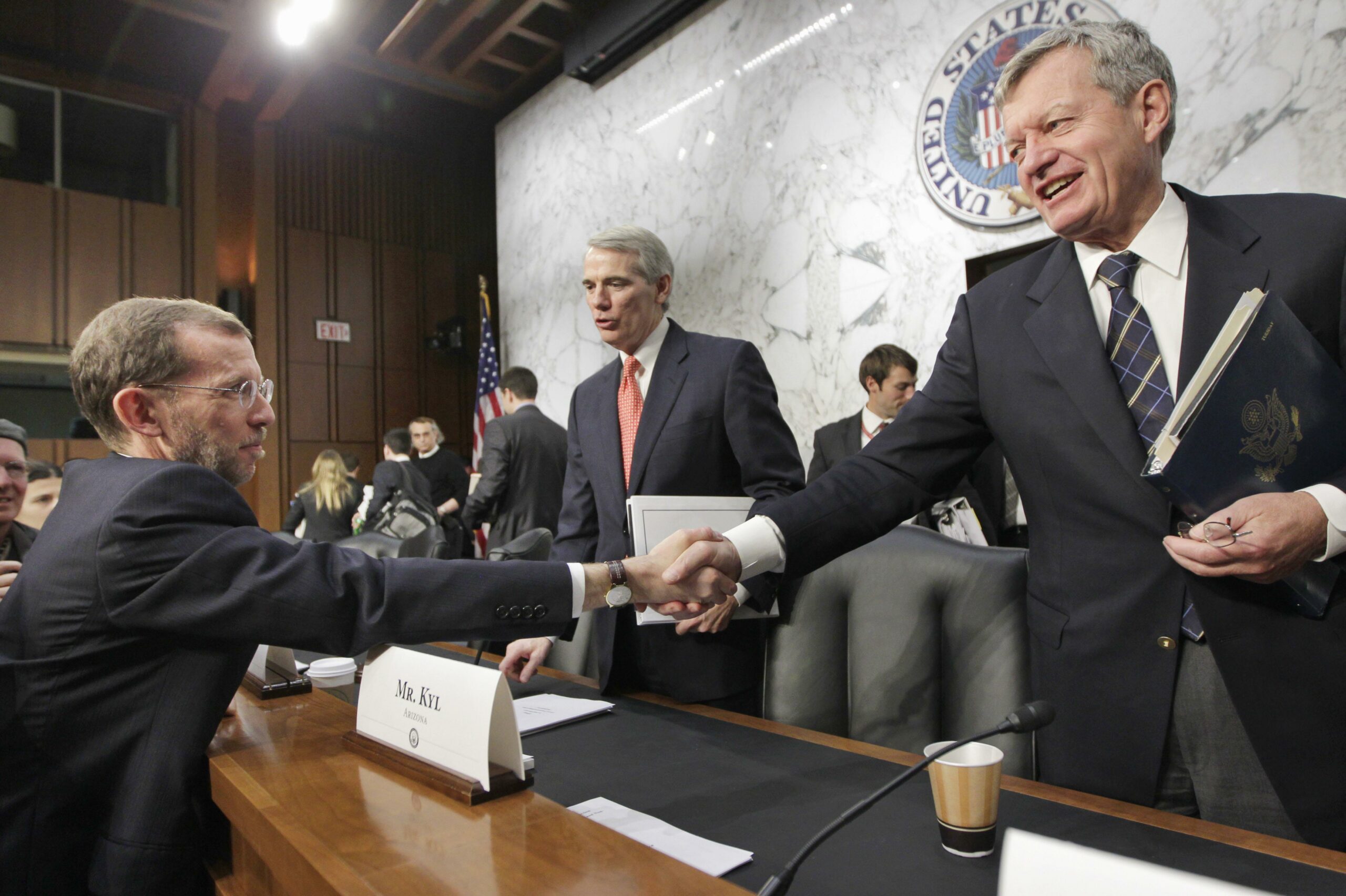
The “supercommittee” charged with reducing the nation’s budget deficit held a rare public hearing Wednesday, providing a glimpse of the partisan differences preventing Republicans and Democrats from reaching an agreement.
The panel, composed of six House members and six senators and divided equally between the parties, has until Nov. 23 to devise a plan that reduces the deficit by at least $1.2 trillion or automatic cuts will kick in.
But in reality, the committee must produce something much sooner — within the next week or so — to give the Congressional budget Office sufficient time to calculate the official cost estimate, according to CBO Director Doug Elmendorf.
Elmendorf, the sole witness at the hearing, gave panel members a rundown of the nation’s current domestic and defense spending. The discretionary budget — which doesn’t include entitlement programs like Social Security and Medicare — is now $1.3 trillion and accounts for 40 percent of all federal spending. Half of that discretionary spending — $712 billion — is dedicated to defense.
Democrats on the panel pointed out that domestic spending outside of entitlements makes up only a fifth of the federal budget and should not be cut much further because it would hurt those earning the least.
“Congress has gone to this relatively small pot with cuts and spending caps again and again while leaving many other pieces of the budget essentially untouched,” Sen. Patty Murray, D-Wash, the committee co-chairwoman, said. “It doesn’t make sense to simply keep going after one small part of the budget that disproportionately affects middle class families and the most vulnerable Americans. There has to be balance.”
Republicans countered that defense spending should remain a top priority and that domestic spending has increased dramatically over the past few years, even if the $1 trillion stimulus spending bill is excluded from the equation.
Supercommittee co-chairman Jeb Hensarling, R-Texas, said Commerce Department spending alone more than doubled between 2008 and 2010 and that Environmental Protection Agency spending jumped more than 35 percent during the same period. Housing and Urban Development’s budget increased 22 percent over those two years, while spending by the State Department increased 132 percent, he said.
But Hensarling pointed out the largest savings must be achieved by reducing spending on entitlement programs like Social Security and Medicare.
“Thus, the challenge before us remains that we must find quality health care solutions, quality retirement security solutions for our nation at a cost that does not compromise our national security, does not compromise job growth in our economy and does not mortgage our children’s future,” Hensarling said.
The panel has been meeting privately for weeks to hash out a plan, but the two parties have fundamental disagreements over how to reduce the deficit. Democrats want substantial revenue increases through new taxes with some cuts and entitlement reform. Republicans want steeper spending cuts and oppose any new taxes.
According to those familiar with the talks, the two sides are now looking toward the bipartisan group of House and Senate leaders to get involved in the discussions.
The next public hearing is scheduled for Nov. 1.
