

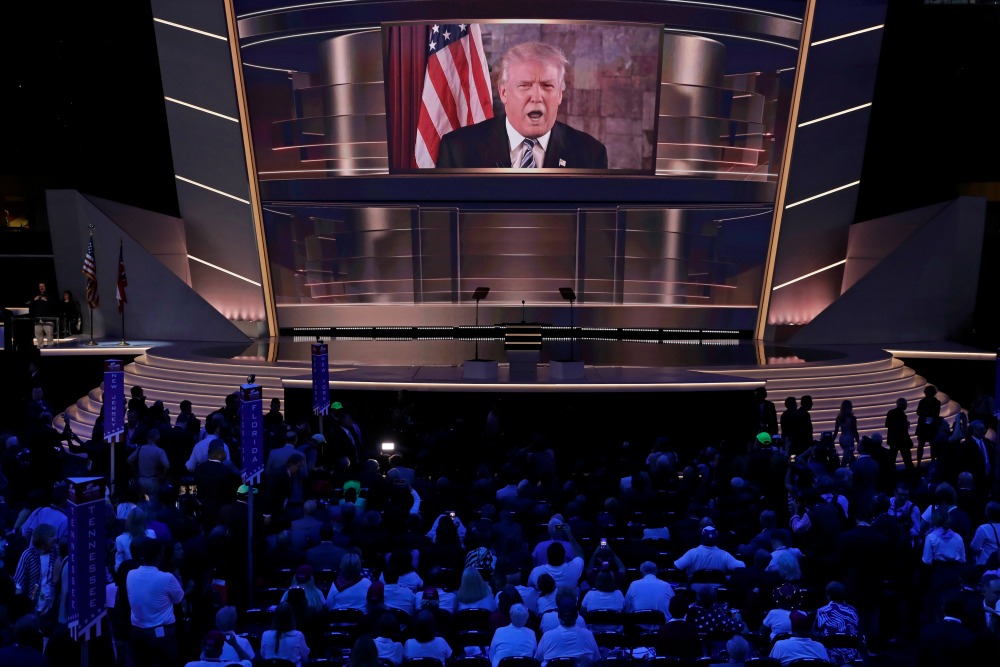
The Republican Party’s platform is a sad reminder of the direction that the GOP has taken with the rise of its nominee, Donald Trump, according to many of the nation’s editorial boards.
“The [Republican Party] formally adopted a platform that reflects the party’s accelerating ideological confusion — and its lurching away from the center of American politics,” the Washington Post’s editorial board said this week.
Recommended Stories


The New York Times was near hysterical in its take on the the matter, and accused the Republican Party of taking its most “extreme” turn to date.
“[T]his document lays bare just how much the GOP is driven by a regressive, extremist inner core,” the paper’s editorial board wrote. “The GOP used to insist it was the ‘big tent’ open to one and all. Now it’s the ‘big wall’ party braced by a destructive platform out of touch with American lives and devoid of the common sense the nation needs for any form of political progress.”
Smaller papers have been equally dismayed by the platform announced this week by GOP party leaders.
“[T]he GOP, through its 2016 platform, is further isolating itself from a changing America. The platform makes the GOP more anti-gay, more Christian-only and hostile to conservation. This is not how the party of Abraham Lincoln, Teddy Roosevelt and Ronald Reagan will remain vibrant and relevant,” said the Bangor Daily News’ editorial board.
“The party’s soul searching after the the 2012 election offered an opportunity for it to move forward,” it added. “It is unfortunate that the party, through its 2016 platform, chose instead to move backward.”
At issue with many of the unflattering editorials written this week about the GOP platform is the party’s continued focus on social issues, including gay marriage, abortion, tax cuts, deregulation and whether the Bible should be taught in schools.
But what has newsrooms most upset is the general direction that the Republican Party has taken with the unprecedented political ascendancy of Trump.
“Donald Trump’s takeover has moved the GOP toward isolationism, anti-trade populism and a concomitant ambivalence on essential economic freedoms,” said the Post.
“The net result is a platform that is more reactionary than visionary, with an emphasis on social matters that is out of step with American public opinion and an isolationist turn that reeks of counterproductive nativism. Party platforms, it is often said, are irrelevant. In this case, the nation can only hope so,” it added.
The Chicago Tribune said this week in reference to the GOP’s acceptence of its nominee that “rarely has any party veered so drastically and alarmingly as the GOP has in choosing Trump.”
The billionaire businessman, who the Tribune characterized as a “human howitzer,” has “shaken and overtaken the GOP, making clear that many of the party’s battle regiments are no longer attached to its traditional policies.”
The New York Times added elsewhere that “rather than trying to reconcile Mr. Trump’s heretical views with conservative orthodoxy, the writers of the platform simply opted to go with the most extreme version of every position.
“Party officials who once spoke of the need for immigration reform have been silenced. The planks of 2016 have been fashioned as underpinnings for Trump jingoism,” it added.
The St. Louis Dispatch’s editorial board reached many of the same conclusions this week, and suggested that Republicans who are too timid to oppose Trump should resign immediately and make room for people who will.
“Thinking people cannot escape the conclusion that a Trump presidency would be disastrous for America. If GOP politicians cannot stand for what they know is right, they don’t belong in office anymore,” it wrote.
